1 month ago
Amid heightened maritime tensions in the Strait of Hormuz, multiple attacks were reported on vessels carrying Indian crew, including a Palau-flagged ship and the vessels Settebello and MT Jalveer, leaving several Indians dead or affected. During the same period, emergency evacuation requests for an Indian sailor went unanswered, raising concerns over response delays.
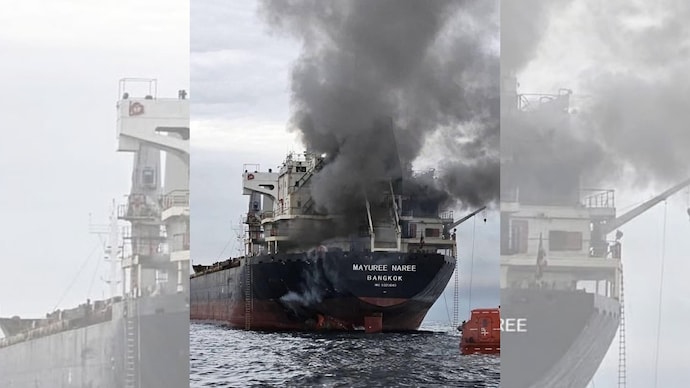
Thai cargo ship enroute to Gujarat port hit by 2 projectiles near Strait of Hormuz, 20 crew members rescued.

New Delhi,UPDATED: Jun 15, 2026 12:46 IST
A body of a 35-year-old Indian sailor lay decomposing for nearly three days off the coast of Oman, while repeated distress calls from the ship’s captain highlighted the desperate situation faced by thousands of Indian seafarers stuck at the Strait of Hormuz. Their ordeal unfolded even as Donald Trump and Iranian officials struck an upbeat tone over a Washington-Tehran peace deal last week, which was later formally announced along with the reopening of the Strait of Hormuz by the US President.
Peace deal or not, three Indian sailors were affected as three merchant vessels carrying Indian crew came under attack in the Strait of Hormuz last week. In another incident, Second Officer Nishanth Uirthanathan died on June 11 after falling ill on June 8, around the same time the vessels were reportedly under attack.
The MT Celestial, carrying Uirthanathan, had sent SOS calls to the US Navy -- responsible for enforcing the naval blockade -- on June 10 and 11, before he eventually died. However, no response was received, according to a Sputnik India report, even as his condition deteriorated.
The report further added that neither the shipping company nor the nearby Duqm Port in Oman was able to arrange immediate medical evacuation, despite repeated requests from the ship’s captain.
Even after his death, the situation onboard remained grim. According to the Forward Seamen’s Union of India (FSUI), which represents Indian seafarers globally, crew members were seen placing cold water bottles on the sailor’s body wrapped in plastic sheets to slow decomposition. The union also said the vessel lacked proper refrigeration facilities to preserve the remains.
The body was later lowered using a crane on June 14 and is now undergoing repatriation, shortly after the Indian Embassy in Oman said the vessel was expected to berth at Duqm Port.
On Saturday, the Indian Embassy confirmed that Uirthanathan had died due to medical complications and that his mortal remains were onboard MT Celestial at Duqm Port. In a statement on X, it said it was coordinating with all stakeholders for early repatriation and expressed condolences to the family.
The Embassy’s response followed social media posts by the union, crew members, and opposition leaders, who alleged delays in medical evacuation despite repeated distress calls amid heightened maritime tensions in the region.
The Congress, sharing a video of the captain and crew beside the sailor’s body wrapped in plastic sheets, alleged that no timely assistance was provided. It blamed the government for failing to ensure the welfare of Indian citizens at sea.
Meanwhile, the US Navy, while it was attacking ships carrying Indian crew members during the same period, did not respond to emergency evacuation requests for Uirthanathan. Separate incidents were also reported in which a Palau-flagged vessel off Oman carrying 24 Indian sailors was struck, followed by another attack on the ship Settebello, which reportedly killed three Indians. A further strike was later reported on MT Jalveer, carrying 20 Indian crew members.
In response, India condemned the attacks and issued a demarche to the US diplomatic mission in New Delhi, seeking an explanation for the incidents involving Indian crew members.
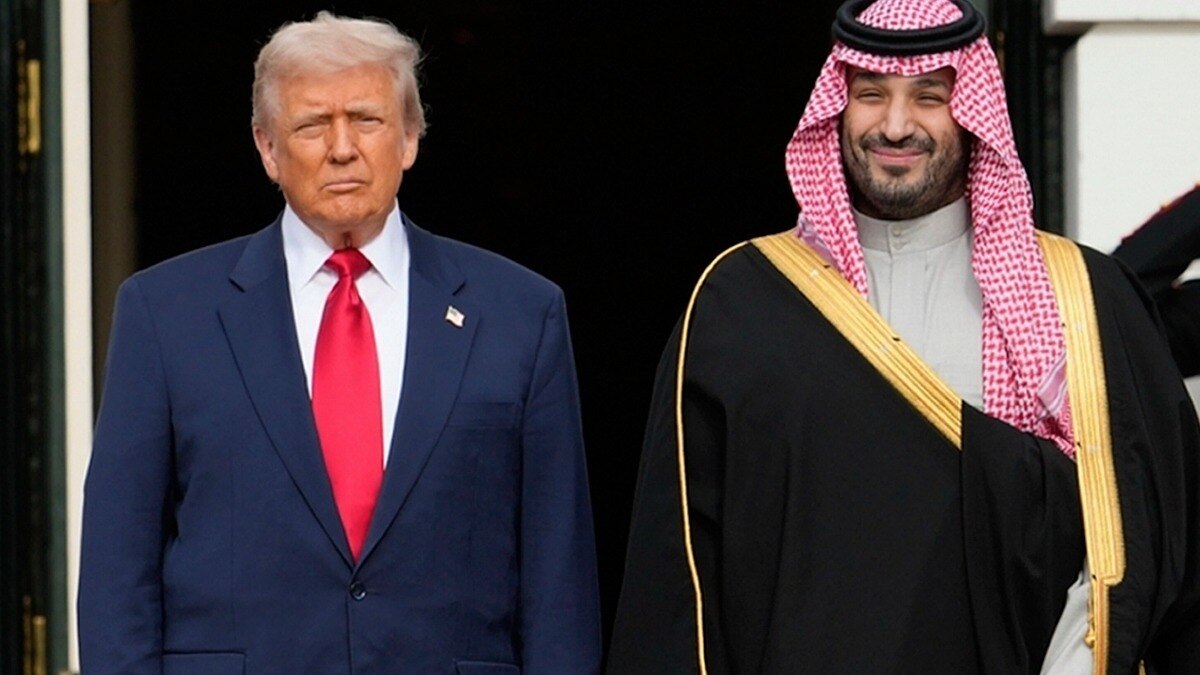
India’s diplomatic protests, however, appeared to have had little effect. US Secretary of State Marco Rubio told External Affairs Minister S. Jaishankar that any illegal transport of oil through the strait “will not be tolerated,” according to the US State Department. US President Donald Trump, meanwhile, alleged that Iran was behind the attacks.
Amid this, Trump on June 10 spoke with Prime Minister Narendra Modi on the occasion of him becoming the longest-serving elected Prime Minister of India, calling him a “strong, healthy, and wise man.” PM Modi thanked him and expressed hope for continued cooperation “for the benefit of both our nations and the world.”
As the Strait of Hormuz becomes a flashpoint for months-long tensions between the US and Iran, the incidents involving Indian sailors highlight a stark reality: at the intersection of geopolitics, military action and diplomacy at sea, it is often merchant seafarers who pay the price -- far from home, and far from help.
- Ends
Published By:
Sayan Ganguly
Published On:
Jun 15, 2026 12:46 IST