1 hour ago
As piracy fears return to the Gulf of Aden, India-linked and other commercial vessels are now broadcasting "armed guards on board".
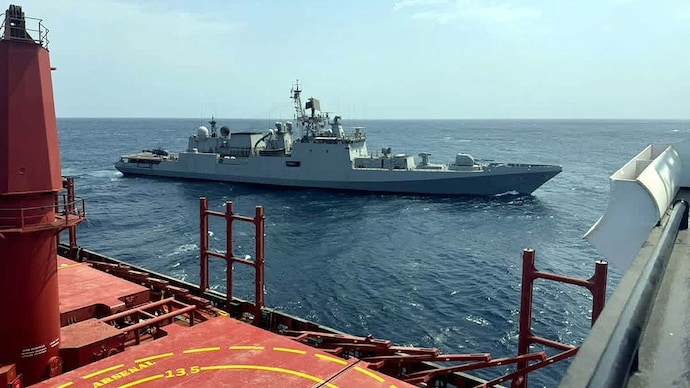
INS Trikand foils piracy attempt on foreign-flagged merchant ship in Gulf of Aden (File Photo)

New Delhi,UPDATED: Jul 3, 2026 16:02 IST
For weeks, the shipping industry has been navigating under the shadow of Iranian drones, US strikes and the uneasy uncertainty around the Strait of Hormuz. But even as that crisis shows faint signs of settling, a fresh threat is opening up along another vital artery of global trade — the Red Sea, where piracy is once again putting commercial vessels on edge.
The Indian Navy on Wednesday said it had successfully responded to a piracy attempt on the merchant vessel MV Golden Arsenal in the Gulf of Aden, with stealth frigate INS Trikand swiftly intercepting and securing the ship after the attack.
The episode underscores a larger shift in the region’s maritime risk. Much like the Strait of Hormuz, the Red Sea and the Gulf of Aden are emerging as critical economic pressure points for global trade.
Telltale signs of this anxiety were visible on Thursday morning. At least 25 vessels, including five India-linked commercial ships, switched their destination signals to indicate armed guards onboard.
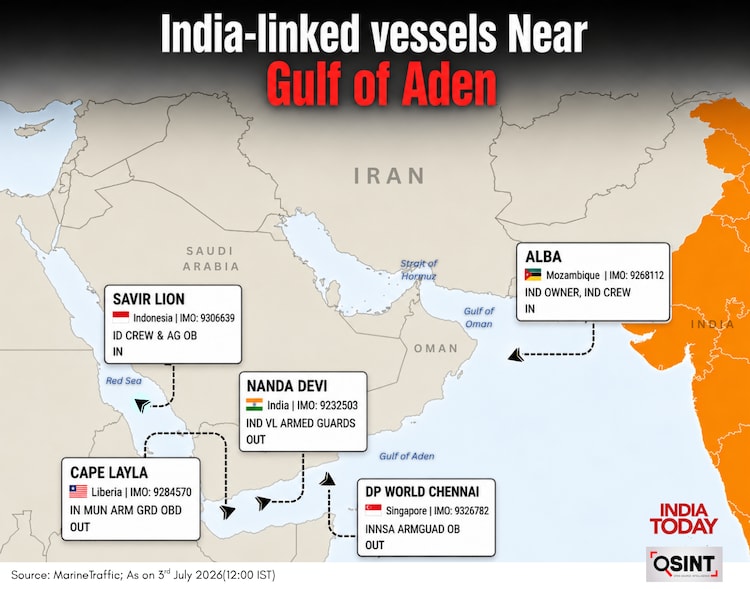
Nanda Devi, an Indian-flagged LPG tanker whose position placed it in the middle of the Gulf of Aden, is at the centre of this crisis. India Today found the vessel displaying the message “IND VL ARMED GUARDS”, indicating an Indian vessel armed guards onboard, as it moved out through the corridor.
It was not alone. Four other India-linked vessels on the map showed similar security signals. Savir Lion, an Indonesian-flagged but India-bound vessel from Chennai, was seen moving in near the Red Sea approach. Cape Layla and DP World Chennai displayed armed-guard-related messages while moving out of the corridor. Alba, a Mozambique-flagged vessel with an Indian owner and Indian crew, was also seen moving in from the Arabian Sea.
Together, these signals show how the Gulf of Aden–Red Sea route is again turning into a high-risk maritime lane, where India-linked vessels are publicly broadcasting armed-guard presence as they navigate a corridor shaped by piracy fears, Houthi threats and wider regional instability.
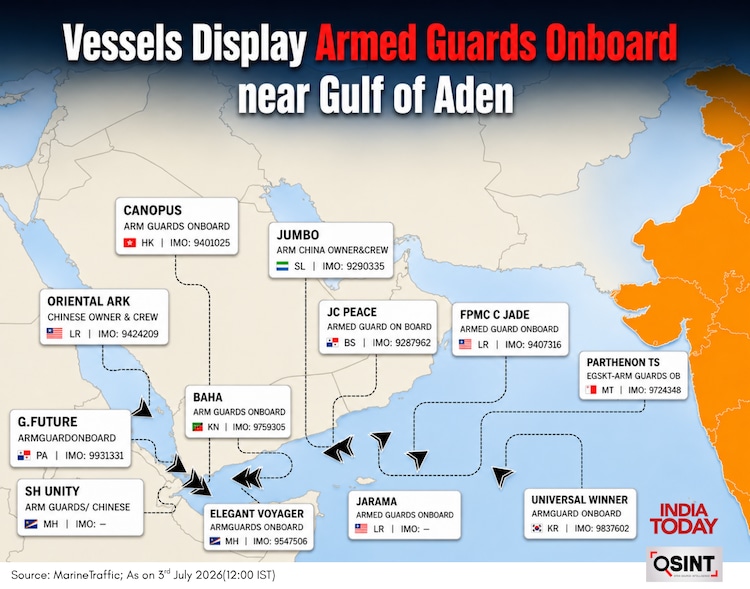
The fear, however, is not limited to Indian vessels alone. By Thursday morning, India Today’s analysis of MarineTraffic signals showed a wider cluster of commercial ships moving through the Gulf of Aden with destination messages indicating armed guards onboard.
Destination signals are short notes manually entered by a ship’s crew into a vessel’s AIS transponder, a GPS-based locator that broadcasts the ship’s position publicly. These messages usually indicate the vessel’s next port of call and are meant to aid navigation safety, traffic awareness and port planning.
Because destination signals are not verified in real time, some vessels use them to display additional information, such as references to ownership or nationality.
At least 18 more commercial vessels displayed similar messages indicating armed guards onboard while transiting the Gulf of Aden in a straight line. Vessels such as Canopus, Oriental Ark, Jumbo, JC Peace, FPMC C Jade, Parthenon TS, Jarama, Universal Winner, Elegant Voyager, Baha, G. Future and SH Unity were seen broadcasting variants of the same security signal.
The pattern cuts across flags and ownership links, from Hong Kong, Liberia, Sierra Leone, Panama and Malta to South Korea and the Marshall Islands, suggesting that anxiety in the corridor is rising across vessels from multiple countries.
- Ends
Published By:
bidisha saha
Published On:
Jul 3, 2026 16:02 IST