1 month ago
Marles predicts ‘significant’ Aukus savings from buying only secondhand subs
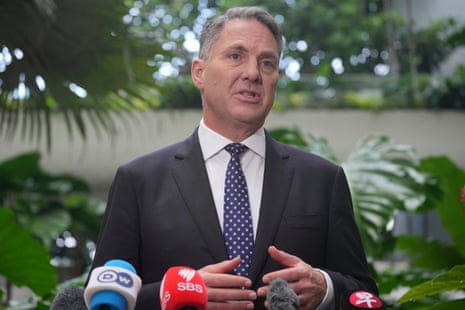
Australia’s defence minister, Richard Marles, has said Australia is saving money and simplifying its navy by taking old US subs instead of a new one.
Marles and his counterparts have agreed Australia won’t take a new Virginia-class submarine from the US as previously planned, with all three ships now to be secondhand.
Speaking in Singapore this morning, Marles said that option had always been considered and he was “really pleased” it had been adopted. He said:
In the context of a very complicated endeavour, we need to place a premium on simplicity.
Marles said the former plan would have had the Australian navy operating up to four classes of submarine at once: the existing Collins class, the secondhand Virginia, the new Virginia model and the SSN Aukus, to come in the 2030s.
That gets pretty complicated in terms of how you’re operating a fleet of submarines. What we will have here is a much simpler pathway. It will mean that the Virginia-class submarines that we are acquiring will all be of the same type.
He said the secondhand models were “cost-effective”, asked if Australia was saving money.
There is the purchase price in respect of each of the submarines and this will be more cost-effective in relation to that and it’ll be significant …
It is definitely cost-effective. And to be clear, you know, this is a very expensive program, obviously. And so we are trying to find every cost-effective option as we walk down this path.
Key events Show key events only Please turn on JavaScript to use this feature

Ben Doherty
Liberal party federal council unanimously backs Taylor’s migration rules
Some news from Saturday: Angus Taylor has said his party would withdraw Australia from its net-zero commitments, reduce migration numbers and end welfare for non-citizens, if elected to government.
At a Liberal Party federal council meeting in Melbourne on Saturday, Taylor made a wide-ranging speech, accusing prime minister Anthony Albanese of starting a war on aspiration with the recent federal budget. He promised to undo Labor reforms to negative gearing, capital gains taxes and trusts, labelling the changes “toxic”.
“Battle lines have been drawn with this budget,” he said.
“It’s clear the coalition and Labor stand for completely different things.”
Taylor reiterated promises to withdraw net-zero commitments, reduce migration numbers and end welfare for non-citizens.
He argued Australia had let in people with the “wrong values” under Labor and promised to tie migration numbers to surplus housing supply.
“Numbers are too high, the standards are too low and both must change,” he said.
“We must shut the door to those who want to import the hatred and violence of another place to our country.”
Taylor’s political mentor John Howard, increased migration massively during his 11 years in office, increasing net overseas migration into Australia from about 83,000 when he became prime minister in 1996, to more than 230,000 by 2007 when his government lost office.
Before Taylor’s speech, the Liberal Party federal council meeting unanimously voted in support of migration policy changes that would allow the potential deportation of visa-holders who breached “values” based on standards including speech and religion.
Minimum English language proficiency would also become a visa requirement under the proposed policy, which would freeze all non-priority permanent visas including parent and partner-child visas.
- with AAP
Hanson says minimum wage workers should not get a pay rise
Pauline Hanson has said Australia’s lowest-paid workers should not be given a wage increase as businesses face rising costs.
The Fair Work Commission on Tuesday will make a call on how much to lift minimum and award wages from July, affecting the pay of 3 million workers.
Business groups have called for an increases of 3% to 4%, below the rate of inflation – 4.2% in the year to April – which would mean real take-home pay goes backwards. Unions have called for a 6% pay rise, to lift real incomes. The Labor government wants a “sustainable” real increase but hasn’t offered up a number.
Hanson, the One Nation leader, appeared on Sky News earlier. When asked if she supported a minimum wage increase above inflation, Hanson said no wage increases should be under consideration. She said:
We’ll go back to what I was saying earlier about cost of living. The pressures that are putting on businesses because the rising cost of electricity due to this government – so everything comes down to cost of electricity. If you lower the cost of electricity, the cost of production and producing those goods, even running businesses, even the shopping centres – they have to cover their cost of electricity.
You can’t just say, we’re going to give you a rise, because, you really need to understand, 50,000 small businesses have gone insolvent because they can’t pay their bills …
Most businesses are struggling, even to make ends meet, let alone – and a lot of them can’t employ staff. So I wouldn’t want to talk too much about employing [sic] putting up wages, because a lot of these employers out there can’t even afford to pay their staff.
Marles backs US claim power must underpin global order
Australia’s defence minister has endorsed the US secretary of defence, Pete Hegseth, in his claim power must underpin the global rules-based order.
Hegseth yesterday spoke to defence counterparts in a private meeting. In public comments, Hegseth warned the Trump administration’s record defence budget request – US$1.5tn (A$2.085tn) – would “unleash America’s arsenal of freedom and expand America’s military dominance for decades to come”.
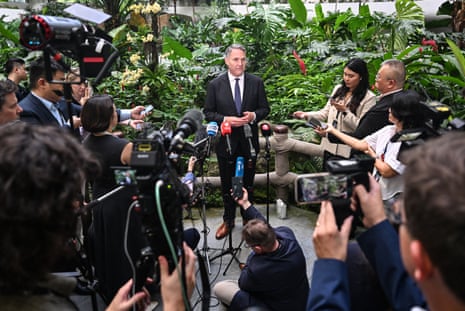
Richard Marles, from Australia, reflected on Hegseth’s comments today, speaking to reporters in Singapore, adding that smaller countries like Australia need the rules-based order.
Australia, the US and UK agreed to deploy new technology to defend undersea cables, while Australia, the UK and 15 other countries signed on to a new agreement to coordinate the defence of underwater infrastructure.
Marles told reporters:
This is a collective challenge and it demands a collective response, which is actually what the rules-based order is all about.
And I think more generally, at times now, it feels as though talking about rules is unfashionable. I think this is an example of why rules are just as important today, if not more important today than they have ever been.
And we also very much understand that there is a connection between rules and power. The rules-based order needs to be underpinned by power, a point that Secretary Hegseth made yesterday. We completely understand that and completely agree with that.
But it’s important that we are all, in the context of a power underwriting of this, we are all committed to a rules-based system, because that is actually what gives middle powers, like Australia or smaller countries, agency.
Marles won’t blame China for undersea cable damage
Richard Marles has avoided directly blaming China for damage to undersea cables.
The defence minister said yesterday the cables, key to Australia’s internet connection, were being cut at an unprecedented rate. China has been blamed for numerous attacks on the cables.
Marles spoke to reporters in Singapore this morning. Asked about Australia’s evidence the attacks were related, Marles said:
Let’s assume what we’re talking about is accidents … what this is demonstrating is the fragility, if you like, of what is now critical global infrastructure. I mean, if it is possible for an anchor to cut a cable in the middle of the night by accident, that of itself ought to be a concern.
But if there is any intention in respect of this, that requires our attention as well.
Marles declined to share more detail when asked if Australia had identified any actors behind the damage:
I’m not going to go further than what I’ve just said in my answer and what I said in my speech yesterday. This is a really important domain and it’s one that all of us need to work hard on.
Marles predicts ‘significant’ Aukus savings from buying only secondhand subs
Australia’s defence minister, Richard Marles, has said Australia is saving money and simplifying its navy by taking old US subs instead of a new one.
Marles and his counterparts have agreed Australia won’t take a new Virginia-class submarine from the US as previously planned, with all three ships now to be secondhand.
Speaking in Singapore this morning, Marles said that option had always been considered and he was “really pleased” it had been adopted. He said:
In the context of a very complicated endeavour, we need to place a premium on simplicity.
Marles said the former plan would have had the Australian navy operating up to four classes of submarine at once: the existing Collins class, the secondhand Virginia, the new Virginia model and the SSN Aukus, to come in the 2030s.
That gets pretty complicated in terms of how you’re operating a fleet of submarines. What we will have here is a much simpler pathway. It will mean that the Virginia-class submarines that we are acquiring will all be of the same type.
He said the secondhand models were “cost-effective”, asked if Australia was saving money.
There is the purchase price in respect of each of the submarines and this will be more cost-effective in relation to that and it’ll be significant …
It is definitely cost-effective. And to be clear, you know, this is a very expensive program, obviously. And so we are trying to find every cost-effective option as we walk down this path.
Ben Doherty
Israel rejected flotilla allegations now subject to ICC submission
For context on that Global Sumud Flotilla submission to the international criminal court: Israel’s ambassador to Australia, Hillel Newman, told the ABC’s 7.30 the flotilla participants were treated with “great sensitivity” and that “no one was hurt”. He rejected allegations of sexualised mistreatment and said claims of violence were “not true”.
The Israeli Prison Service has said allegations of violence against flotilla participants were “false and entirely without factual basis”.
Israel’s treatment of the humanitarian sailors onboard the flotilla attracted international condemnation when the country’s national security minister posted a video online showing him taunting and humiliating flotilla participants while they were zip-tied, and forced to kneel in stress positions, with the Israeli national anthem blared over loudspeakers.
Itamar Ben-Gvir, the leader of the far-right, racist Otzma Yehudit party, mocked the bound human rights defenders, waving an Israeli flag and shouting “welcome to Israel, we are the landlords”.
As those detained scream in pain, Ben-Gvir yells, “give them to us for the terrorists’ prisons”.
Newman said Ben-Gvir’s humiliation of the human rights defenders had been “condemned by the government of Israel entirely”.
It’s not acceptable, it’s disgraceful … it does not reflect our values … and therefore is condemned and declared disgraceful and harmful to the state.
The international criminal court (ICC) issued arrest warrants for Israel’s prime minister, Benjamin Netanyahu, and former defence minister Yoav Gallant in 2024 for alleged war crimes and crimes against humanity in Gaza.
The warrants allege the two leaders used starvation as a method of warfare, as well as intentionally directing attacks against civilians, murder, persecution and other inhumane acts.
Ben Doherty
Gaza flotilla activists submit torture allegations to international criminal court
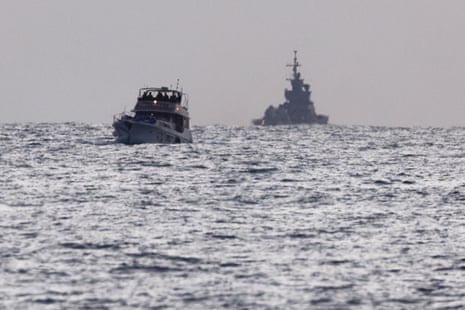
Australians who sailed on the Global Sumud Flotilla to bring aid to Gaza have joined an official submission to the international criminal court (ICC) detailing allegations of torture, sexual violence, beatings and other serious abuses during their detention by Israeli forces.
The submission included testimonies from flotilla participants, medical examination documents and legal affidavits, gathered after the flotilla was intercepted and participants detained.
The Global Samud Flotilla sailed from ports in the Mediterranean attempting to deliver food, medicine and baby formula to Gaza, where hunger is widespread and the medical system has been devastated by years of war. Those onboard the flotilla were civilians and unarmed.
The Australian lawyer Bernadette Zaydan is a member of the legal team putting evidence before the court in The Hague.
The submission to the ICC alleges war crimes, crimes against humanity, torture and other serious violations of international law arising from the interception and detention of flotilla participants during the Spring 2026 missions.
But Palestinian-Australian Subhi Awad, a spokesperson for the flotilla delegation, said the accounts of survivors defied the official narrative.
Our people were beaten. Our people were tortured. Our people suffered sexual violence. An Australian humanitarian was injected with an unknown substance.
Who do Australians believe – Israeli officials, or Australian survivors? Who do Australians believe – the perpetrators, or the evidence?
Awad said the flotilla participants were being gaslit by accounts from the Israeli government.
Telling Australians they were treated with ‘great sensitivity’ is an insult to every survivor and every Australian watching.

Tom McIlroy
Rinehart ‘very disgruntled’ with the Liberals, Hanson says
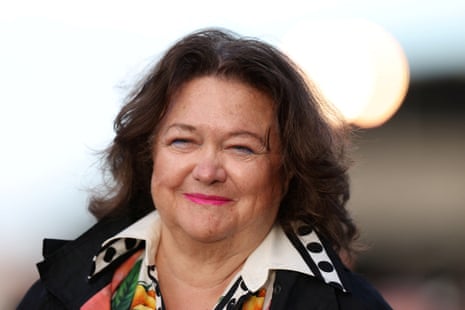
The One Nation leader, Pauline Hanson, has talked up the mining billionaire Gina Rinehart’s influence in Australian politics, and says she has become “disgruntled” with the Liberal party.
Hanson said on Sky News this morning:
Gina Rinehart has been supportive of my policies. Why? Because she can see that this is going to drive change in this nation.
The Liberal party were lax. The Liberal party have become full of the moderates, who are, you know, this woke agenda – male, female rubbish that’s been pushed on to us.
There’s no productivity, you know the division that’s happening.
Hanson says Rinehart is “a great Australian”.
Her voice is no different to anyone here … Anyone else here that has an opinion, or the farmer, whoever they are … Her voice is no different to anyone else’s.
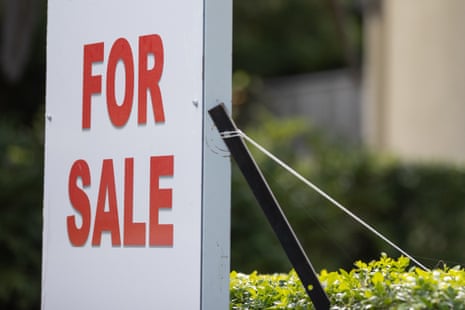
House price downturn no problem for 5% deposit scheme buyers, O’Neil says
The federal government says its 5% deposit scheme for first home buyers is “really robust”, as an expected house price slide raises the risk new homeowners could be left in negative equity.
Buyers who borrowed a bigger loan under the scheme may be left with a debt worth more than their home they bought it with, if prices slide, raising the risk of defaulting on their loan.
Labor’s housing minister, Clare O’Neil, said the 5% deposit scheme was holding up well, when asked on the ABC’s Insiders whether she was worried.
Our government is incredibly proud of this program. We have now got 260,000 Australians into their own home with the support and backing of an Albanese government that saw their aspiration and helped them realise it. I don’t care what your politics is, this that is a massive number of people to have support.
… This is a really robust scheme. Defaults against this scheme are vanishingly small and, in fact, [the Commonwealth Bank] said pretty recently, the average 5% deposit holder is actually more ahead on their mortgage than the average mortgage holder in this country.
What does that tell us? It tells us that when ambitious young people who are trying to build wealth for themselves and their family get the opportunity of a government to back them in, they will do the right thing.
Labor says tax changes not main driver of impending house price fall
Australian house prices are expected to slide, if only briefly, but the federal housing minister has avoided taking the blame (or the credit).
Clare O’Neil has said interest rates are the main influence on the speed of price growth, when asked on Insiders about projections house prices could fall up to 10% from their peak before steadying and rising again. She said:
The tax changes we are making in the budget are not the main driver of that.
House prices in our country move. The biggest driver of them is what goes on with interest rates.
Treasury has modelled the impact of our tax changes on house prices. There is a mild affordability impact. For that, we get 75,000 rental households into their own home and a fairer market for housing in this country forever. So it’s about a 2% slowing of growth that Treasury has predicted, and indeed it’s not just Treasury.
If you look at the Grattan model they have built – they’re very reliable voices on this – their estimates are the same, same with the Commonwealth Bank of Australia …
Asked specifically if she thought housing prices would fall, O’Neil said:
I don’t get into a speculation about what happens with property prices in this country.