4 weeks ago
Patricio Guzmán, the film-maker who chronicled Chile’s bloody 1970s political strife and its subsequent social and political turmoil in films such as The Battle of Chile and Nostalgia for the Light, has died aged 85. According to Chilean news outlet Emol, Guzmán died on Tuesday in Paris after a cardiorespiratory arrest.
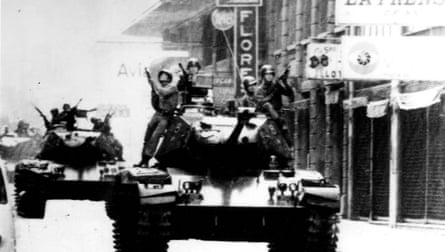
Guzmán’s chief preoccupation throughout his career was the carnage unleashed by Augusto Pinochet’s coup in 1973 against Salvador Allende, Chile’s elected president. He later told the Guardian: “I’m a film-maker who was very marked by the ways of the dictator. It has remained with me for ever. I cannot leave it behind.” However, he resisted the idea that he was an activist, political film-maker, adding: “I’m not a sociologist. Neither am I a politician. I make films that are metaphorical and poetic; I interpret reality through my own personal way of looking.”
Born in Chile in 1941, Guzmán initially worked in advertising before studying film, first in Chile and then in Madrid. On his return to Chile, Guzmán responded to the febrile political atmosphere after Allende’s election in 1970, eventually completing the mammoth Battle of Chile documentary that chronicled Pinochet’s ultimately successful attempt to overthrow Allende, resulting in the latter’s suicide. Guzmán did not shrink from the brutality of the period, even including footage shot by camera operator Leonardo Henrichsen as he is shot dead by the soldier he is filming.
Guzmán was helped in the endeavour by French film-maker Chris Marker, who supplied film stock and connections that proved vital to make the film. Guzmán himself was arrested but eventually released, but the film’s cinematographer Jorge Müller was not so lucky – along with his girlfriend Carmen Bueno, he was arrested, tortured and “disappeared” in 1974.
Guzmán completed The Battle of Chile outside the country, releasing each of its three parts – The Insurrection of the Bourgeoisie (1975), The Coup d’État (1976) and Popular Power (1979) – through the rest of the 70s. Described by the Guardian as “an outstandingly photographed example of a newsreel film that captures the drama and volatility of the period”, it has continued to attract acclaim since then. Guzmán revisited the film in the mid-90s with Chile, Obstinate Memory, in which he returned to the country after a quarter-century of exile. In 2001 he completed The Pinochet Case, after the Chilean former dictator was arrested in London in 1998.
The director moved on to more metaphysical subjects with a trilogy of films starting in 2010: Nostalgia for the Light, The Pearl Button and The Cordillera of Dreams. They sought to explore Chile’s traumatic past by absorbing the country’s magnificent natural landscapes. His final film, My Imaginary Country, was premiered in 2022 and covered Chile’s dramatic 2019 street protests.