1 month ago
Last Updated:February 24, 2026, 16:48 IST
This rare and extremely dangerous ‘bomb cyclone’ has covered America's areas from Virginia to Maine with a thick layer of snow


More than 40 million people in the US are under blizzard warnings. (AP)
A massive bomb cyclone or Winter Storm Hernando is currently walloping the U.S. Northeast, bringing record-breaking snowfall and hurricane-force winds that have paralysed the region.
This rare and extremely dangerous ‘bomb cyclone’ has covered areas from Virginia to Maine with a thick layer of snow. All you need to know.
What is a ‘Bomb Cyclone’?
A bomb cyclone, known scientifically as ‘bombogenesis’, is a storm whose intensity increases explosively in a very short time. When a storm’s central air pressure drops by at least 24 millibars in 24 hours, it is classified as a bomb cyclone. The faster the pressure drops, the stronger the storm becomes. Simply put, it’s like a winter hurricane.
This specific storm was triggered by a clash between frigid Arctic air diving south from Canada and warm, moist air over the Atlantic Ocean.
A rapidly spinning low-pressure system pulls in cold Arctic air, creates blizzard-like winds, and dumps so much snow that city systems struggle to cope. For a storm to be officially declared a blizzard, winds must exceed 56 kilometers per hour, there must be heavy snowfall, and visibility must be less than a quarter mile for at least three hours. The current storm has surpassed all these criteria.
The effect
New York City’s skyline is covered in snow, and heavy snowfall and strong winds have nearly stopped movement on the streets. Experts say this is one of the most powerful storms in decades, and its effects are not over yet.
Parts of the Northeast have seen up to 36 inches (3 feet) of snow. Warwick, Rhode Island reported 91 centimetres (approx. 36 inches), while Providence saw its biggest snowstorm on record.
At the height of the storm, over 600,000 customers lost power. As of Tuesday morning, roughly 450,000 homes remain in the dark, primarily in Massachusetts and New Jersey.
More than 11,000 flights have been cancelled since Sunday. Over a thousand flights have been canceled at New York City’s three major airports—LaGuardia, John F. Kennedy , and Newark Liberty . Two-thirds of incoming flights at JFK have been cancelled. Regional rail services have also been suspended. Major hubs like JFK and LaGuardia in New York, and Logan in Boston, faced near-total shutdowns.
Hurricane-force wind gusts up to 84 mph were recorded in New York and Massachusetts, creating dangerous whiteout conditions.
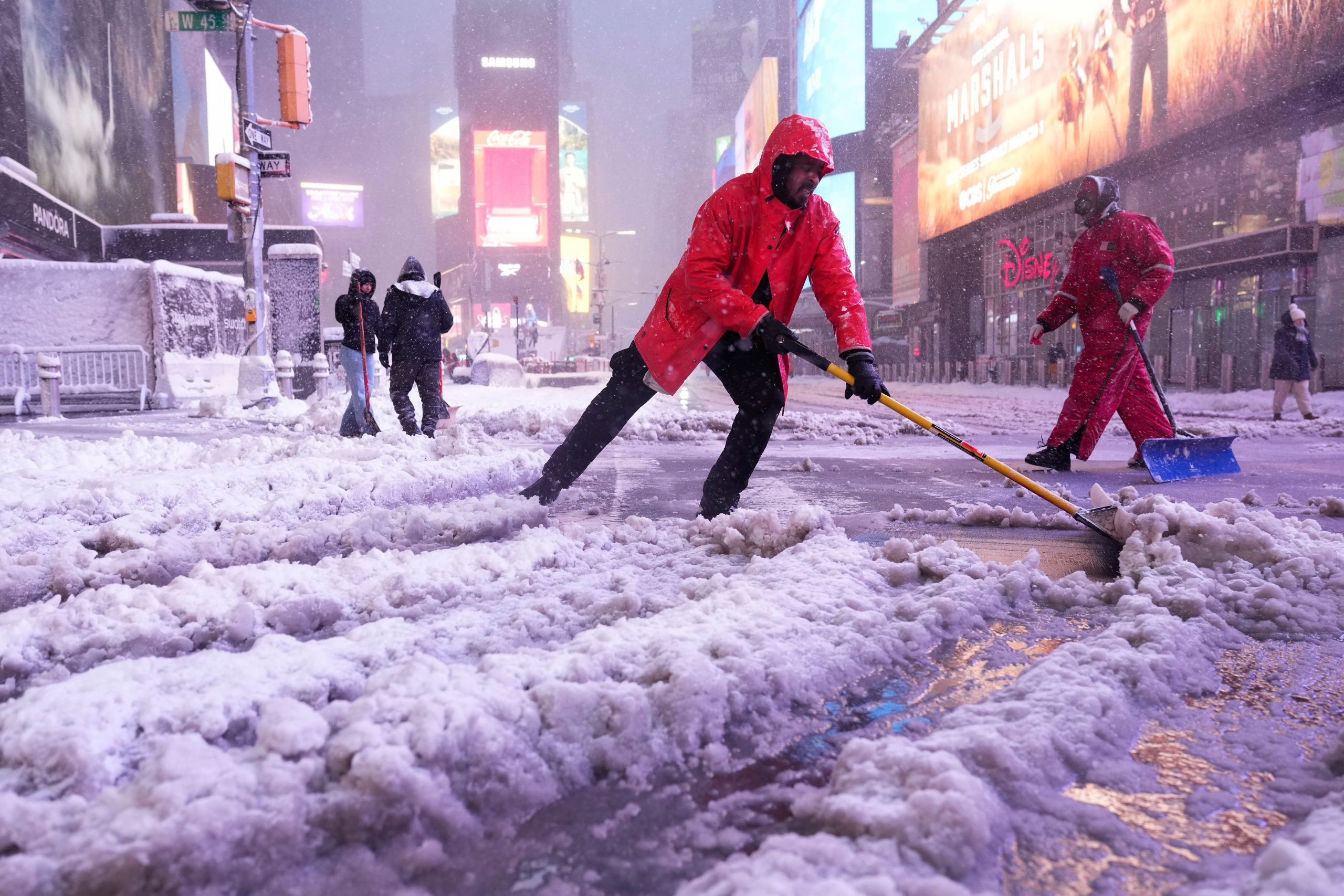
Blizzard warnings: Historic since 1996
More than 40 million people are under blizzard warnings. Blizzard warnings have been issued for New York City, Long Island, Lower Hudson Valley, most of New Jersey, and southern Connecticut. Coastal flood warnings are also in effect in all three states.
By midnight local time, Staten Island’s Dongan Hills area had recorded more than a foot (about 30 centimeters) of snow, and conditions kept getting worse. According to the weather department, all 29 counties in the New York area have blizzard warnings at the same time, something not seen since the historic blizzard of 1996.
Governors in six states (New York, New Jersey, Massachusetts, Connecticut, Delaware, and Rhode Island) declared states of emergency, banning non-essential travel.
New York City’s mayor, Zohran Mamdani, declared a state of emergency and ordered all roads, highways, and bridges closed from Sunday night at 9 PM to Monday afternoon. Twenty-two ‘warming buses’ have been deployed for the homeless and vulnerable, taking people to shelter homes in all five boroughs. ‘Code Blue’ has been implemented, meaning no one in need will be turned away from shelters. Rhode Island, Pennsylvania, Connecticut, Maryland, and Massachusetts have also declared emergencies. The governors of New York and Massachusetts have deployed the Guard.
More than 100,000 customers in northeastern America have lost power, and experts say the worst is yet to come.
The visuals
The powerful bomb cyclone hovering near America’s east coast looks like a hurricane in satellite images. From space, it appears as a massive spiral of dense clouds, with a ‘spinning eye’ structure near the center, especially close to New Jersey. Meteorologists say this system intensified very quickly, which is a hallmark of bomb cyclones. Current data shows central air pressure has dropped to about 972 millibars, which is typical for powerful coastal storms. In some areas, sustained winds have reached 75 miles per hour (about 120 km/h), with gusts up to 90 miles per hour (about 145 km/h). Technically, it’s not a hurricane because it doesn’t get its energy from warm ocean water. Instead, it draws strength from sharp differences in atmospheric temperature. However, experts say its structure and wind strength make it “functionally like a hurricane".
What next?
With the storm near the coast, the sea has become very rough in New Jersey and nearby coastal areas. As it moves north, heavy rain, strong winds, and coastal flooding are expected in New York City and surrounding areas. Emergency officials have urged people to secure loose items outside and prepare for possible power outages. Strong winds can bring down tree branches and power lines. Air travel and ferry services may also be affected, and coastal communities have been warned about dangerous waves and erosion.
The weather department is monitoring the storm continuously via satellites. Although it is expected to weaken after making landfall, strong winds and heavy rain may continue for several hours afterward. Residents of northeastern America are advised to keep an eye on official weather warnings as this powerful bomb cyclone moves toward one of the country’s most densely populated regions.

What scientists say
Scientists have long warned that even though the number of winter storms may decrease as global temperatures rise, the storms that do occur will be more intense and destructive. Disturbances in the ‘polar vortex’, the layer of cold air over the Arctic, are also linked to climate change. When it weakens, cold Arctic air is pushed into populated areas, causing explosive storms. This storm hit just weeks after the region recovered from another deadly weather system that caused over 100 deaths.
Climate scientists say this pattern is becoming hard to ignore.
New York Governor Kathy Hochul said clearly, “The worst is yet to come."
First Published:
February 24, 2026, 16:47 IST
News explainers Bomb Cyclone Hits US, 40 Million Under Weather Warnings: The Blizzard Explained
Disclaimer: Comments reflect users’ views, not News18’s. Please keep discussions respectful and constructive. Abusive, defamatory, or illegal comments will be removed. News18 may disable any comment at its discretion. By posting, you agree to our Terms of Use and Privacy Policy.
Read More