1 month ago
BRICS leaders in New Delhi issued a declaration that omitted the Russia-Ukraine war, breaking from previous joint statements while addressing conflicts in Gaza, West Asia and Sudan.
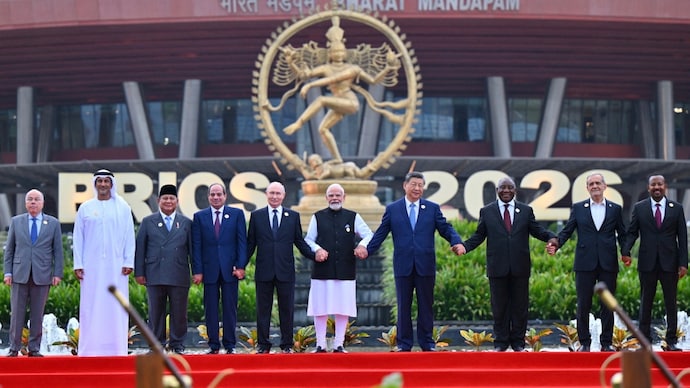
Leaders pose for a family photo during the BRICS Summit in New Delhi. (Photo: Reuters)
The BRICS summit in New Delhi has produced a notable departure from the grouping's previous joint declarations, with the 2026 leaders' declaration making no reference to the Ukraine war despite explicitly addressing several other conflicts around the world.
The omission is a big shift from the framing adopted at the 2025 BRICS summit in Rio de Janeiro, where leaders had devoted a separate paragraph to the conflict. The war, now in its fifth year, had also featured in the declaration issued under Russia's BRICS presidency in Kazan in 2024.
The New Delhi document contains 15 paragraphs dealing with conflicts and crises, including the situation in Palestine, the wider West Asia conflict, Syria and Sudan. It also raises the issue of the economic blockade of Cuba. Despite this, there is no specific reference to the Russia-Ukraine conflict.
THE BIG CHANGE FROM RIO TO DELHI
The difference is particularly striking when compared with the wording agreed by BRICS leaders in Rio last year. The 2025 declaration stated: "We recall our national positions concerning the conflict in Ukraine as expressed in the appropriate fora, including the UN Security Council and the UN General Assembly."
It also noted mediation efforts, including the African Peace Initiative and the Group of Friends for Peace, aimed at resolving the conflict through dialogue and diplomacy. "We expect that current efforts will lead to a sustainable peace settlement."
Rather than naming Ukraine, the New Delhi declaration adopts broader language centred on dialogue, diplomacy, international law and the peaceful resolution of disputes. The change is significant because BRICS decisions are based on consensus, meaning all members must agree to the final text. Russia, which launched its full-scale invasion of Ukraine in February 2022, is one of the bloc's key members. India has maintained close ties with Moscow while also strengthening its strategic partnerships with the US and Europe.
India had previously played a major role in shaping the G20's position on Ukraine during its presidency in 2023. At the time, New Delhi helped bridge differences between Western countries, the European Union and Russia over the joint declaration.
The final declaration also reflects the delicate negotiations surrounding the ongoing West Asia conflict. Iran and the United Arab Emirates, both BRICS members, have been on opposing sides of the regional tensions, making the wording of the Middle East section particularly sensitive.
Despite those tensions, Iran and the UAE signed up to a joint BRICS position calling for restraint and de-escalation.
"We express deep concern over the continued escalation of tensions in Middle East/West Asia ... call for exercising maximum restraint, as well as avoiding actions that could further aggravate the situation, the declaration said. The statement also called for civilians to be protected and urged respect for the sovereignty and territorial integrity of states. It highlighted the need to safeguard global trade, supply chains, energy flows and maritime security.
Iranian President Masoud Pezeshkian separately met Abu Dhabi Crown Prince Sheikh Khaled bin Mohamed bin Zayed Al Nahyan on the sidelines of the summit. The meeting was the highest-level interaction between the two countries since the conflict began, although neither side publicly disclosed details of the discussions.
BRICS PUSHES FOR A BIGGER GLOBAL ROLE
The negotiations over the declaration come as BRICS attempts to strengthen its role in global affairs and present itself as a counterweight to a US- and Western-led international order.
The grouping began in 2009 with Brazil, Russia, India, China and South Africa and has since expanded to include Egypt, Ethiopia, Indonesia, Iran and the UAE, among others.
Prime Minister Narendra Modi said BRICS had "come of age" and urged its members to turn their consensus into concrete outcomes on the world stage. The bloc has been seeking greater influence over international rules while advocating reforms to institutions including the World Bank, Monetary Fund and World Trade Organisation, which some members regard as overly influenced by Western powers.
Chinese President Xi Jinping also called on BRICS countries to stand on the "right side of history" and said China was ready to play its "due role" in promoting peace and stability in the Middle East.
NEW DELHI'S DELICATE BALANCING ACT
The summit also reflects the delicate balancing act India is navigating on the diplomatic front. New Delhi has strategic ties with the US, Russia, Israel, Iran and the Gulf states, even as it pushes within BRICS for stronger trade links and greater economic cooperation.
Former Indian ambassador to the UAE Sunjay Sudhir said India's role was less about resolving the conflict directly and more about keeping diplomatic channels open.
"The key to ending the war lies with the US and Israel," Sudhir told news agency Reuters.
"What India has done is keep the difficult conversations going, by showing that countries of the region can sit at the same table, engage diplomatically, and build on where their interests converge," he added.
Against that backdrop, the absence of Ukraine from the New Delhi declaration is particularly notable. Russian air strikes continued across several Ukrainian regions on Saturday, killing nine people, injuring dozens and damaging residential buildings and infrastructure, according to Reuters.
The attacks continued as the civilian death toll in Ukraine has risen sharply over the past two months, with Russia intensifying strikes on power plants and other infrastructure. Ukraine has also targeted energy facilities and warehouses deep inside Russia, while both sides have struck each other's shipping.
- Ends
Published By:
Satyam Singh
Published On:
Sep 13, 2026 01:04 IST