1 hour ago
Burnham says country needs 'substantial change', and he will deliver it
Burnham says his approach to the prisoner early release scheme is an example of doing politics differently.
This is politics done differently, problem-solving, over point-scoring. It is what the country needs. It is what the public want more of, and it will characterise my time in office.
He says another example has been starting cross-party talks on social care. Ed Davey, the Lib Dem leader, and Stuart Andrew, who was shadow health secretary until yesterday, participated, he says.
When it comes to the biggest issues facing the country, the economy and the cost of living crisis, people are looking for much more substantial change, as promised in our manifesto, and that is what I will bring.
Britain is not where any of us would wish it to be. Things are not working as they should.
Key events
In response to a question from Meg Hillier, chair of Treasury committee, Burnham says he wants to ensure more public land is released so that council and social housing can be built there.
Burnham says he cut taxes twice in his first week, as he rejects Badenoch's attack on his economic policies
Burnham is responding to Badenoch.
He starts with a joke. Badenoch went to Italy to meet Giorgia Meloni to be told not to do a deal with Reform UK. He could have told her that himself, he says.
On defence, he says the appointment of John Healey as chancellor should be taken as evidence of how serious he is about raising defence spending.
On small boats, he says it is “hard to accept” Badenoch’s claim that the Labour government has had nothing to do with the fall in small boat numbers.
I heard an opposition spokesperson on the radio this morning trying to find any excuse – the weather and all kinds of things – [to explain the fall in small boat arrival numbers]. Can they not just accept that the action that we’re taking is making a progress?
On prisoners, he says he hopes the opposition will work with the government on dealing with the problem of IPP sentences.
On the economy, he says he cut tax twice in his first week. (He is referring to cutting VAT on fuel bills, and business rates for pubs.)
He defends talking about the 1980s.
I have to say to [Badenoch] that is the legacy that we are still struggling to reverse. It’s the reason why people paying such high water bills and the infrastructure is crumbling before our eyes.
Why are energy bills in this country the highest in Europe? Why do members opposite represent constituencies where bus services year after year have been cut and the fares have gone up?
They know the truth of what I’m saying.
He ends saying Badenoch has appointed the author of Liz Truss’s mini-budget [Andrew Griffith] as shadow chancellor.
In another six days, his government will have outlived Truss’s, he says.
Badenoch says Burnham's theory of growth 'completely wrong'
Kemi Badenoch is responding to Burnham now.
She starts by saying that, although she has heard him over the summer talking about how to make tea, and his views on pork scratchings, she has not been able to ask him any questions yet.
She says is asking some now, she says.
On defence, she asks if he will commit to raising defence spending to 3% of GDP by the end of this decade.
On small boats, she says the fall in the crossing numbers has nothing to do with Labour. It is a consequence of decisions taken in Europe, she says.
She asks if it is true that Burnham may revive a version of the Rwanda plan.
On the prisoner early release scheme, she says Burnham has” had five different positions on early release in six weeks”. She asks when foreign prisoners will be sent home.
On the economy, she challenges Burnham to rule out future tax rises.
She says Burnham’s theory of growth is “completely wrong”.
[Burnham] thinks that if government spends more money, we will all get richer. That is not how this works. Companies are not leaving our shores because there isn’t enough government.
She also says she has heard rumours Burnham is planning to miss PMQs next week.
Burnham says he will ensure areas in England without mayors can also benefit from devolution deals
Burnham says he has heard concerns about his devolution plans, and fears that areas without a metro or regional mayor won’t have the same advantages as those that do have one. He says he understands the concerns about the potential emergence of a two-tier England”.
He goes on:
I will not ignore [the concerns]. So I have asked No 10 North to begin work with Cornwall council and its six MPs on a devolution deal, with or without an elected mayor.
And I today extend the same offer to all parts of England without devolved power. The first secretary of state will today write to every member of this house setting out how they can engage No 10 North in the service of the places they represent.
I extended the same offer to the first ministers of Scotland and Wales, and the first and deputy first ministers of Northern Ireland when I met them over the summer, as they rightly pointed out, their situations are different, but there is interest in what a local model of devolution could look like in each of the home nations.
Burnham says he wants to give communities more control over services.
The government I lead will be relentless in giving people and places what they were promised 10 years ago, ownership and control, and from that control over their destiny comes change and growth.
And he says he can say this from his experience as mayor of Greater Manchester.
I say this with confidence. I do. Let me explain why. Because it is backed by a decade of personal experience.
Turning around one of the UK’s former industrial heartlands and turning it into the fastest growing city region in the country, bucking the low-growth trend.
Burnham claims he has 'clear diagnosis of what has gone wrong' with UK
Burnham says, coming back to the Commons after 10 years, he has “a clear diagnosis of what has gone wrong”.
He goes on:
And let me lay it out clearly.
From the 1980s, this country took a series of wrong turns. Political power was centralised, economic power privatised, the country de-industrialised austerity followed, hollowing out councils and depriving them of the agency to act to reverse any of this.
And then Brexit compounded the damage, ushering in a decade of low growth and stalled regeneration.
Change begins with honesty. I’m not hearing much of it this afternoon. Unless we are blunt about what went wrong, we won’t turn things around.
Far from taking back control, the combination of these policies took control out of the hands of communities up and down Britain.
For 40 years, too many places have been drifting. Too many British high streets tell the story of this decline. People yearn to see them restored to what they once were.
Burnham says country needs 'substantial change', and he will deliver it
Burnham says his approach to the prisoner early release scheme is an example of doing politics differently.
This is politics done differently, problem-solving, over point-scoring. It is what the country needs. It is what the public want more of, and it will characterise my time in office.
He says another example has been starting cross-party talks on social care. Ed Davey, the Lib Dem leader, and Stuart Andrew, who was shadow health secretary until yesterday, participated, he says.
When it comes to the biggest issues facing the country, the economy and the cost of living crisis, people are looking for much more substantial change, as promised in our manifesto, and that is what I will bring.
Britain is not where any of us would wish it to be. Things are not working as they should.
Burnham says problems with indefinite IPP sentences have been 'ignored for too long'
Burnham confirms that the prisoner early release scheme rules are being changed to stop the killers of PC Andrew Harper being released.
And he says part of this plan will involve tackling the number of prisoners still in jail on indefinite IPP (imprisonment for public protection) sentences. This is an issue the Commons has “has ignored for too long”.
Burnham says he visited Dover in August where the government’s efforts to stop small boat crossings are delivering real results. He says numbers arriving over the summer have halved since last year. (See 9.29am.)
Burnham pays tribute to the two police officers killed “in the line of duty on the A66”.
He expresses condolences to those affected by the flooding on the Nepal/China border.
And he confirms he will attend the next Cop conference on the climate crisis in Turkey.
Britain's defence 'starts in Ukraine', says Burnham
Burnham says the government will continue to “stand firm in providing what help we can to enable Ukraine to defend itself from this illegal invasion”.
He goes on:
Britain’s defence starts in Ukraine and the defence of our nation will always be my first priority on public safety.
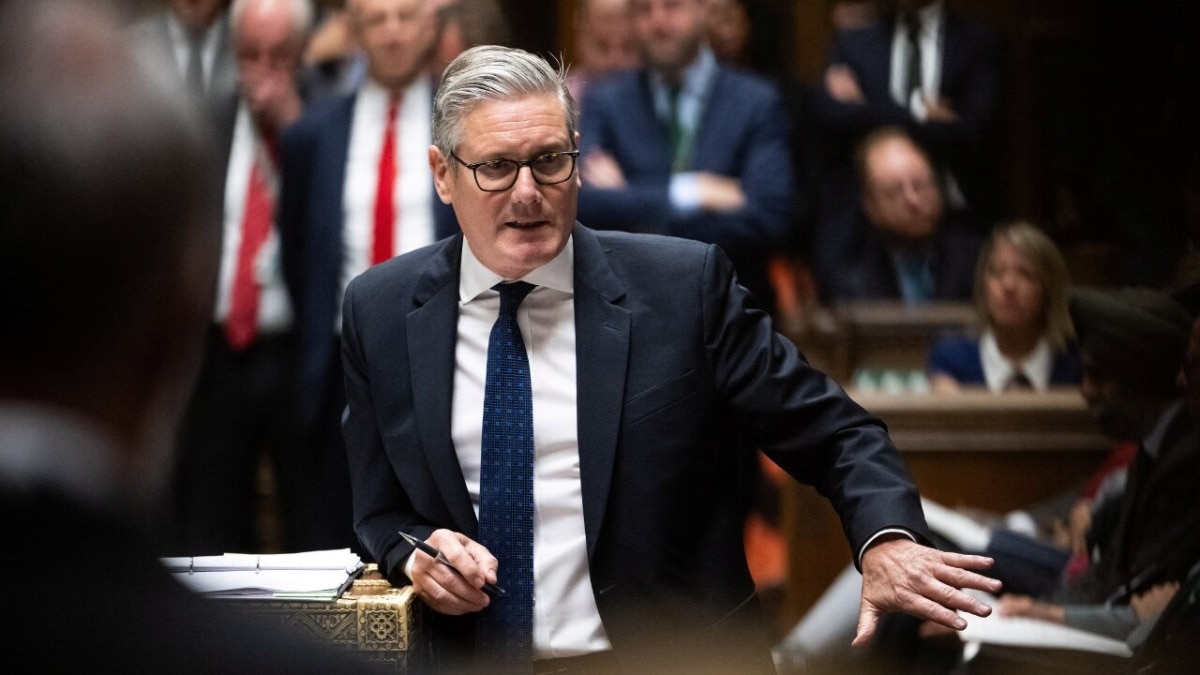
Burnham starts statement to MPs with tribute to Starmer, saying he gave Labour a platform 'and we will use it well'
Andy Burnham is making his statement to MPs on “government direction”.
He starts by saying he comes to the Commons having visited every region of the UK, and Ukraine, over the summer.
He says the UK is standing by Ukraine, in line with the policy set out by Keir Starmer.
And he pays tribute to Starmer, saying he took Labour “from one of its worst defeats to one of its best victories”.
Starmer gave Labour a platform, he says. “And we will use it well.”
John Swinney announces plans to slash number of NHS boards in Scotland
Scotland’s NHS boards will be slashed from 14 to two, John Swinney has announced. As the Press Association reports, the Scottish first minister announced the major shake-up of Scotland’s health service during his Programme for Government at Holyrood. “This will be the most significant structural reform of our NHS in the devolution era,” he said.
This is from Kemi Badenoch, the Conservative leader, on Keir Starmer’s decision to resign from parliament.
Wishing Keir Starmer all the best for the future.
I was surprised to hear he was standing down from Parliament. But I can understand why he would not want to spend time with the Labour MPs who treated him so badly after he won them their seats.
What election experts are saying about Holborn and St Pancras byelection
And here are some elections experts on the Holborn and St Pancras byelection.
From the Economist’s Owen Winter
Holborn and St Pancras’s local election results in May (ish): Labour 38% Green 29% Conservative 10% Reform 9% Lib Dem 7%
The post-Burnham MRPs show Labour winning Holborn and St Pancras with ~41% of the vote versus the Greens on ~22%. By-election dynamics could of course scramble that
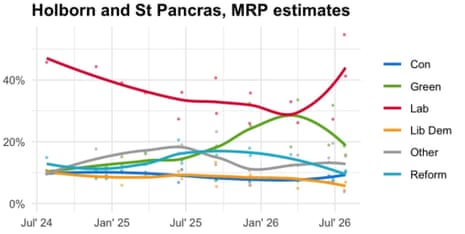
From Rob Ford, a politics professor
Starmer’s parting gift to his successor: a tricky first by-election defence in a Labour seat where the Greens will fancy their chances...
Labour’s vote dropped 17 points to 48% in this seat in 2024, with a combined 29% going to the Greens (10%) and the left independent Andrew Feinstein (19%). A high profile Green candidate (Polanski?) consolidating that vote would only need a 10 point swing from Lab to win
The 2026 Camden local elections also underline Green strength on the ground in this seat - they were first or close second in all but 3 of the 11 wards wholly or partly in the seat (and in two of the others they stood aside in favour of “Camden People’s Alliance”)
The seat has exceptionally high shares of non-white voters (66%), graduates (51%) and young ppl (47% aged 16-39) - all groups that have swung Lab to Green in recent years. This could be a humdinger of a by-election
Just as Burnham standing in Makerfield transformed that race, Polanski standing here would transform this one, and for similar reasons: the opportunity to elect a national leader changes the nature of the contest
From Josh Housden from Nowcast UK
Holborn & St Pancras is well within the London crescent of seats where Greens are likely to come 2nd to Labour, under normal non-by-election circumstances
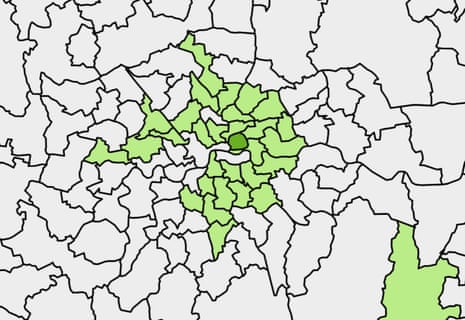
Bethnal Green & Stepney is highlighted as the one seat Greens are likely to flip based on current polling. Not too far from Holborn & St Pancras
Ed Miliband says government accepts need for 'step change' in action to stop expansion of illegal West Bank settlements
Ed Miliband is now taking questions in the Commons in his new role as foreign secretary. The first two questions were answered by junior ministers, but Miliband took the third question himself. It was from Labour’s James Naish, who asked what the government would do to stop the expansion of illegal settlements on the West Bank.
Miliband condemned the settlements and said that the government would “not acquiesce in the destruction of the two-state solution”. He said the government was consulting with allies, and that an announcement about the measures it would take was coming soon.
He said Andy Burnham himself spoke recently about the need to do more to ban trade with the illegal settlements.
Asked by Labour’s Martin Rhodes if a trade ban affecting the illegal settlements would apply to the trade in services, Miliband said Rhodes had made an important point. He went on:
We need to look and we are looking indeed at our wider economic relationship with the occupied territories and the different tools we have to tackle it.
I want to be very clear; we do not want British companies financing, constructing or advertising new settlements. The work we are now undertaking is how we can stop that.
When Kit Malthouse (Con) criticised previous government ministers for mouthing “platitudes” on this issue “like goldfish”, and said they had completely failed to stop the expansion of illegal settlements, Miliband said that he agreed with Malthouse “pretty much entirely”.
And when the SNP’s Brendan O’Hara attacked Labour’s record on this, Miliband said the recognition of Palestinian statehood was significant. He went on:
I think we on this side of the house, as the prime minister has said, recognise the need for a step change in our approach, given the urgency and, as I say, he won’t have to wait too long [for an announcement].
Here are some comments from journalists on Keir Starmer’s decision to stand down as an MP.
From ITV’s Paul Brand
If Polanski stands in Holborn, it’s kinda wild that three current party leaders will have all stood in by-elections in the past three months. By-elections rarely been so in vogue! (Burnham, Farage, Polanski)
From the Guardian’s Jessica Elgot
Makerfield was proof of concept for Burnham to beat Reform. Now, conveniently, we have another opportunity for him to prove another concept...
From the New Statesman’s Ben Walker
It’s not a guarantee for Polanski. I imagine he’s quite fairly holding out for a Hackney but I don’t doubt he’ll feel pressure to stand...
I mean if Labour stands an arms dealer or member of Pinochet’s cabinet then yeah sure it’s an easier ask
From Novara Media’s Ash Sarkar
There’s an emotionally generous way you could read this (he genuinely thinks it’s detrimental to the Labour Party and government to have to fight for his seat at the next election). But, to be honest, my sense is that Keir Starmer is a man who likes Being Important more than he’s interested in serving the public.
From the Sun’s Harry Cole
Big moment for Whacko Zacko just as Burnham’s entire strategy of stemming the Green bleed gets up and running with virtue signalling on Israel etc
Exquisite timing by Starmer.
From the Guardian’s Owen Jones
All that crap about Keir Starmer being about public service
He wanted power for its own sake. That’s it.
He was only interested in climbing the ladder of power.
The ladder collapsed under the weight of his own cynicism, so now he’s off to try and find another ladder.
From the Spectator’s Madeline Grant
Having repeatedly taunted Rishi Sunak with suggestions he’d move to California after losing the General Election, Starmer himself is the one who cuts and runs. V apposite that his departure involves one final bit of shameless hypocrisy
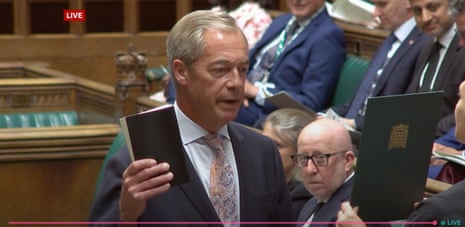
Farage takes seat in Commons after winning Clacton byelection
In the Commons Nigel Farage, the Reform UK leader, has been sworn in as MP for Clacton. He was MP for Clacton before the summer anyway, but he triggered a byelection as a protest about the inquiry into claims he broke Commons rules by not declaring a £5m donation from the cryptocurrency billionaire Christopher Harborne.
After he won the byelection in August, Farage gave an interview in which he said “maybe” he should have declared the donation after all – implying he does now accept the inquiry is justified. (But he is also angry about the inquiry being extended to include financial support he received from his friend George Cottrell that also wasn’t declared.)
From the start of this academic year student nurses, and other people doing healthcare courses in England, will get upfront payments to cover placement costs. That means they will get the money they need for travel and accommodation costs for clinical placements in advance, instead of having to claim the money back. The Department of Health and Social Care has a news release about this here.