1 month ago
Israel came under fire from Human Rights Watch for allegedly using white phosphorus weapons in a civilian area in Lebanon. The use of white phosphorous against civilians is banned under international law. Here are 10 weapons that are either restricted or outright banned in warfare.
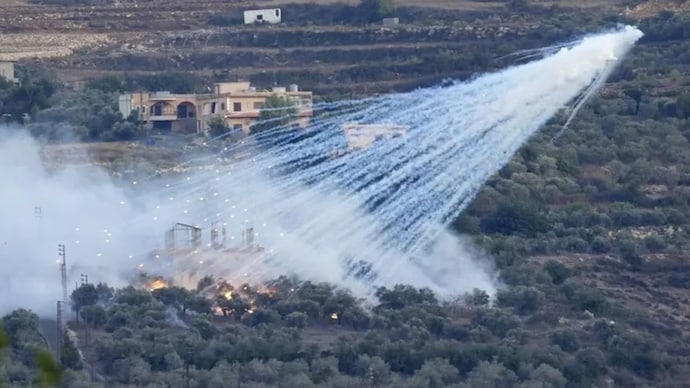
While weapons like white phosphorus muntions are legal to use in war, international law prohibits their use against civilian targets. (Image: File)
One of the most haunting images from any war is that of the Napalm Girl. The world-famous photo, taken by Associated Press photographer on June 8, 1972, shows a terrified group of children, including 9-year-old Kim Phuc, who had ripped off her burning clothes, while fleeing a napalm attack amid the Vietnam War. Napalm is one of the weapons that are banned for use in war.
We are talking about napalm because the Human Rights Watch (HRW), a non-profit watchdog group, accused Israel of firing white phosphorus munitions over homes in the southern Lebanon region earlier this month. Like napalm, the use of white phosphorus is also a violation of international laws as the use of such munitions is banned in civilian areas.
This is hardly the first time such allegations have been levelled against Israel, with the HRW and Amnesty having documented similar incidents across southern Lebanon and Gaza since October 2023.
White Phosphorus, a commonly used substance in warfare since the early 20th Century, is not a banned weapon, but its usage as an incendiary weapon in areas with civilian populations is banned due to the chemical's volatile nature and its ability to inflict life-threatening injuries.
It is, however, not the only weapon whose usage is regulated or outright banned by international conventions. Here is a list of 10 weapons that are banned in warfare due to the suffering they cause to combatants, and the risk they pose to civilian populations.
1. CHEMICAL WEAPONS
Chemical weapons are specialised munitions that use toxic chemicals to kill or injure humans. The Organisation for the Prohibition of Chemical Weapons defines them as any chemical compound or precursor capable of causing death, injury, temporary incapacitation or sensory irritation through its chemical action. These include nerve agents such as novichok and sarin, blister agents like mustard gas, and choking agents such as chlorine and phosgene.
Chemical weapons were first used on a large scale during World War One, causing an estimated 1.3 million casualties. Their production, use and stockpiling were later banned under the Chemical Weapons Convention of 1993, which also requires signatory states to destroy existing stockpiles.
Chemical weapons were extensively used by Saddam Hussain in the 1979-1989 Iran-Iraq war, and later against Kurds and Shia Muslims in Iraq itself. Under the leadership of Iraqi military officer Ali Hassan al-Majid, later nicknamed Chemical Ali, Saddam's Iraq produced large amounts of mustard gas and nerve agents like Tabun, Sarin and VX.
The most notorious Iraqi use of chemical weapons was during the Halabja massacre on March 16, 1988, where Iraqi forces attacked the town of Halabja in Iraqi Kurdistan with a mixture of mustard gas, tabun, sarin, and VX. The attack killed approximately 5,000 civilians and injured thousands more.
2. WHITE PHOSPHORUS MUNITIONS
White phosphorus munitions, as the name suggests, use white phosphorus, a highly reactive chemical that ignites on contact with air and can set fire to cloth, fuel, ammunition and other combustibles, while generating large amounts of smoke. They are widely used in modern warfare in the form of smoke grenades, tracer rounds and illumination shells, but can also function as incendiary weapons.
Their use for creating smoke screens and illumination is legal. However, Protocol III of the Convention on Certain Conventional Weapons, which was adopted in 1980, prohibits using incendiary white phosphorus weapons against civilians or military targets near civilian populations because of their ability to cause severe life-threatening injuries and uncontrollable fires.
Exposure to white phosphorous munitions can cause severe injuries which are notoriously difficult to treat. Since they ignite in the presence of oxygen, white phosphorus is difficult to extinguish, and fragments can burn through skin and tissue right down to the bone.
According to the World Health Organisation, first responders often have to use forceps to dig out fragments of still burning white phosphorous from the bodies of survivors, before attempting further treatment.
3. NAPALM
Napalm refers to a mixture of petrochemicals like petrol or diesel and various gelling agents, which make the original fuel more viscous, stick to surfaces easily, and burn for longer periods of time. Developed by the US in 1942, Napalm was used as an incendiary weapon by US forces in the Second World War, Korean War, and most infamously the Vietnam War, from which 'The Terror of War' photograph of the Napalm Girl emerged.
The substance is delivered to its targets in the form of air-dropped munitions, as well as flamethrowers used by infantry and vehicles. Although the use of napalm in warfare is not explicitly banned, Protocol III of the Convention of Certain Conventional Weapons explicitly bans their usage against civilian targets and military targets in proximity to civilian areas.
4. CLUSTER MUNITIONS
Cluster munitions are weapons that release dozens or hundreds of smaller explosive submunitions or bomblets over a wide area. They can be deployed by aircraft, missiles or artillery and are designed to cause maximum damage on targets spread out across a large area, such as airfields or troop formations.
The 2008 Convention on Cluster Munitions, or the Oslo Convention, explicitly bans the usage of these weapons due to the high risk posed to civilians by unexploded submunitions that are spread out over a wide area, and often fail to explode on initial usage, later injuring unsuspecting civilians.
5. ANTI-PERSONAL LANDMINES
Anti-personnel landmines are explosives designed to detonate when triggered by human contact, usually through pressure plates or tripwires. Unlike anti-tank mines, they are specifically meant to target people and are often designed to injure rather than kill, overwhelming enemy medical systems. They are often made out of non-ferrous substances like plastic and wood, making their detection and disposal harder.
Their production and use were banned under the Ottawa Treaty of 1997, because they continue to pose a danger to civilians long after conflicts end.
Landmines remain dangerous for years, even after the ending of hostilities. Undiscovered landmines were responsible for 1,945 deaths and 4,325 injuries (6,279 total casualties) in 2024, according to a report by Landmine Monitor. Princess Diana who played a prominent role in raising awareness about the need to ban anti-personnel mines, and support demining efforts.
6. EXPANDING BULLETS OR DUM DUM BULLETS
Expanding bullets, also known as soft-point bullets and Dum Dum bullets (due to them being first produced by the British at the Dum Dum Arsenal in India in 1896) refer to bullets designed to expand in diameter after hitting a target, causing more lethal injuries.
The use of expanding bullets in warfare against human targets was banned by The Hague Convention of 1899, but it continues to be used in other applications like hunting, law-enforcement and self-defence.
7. BIOLOGICAL WEAPONS
Biological weapons are munitions that utilise lethal pathogens and biotoxins as a weapon against human combatants. This includes the use of lethal bacteria, viruses, insects, and fungi with the intent to kill, harm or incapacitate humans, animals or plants as an act of war.
The 1972 Biological Weapons Convention, which has been signed by 183 countries across the world as of 2025, explicitly prohibits the development, development, production, acquisition, transfer, stockpiling and use of biological weapons.
8. BLINDING LASER WEAPON
Blinding laser weapons refer to directed-energy systems designed to cause permanent, irreversible vision loss to its targets. These systems damage the retina via concentrated heat, potentially rupturing blood vessels with intense light.
Although directed energy weapons are not banned and are now in vogue in armies across the world due to their use as anti-drone weapons, Protocol IV of the 1995 UN Protocol on Blinding Laser Weapons explicitly bans laser weapons designed to blind enemy combatants.
9. NON-DETECTABLE FRAGMENTATION WEAPONS
According to the Humanitarian Law Database, this refers to weapons which cause injuries by fragments/shrapnel made of materials like glass and plastic which are difficult if not impossible to detect with X-rays.
The use of such weapons was banned by Protocol I to the Convention on Certain Conventional Weapons, and their use is considered a war crime by several nations.
10. BOOBY TRAPS
Booby traps are explosive devices designed to detonate when disturbed by people. While some military uses are permitted, international law restricts their deployment.
Protocol II of the Convention on Certain Conventional Weapons prohibits disguising booby traps as everyday objects such as toys, food, medical supplies or electronic items because of the high risk they pose to civilians.
Before they were outlawed, weapons like these killed and injured hundreds of thousands of people worldwide, soldiers and civilians alike, and in the case of unexploded mines and cluster bombs, continue to do so. War inevitably claims lives, but banning such weapons seeks to limit casualties and suffering among civilian populations.
- Ends
Published By:
Shounak Sanyal
Published On:
Mar 10, 2026 16:30 IST