1 month ago
Pakistan is likely to acquire Shaanxi KJ-500, an Airborne Warning and Control System (AWACS) aircraft, from China. Negotiations started in June 2025. Just a month before that, India had shot down at least one AWACS aircraft of Pakistan in Operation Sindoor. AWACS is considered a major asset and force multiplier.
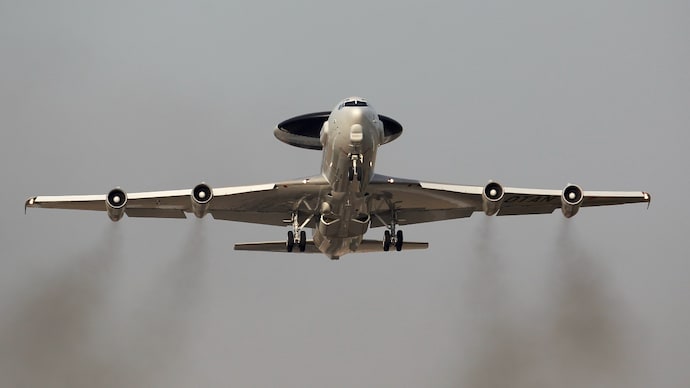
The AWACS aircraft Pakistan is set to acquire from China would enable its military to detect and track aircraft, missiles, and drones at extended ranges. (Image for representation: Reuters)

New Delhi,UPDATED: Apr 11, 2026 14:56 IST
Almost a year after Operation Sindoor, Pakistan seems to be still trying to recover from the damage caused by India. Pakistan is about to acquire China's Shaanxi KJ-500, an Airborne Warning and Control System (AWACS) aircraft. The shooting down of the AWACS aircraft was a big setback for Pakistan because it is considered a major strategic asset and a force multiplier.
The KJ-500 is a modern airborne early warning aircraft designed to detect, track, and coordinate responses against aerial threats over long distances. The initiative to get the KJ-500 aircraft forms part of a comprehensive defence package that China is providing to Pakistan, which also includes J-35A stealth fighters and HQ-19 air defence systems. The deal also includes advanced stealth, sensor fusion, and integration of HQ-19 systems to build a networked combat capability.
According to Pakistani media, officials from China and Pakistan began formal negotiations for the AWACS aircraft in June 2025.
The point to be noted here is that in August 2025, the chief of the Indian Air Force (IAF), Air Marshal Amar Preet Singh, said India had shot down six Pakistani aircraft, among which five were fighter jets and one reportedly an AWACS during Operation Sindoor in May 2025.
The new AWACS aircraft that Pakistan is buying from China can allow Pakistani officials to track aircraft, missiles, and drones much before coordinating interceptors as well as air defence missile batteries.
Earlier, Pakistan Air Force had the Saab Erieye-2000 AWACS aircraft, which, according to the Canada-based Eurasian Times, a Defence and Geopolitics news outlet, had been shot down by India. In addition, the Eurasian Times also claimed that Pakistan might have even lost a second Saab Erieye-2000 in an Indian missile strike on the Bholari Air Base, as acknowledged by PAF's ex-Air Marshal Masood Akhtar.
However, there was no official confirmation from the Pakistani side on losing its AWACS aircraft.
INDIA'S OP SINDOOR DAMAGE TO PAKISTAN AIR FORCE
India launched Operation Sindoor on the night of May 7 against nine terrorist locations across Pakistan. The operation was in retaliation against the Pahalgam terrorist attack that killed 26 in Jammu and Kashmir in April. "We struck a large number of their airfields, and we struck a large number of installations," said IAF's Air Chief Marshal.
He also said that Pakistan faced extreme losses from Indian strikes. "Radars in at least four places, command and control centres at two places, runways damaged at two places, then three of their hangars in three different stations have been damaged," Air Marshal Singh said.
He also highlighted that the IAF had evidence of Pakistan's one C-130 class of aircraft and at least four to five fighter aircraft, most likely F-16, destroyed.
The list did not end there. Air Marshal also claimed the IAF had destroyed one SAM system, and he claimed to have clear evidence of one long-range strike, more than 300 km, which happened to be either an AEW&C aircraft.
The push to acquire advanced AWACS platforms like the Shaanxi KJ-500 suggests an urgent attempt to rebuild surveillance and command capabilities that were either degraded or exposed during Operation Sindoor. If the acquisition goes through, it would not just be about replacing a lost asset, but about recalibrating Pakistan's air defence architecture with deeper Chinese integration. The tremors of Operation Sindoor are still resonating in Rawalpindi and Islamabad.
- Ends
Published By:
Avinash Kateel
Published On:
Apr 11, 2026 14:56 IST