
 4 weeks ago
A nuclear-powered tank with a 450-km railgun? Chinese researchers have mapped out a futuristic battlefield concept that could emerge after 2045.
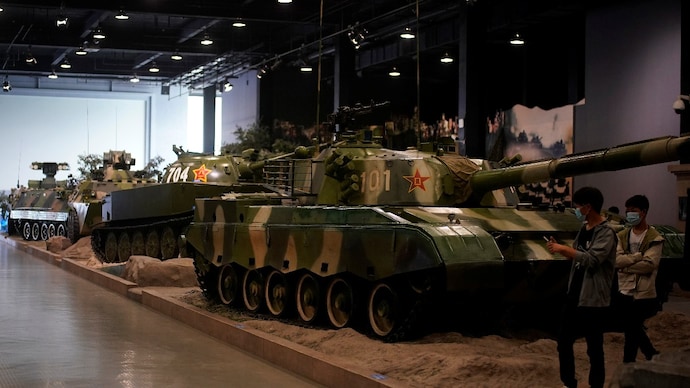
The first stage would focus on putting electromagnetic weapons on existing tank platforms. (File Photo: Reuters)

UPDATED: Sep 15, 2026 19:43 IST
A tank powered by a nuclear reactor and capable of firing at targets 450 km away may sound like science fiction. But Chinese military researchers have laid out a roadmap for building exactly that, with the futuristic war machine potentially entering the battlefield after 2045.
According to the South China Morning Post, Chinese researchers have outlined a concept for a 60-tonne main battle tank powered by a small modular nuclear reactor and armed with a 50-megajoule electromagnetic railgun. If the ambitious plan can overcome major engineering hurdles, such a vehicle could potentially emerge after 2045.
The proposal was detailed in a peer-reviewed paper published in June in the Chinese journal Acta Armamentarii. Researchers from Inner Mongolia First Machinery Group and the Beijing Institute of Technology were behind the study, reported the SCMP. Inner Mongolia First Machinery Group is part of China's defence industry and is closely linked to the development and production of tanks and armoured vehicles.
The research was funded by the Key Laboratory of Special Vehicle Design and Manufacturing Integration Technology through a special research project.
A TANK THAT COULD FIRE 450 KM
At the heart of the proposal is a 10-megawatt-class small modular reactor (SMR) that would provide power to the vehicle. The researchers envisage pairing it with an electromagnetic railgun.
The proposed weapon could theoretically launch projectiles at speeds of around 3.5 km per second, giving it a notional range of roughly 450 km (280 miles).
Putting that much energy into a weapon in a matter of milliseconds is a far bigger challenge than simply generating the energy. The researchers have therefore proposed a gradual development path rather than attempting to build the nuclear-powered tank immediately.
THREE-STAGE PLAN FOR FUTURE WARFARE
The first stage, planned for before 2035, would focus on putting electromagnetic weapons on existing tank platforms using relatively mature power systems, as per the report.
The concept at this stage involves a 60-tonne-class tank fitted with a 10 MJ electromagnetic gun with a range of about 150 km. It would also feature 2 MJ electromagnetic armour and a 1,500-horsepower diesel generator supported by hybrid energy storage using supercapacitors and flywheels.
The second stage, covering 2035 to 2045, would involve a substantial increase in both weapon power and onboard energy storage. The proposed tank would have a 20 MJ electromagnetic gun with a range of about 300 km, alongside 10 MJ active electromagnetic armour.
Power would come from a 2,000-horsepower diesel system, while around five tonnes of advanced energy storage would be carried onboard. The system could include solid-state batteries, superconducting storage and an intelligent microgrid. Only after 2045 would the researchers seek to make the leap to a fully nuclear-powered vehicle with the railgun.
THE NUCLEAR REACTOR IS THE BIGGEST HURDLE
Making such a tank work in the real world would be an enormous engineering challenge.
According to the proposal, the reactor would have to fit within just 2 cubic metres, while its radiation shielding could weigh no more than 3 tonnes. The system would also need a fuel replacement interval of at least five years.
The proposed reactor would be a 10 megawatt thermal lead-bismuth-cooled design. However, the researchers admitted that development remains largely at the simulation stage.
WHAT ARE MAJOR DRAWBACKS?
The idea also faces questions beyond engineering.
A veteran military equipment expert told SCMP that putting a fission reactor inside a tank would create a host of problems involving space, weight and survivability. The expert said the technology may be advancing, but adapting nuclear power for use in a tank remains highly impractical.
A nuclear-powered tank would need not only the reactor but also power-conversion systems, radiation shielding and equipment to manage heat. All of that would compete for limited space and weight alongside armour, weapons and crew protection.
The expert also questioned whether having effectively unlimited onboard energy would translate into a major battlefield advantage.
There is another problem: survivability.
With anti-tank missiles and drones becoming increasingly common, putting a nuclear reactor on a crewed combat vehicle could create an additional vulnerability if the tank were destroyed.
Such a vehicle could potentially serve as more than a conventional tank. For the time being, China's nuclear-powered railgun tank remains a futuristic concept rather than a battlefield reality.
- Ends
Published By:
Satyam Singh
Published On:
Sep 15, 2026 19:43 IST