1 month ago
High-resolution satellite imagery shows the permanent nature of new Chinese structures coming up close to the Pangong Tso buffer zone.
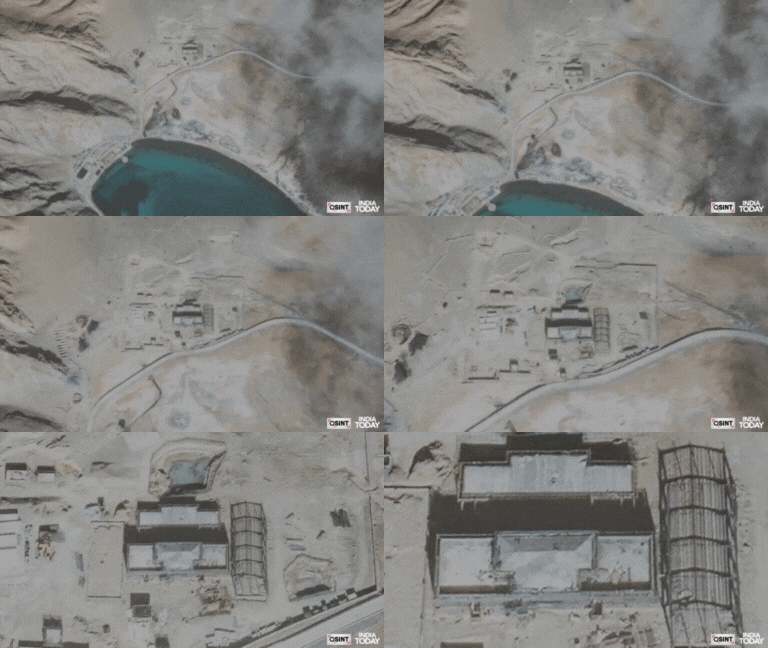
Satellite image dated 28 December 2025 shows a new permanent facility under construction near Eastern Ladakh. Satellite image ©2026 Vantor

New Delhi,UPDATED: Jan 6, 2026 16:16 IST
New high-resolution satellite imagery sourced by India Today shows China continuing to upgrade its permanent military presence in the disputed Eastern Ladakh region of Pangong Tso. China has controlled this position near the Sirijap post since the 1962 war, when it was lost from India’s control, though India continues to consider it part of its territory. The imagery clearly shows construction work on a new complex with multiple permanent structures coming up only meters away from the water body. This is significant as it could allow China's People’s Liberation Army (PLA) to station more resources closer to the current buffer zone.
China established a road network in this area in 2013, which was initially used by both sides for patrolling. However, since the May 2020 standoff, Indian patrols have not been allowed to operate here.
Since 2020, temporary structures have been used to accommodate troops, along with boats and a pier to support movement across the lake. Imagery from December 28 provided by space intelligence firm Vantor shows both the temporary accommodation and the new construction site. Boats seen near the pier in imagery collected on June 2 last year are now covered and parked away from the water, likely due to the anticipated freezing of the lake during winter.
The pace of construction at the site appears to have increased in the second half of 2025, with clearly visible building structures in the December imagery.
The past year witnessed a thaw in India-China relations, with Prime Minister Narendra Modi visiting China for the SCO summit after seven years and the resumption of direct flights between the two countries. While both sides have managed to “disengage” from all friction points in Eastern Ladakh, a term used to describe a relatively relaxed posture from the earlier eyeball-to-eyeball deployments, questions remain about China’s true intentions and its future approach along the border even as diplomatic and commercial ties improve.
“China’s latest construction effort at the contested Pangong Lake aligns with Beijing’s established pattern of building fixed infrastructure to convert presence into control. The likely military-linked project sits just outside the 2020 disengagement zone and improves China’s ability to sustain year-round operations, including under adverse weather conditions,” said Damien Symon, a geospatial researcher with The Intel Lab, who first observed these developments using low-resolution imagery, while speaking to India Today. “Although the development is located in territory currently held by China, it lies within the broader area claimed and disputed by India. Such construction reinforces Chinese sovereignty in disputed areas, directly undermining India’s position and signaling long-term entrenchment,” he added.
An earlier India Today report, based on satellite imagery, showed China establishing new air defence sites with covered and retractable roofs for Transporter Erector Launcher (TEL) vehicles capable of carrying, elevating and firing missiles.
Just beyond the disputed area, China has also been constructing another large settlement, which many believe could be a dual-use facility.
According to the Ministry of External Affairs (MEA), until October 2024, India and China engaged to resolve disengagement-related issues along the Line of Actual Control through the Working Mechanism for Consultation and Coordination (WMCC) and Senior High-Level Military Commanders (SHMC) meetings. Since the disengagement in 2024, apart from these mechanisms, both sides have held several other meetings “to stabilise and rebuild ties, with priority on people-centric engagements including the Kailash Mansarovar Yatra, direct flight connectivity, transboundary rivers, and activities to commemorate the 75th anniversary of the establishment of diplomatic relations.”
- Ends
Published On:
Jan 6, 2026