1 month ago
Pakistan is fighting three separate "wars" at once, in three provinces, against three armed and unarmed actors it has spent years refusing to address on their own terms.
Representative image generated using AI
Khyber Pakhtunkhwa faces a resurgent Tehreek-e-Taliban Pakistan (TTP) since the US withdrawal and Taliban takeover of Afghanistan in 2021. Balochistan faces a sophisticated Baloch Liberation Army (BLA) since 2022. Pakistan-occupied Jammu and Kashmir (PoJK) faces a banned civil rights coalition, the Jammu Kashmir Joint Awami Action Committee (JAAC), whose protests have sustained through 2025 and have curdled into open unrest.
Each conflict began separately, years apart, over entirely different grievances. By mid-2026, all three are running simultaneously, and Islamabad's response to each has followed the same pattern: deny the root cause, blame an external hand, and reach for force.
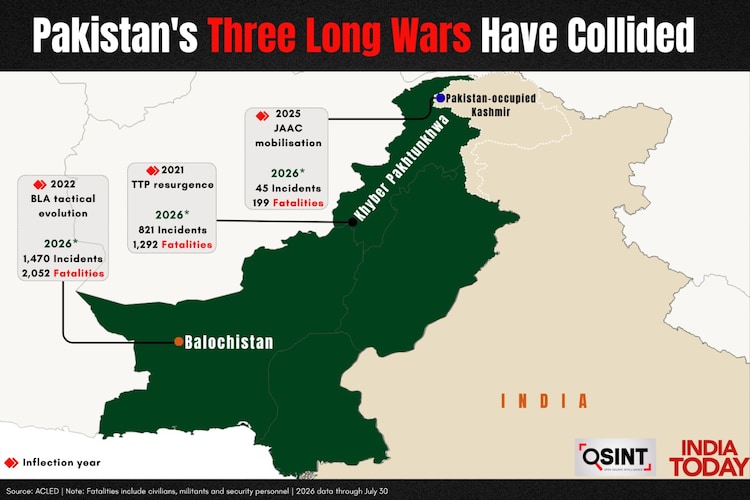
India Today's Open Source Intelligence (OSINT) team's analysis, based on ACLED conflict data and official documents, government statements, policy papers, and publicly available records, identified 12,889 recorded conflict events and 17,105 reported fatalities across the three regions between January 2020 and July 30, 2026.
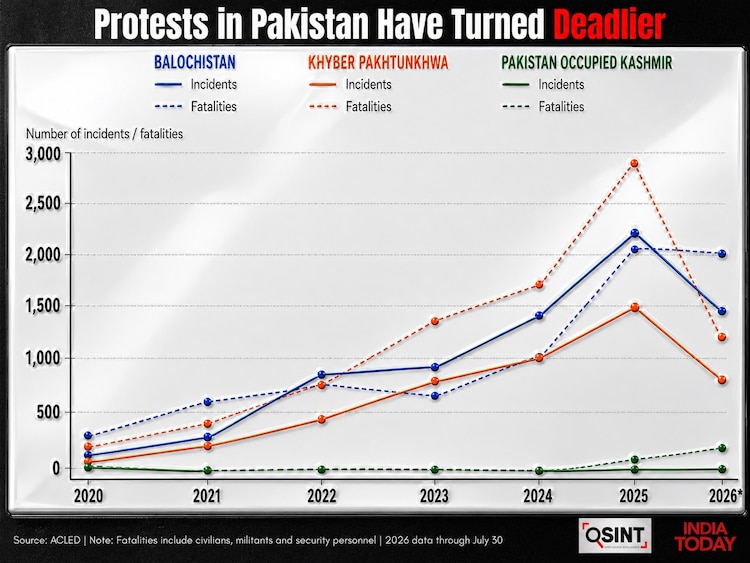
The real story is not the protest itself but what changed after the 2021, 2022, and 2025 inflection points was not just the number of incidents, but their lethality. In Khyber Pakhtunkhwa, incidents rose from 316 in 2021 to 1,497 in 2025, while fatalities climbed from 598 to 2,421, a 305% increase. In Balochistan, incidents increased from 867 in 2022 to 2,191 in 2025, but fatalities rose from 815 to 2,504, a 207% increase. The sharpest shift came in Pakistan-occupied Jammu and Kashmir, where fatalities jumped from 5 in 2024 to 60 in 2025, before reaching 199 by July 30, 2026 alone, a 232% increase over the whole of 2025, despite 20% fewer recorded incidents (45 versus 56). The data suggests these conflicts are no longer just expanding in scale; they are becoming progressively deadlier.
Pakistan's own military confirms the scale of the fight. Local media, quoting DG ISPR Lieutenant General Ahmed Sharif Chaudhry, said security forces had conducted "40,348 intelligence-based operations" so far in 2026, or "nearly 194 operations every day", killing 2,084 militants while losing 819 personnel and civilians, including 303 soldiers. He said Pakistan recorded 28 suicide bombings this year and claimed, "The majority of the suicide bombers were Afghan nationals."
KHYBER PAKHTUNKHWA: TTP RETURNS
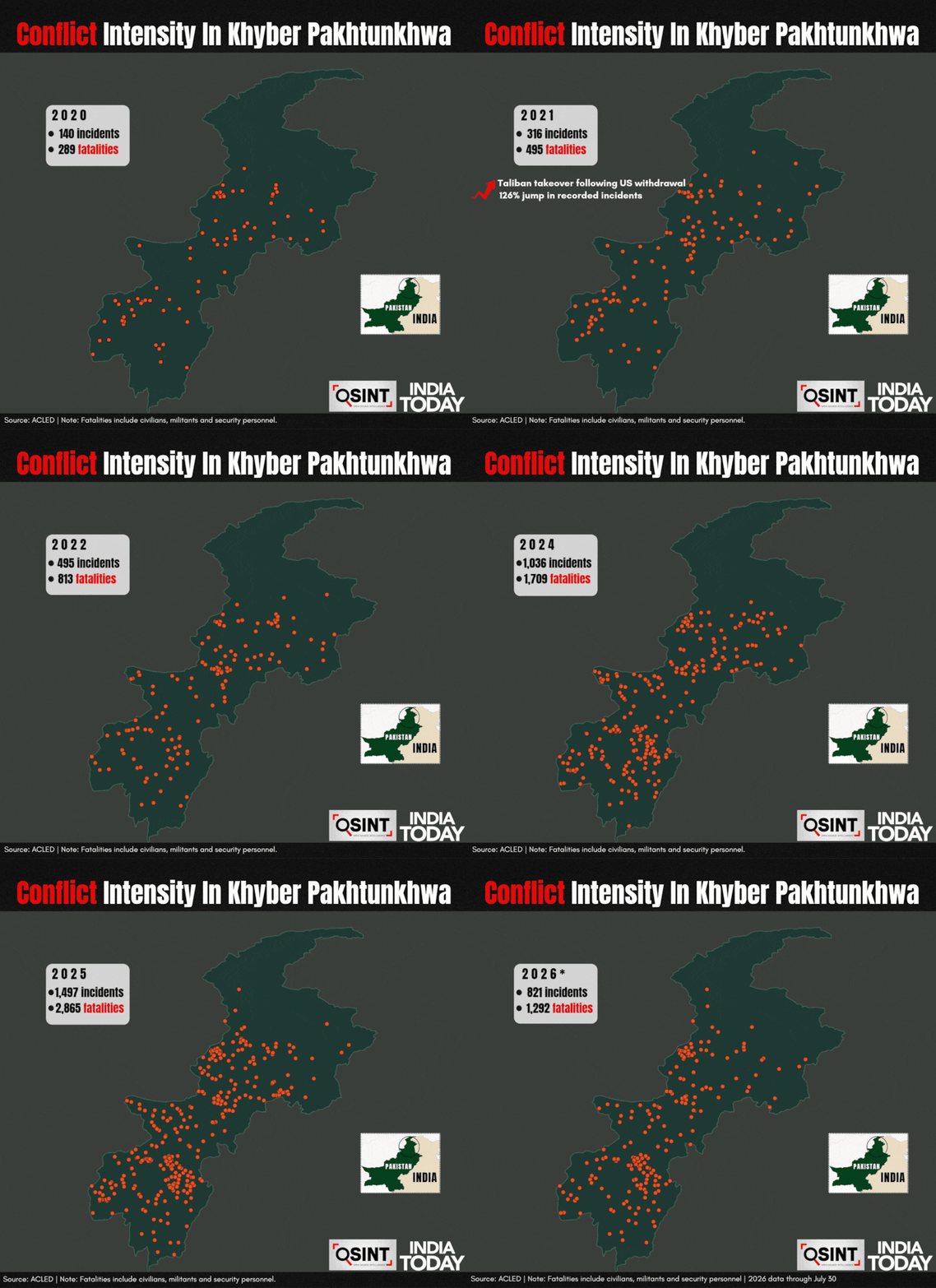
Khyber Pakhtunkhwa marked the first major inflection point in Pakistan's three-front internal security crisis. Conflict incidents surged 126% year on year in 2021, from 140 to 316, following the Taliban's return to power in Afghanistan. Between 2020 and July 30, 2026, the province recorded 5,180 incidents and 8,809 reported fatalities, the highest death toll among Pakistan's three conflict theatres.
The Carnegie Endowment for Peace, in its paper, says that TTP’s "armed struggle aims to establish an Islamic political system in Pakistan based on the group's interpretation of sharia."
The group's rise also reflects Pakistan's own security policies. Carnegie notes that many militants who later formed the TTP had previously fought "on behalf of the Pakistani government in Afghanistan and in Indian Kashmir" before turning against Islamabad after Pakistan joined the US-led war on terror.
The Taliban's return to Kabul accelerated that trajectory. ACLED found the TTP's "remarkable resurgence has coincided with, and benefited from, the return of its ideological namesake... in Afghanistan in 2021." Incidents peaked at 1,497 in 2025.
Islamabad responded by rebranding the TTP as "Fitna al-Khawarij" in official communication. But the MP-IDSA said the move would "neither delegitimise TTP nor diminish the threat it poses," calling it a symptom of "the desperation of the Pakistani state in its dealing with the TTP."
BALOCHISTAN: THE LONGEST REBELLION
Balochistan marked the second major inflection point in Pakistan's three-front internal security crisis. Conflict incidents surged 140% year on year in 2022, from 361 to 867, as the Baloch Liberation Army (BLA) entered a more coordinated and sophisticated phase. Between 2020 and July 30, 2026, the province recorded 7,425 conflict events and 7,880 reported fatalities, the highest number of incidents among Pakistan's three conflict theatres.
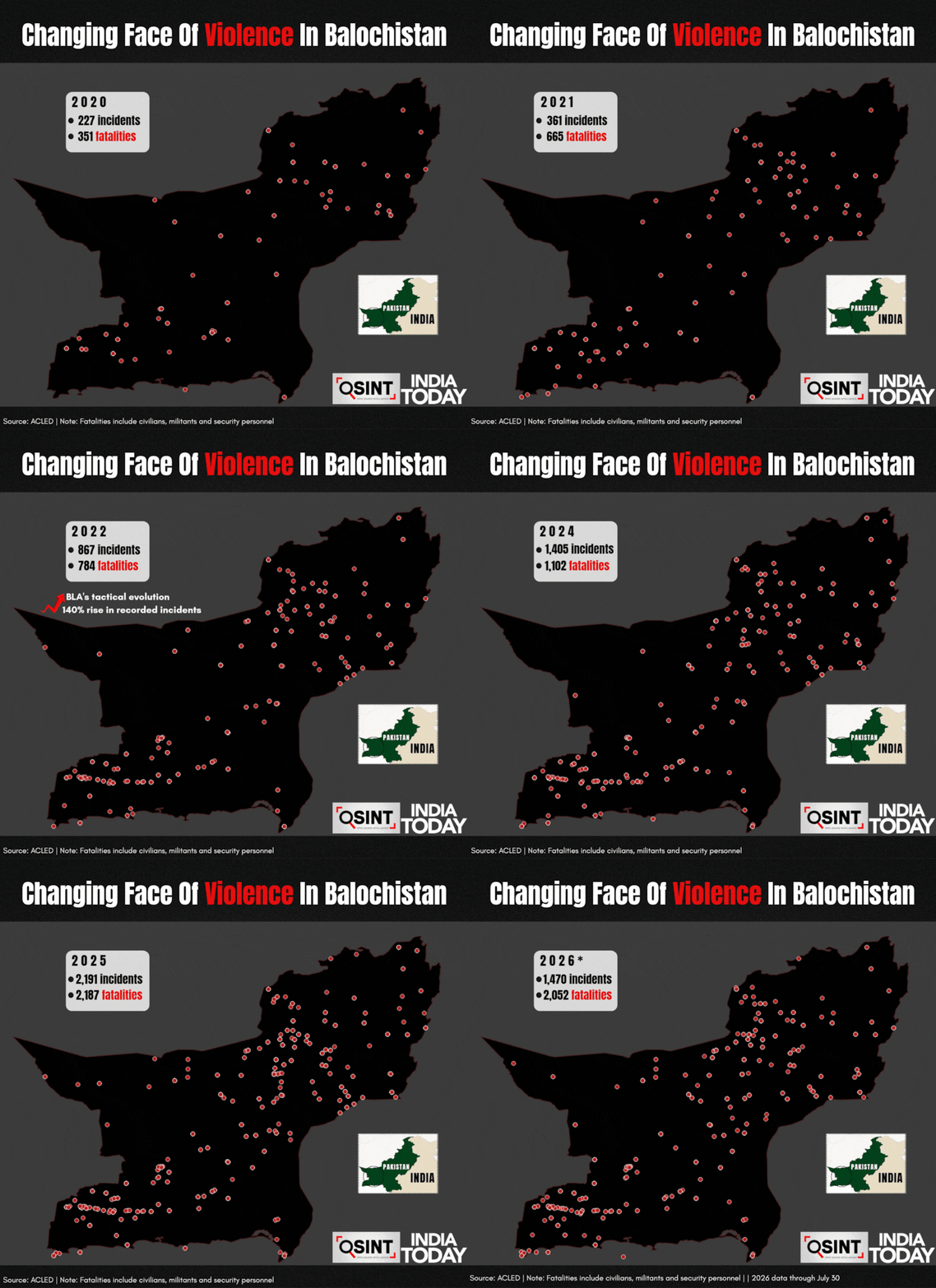
The BLA frames its insurgency as resistance against what it calls “Islamabad's exploitation of Balochistan's vast natural resources” while the province remains among Pakistan's least developed. The China-Pakistan Economic Corridor (CPEC) deepened those grievances, with the group repeatedly targeting Chinese nationals, infrastructure and the Gwadar port project.
The deeper driver, however, remains enforced disappearances. Pakistan's Commission of Inquiry on Enforced Disappearances itself has registered 2,752 cases, while Baloch rights groups estimate the number exceeds 7,000. Human Rights Watch has "condemned Pakistani security forces for committing 'serious human rights violations,' including arbitrary arrests and extrajudicial executions."
Yet even as Baloch grievances over resource extraction, political marginalisation and enforced disappearances intensified, Islamabad continued opening the province's mineral wealth to foreign investors instead of addressing the underlying drivers of the insurgency. In 2025, Pakistan approved the updated feasibility study for the Reko Diq copper and gold project and appointed US-based Fluor as the lead Engineering, Procurement and Construction Management (EPCM) partner. Barrick described Reko Diq as "one of the world's largest undeveloped copper-gold projects" and said the project would "advance with major works in 2025," reflecting Islamabad's continued push to unlock Balochistan's strategic mineral reserves despite the deteriorating security environment.
That approach has failed to contain the insurgency. Georgetown University's Journal of Affairs says that "collective punishment, forced disappearances, and extrajudicial killings have deepened resentment and, paradoxically, fostered greater unity among disparate Baloch factions." The trend is reflected in the data. Conflict incidents rose from 867 in 2022 to 2,191 in 2025, as Pakistan intensified military operations.
PAKISTAN-OCCUPIED JAMMU AND KASHMIR: NO PLACE FOR DISSENT
Unlike Khyber Pakhtunkhwa and Balochistan, Pakistan-occupied Jammu and Kashmir is not witnessing an armed insurgency. It is confronting a prolonged civil-rights movement led by the Jammu Kashmir Joint Awami Action Committee (JAAC). Conflict incidents remained comparatively low, but the violence turned markedly deadlier. Fatalities surged 1,100% year on year in 2025, while 2026 recorded 45 incidents and 199 reported fatalities through July 30, despite 20% fewer incidents than the previous year.
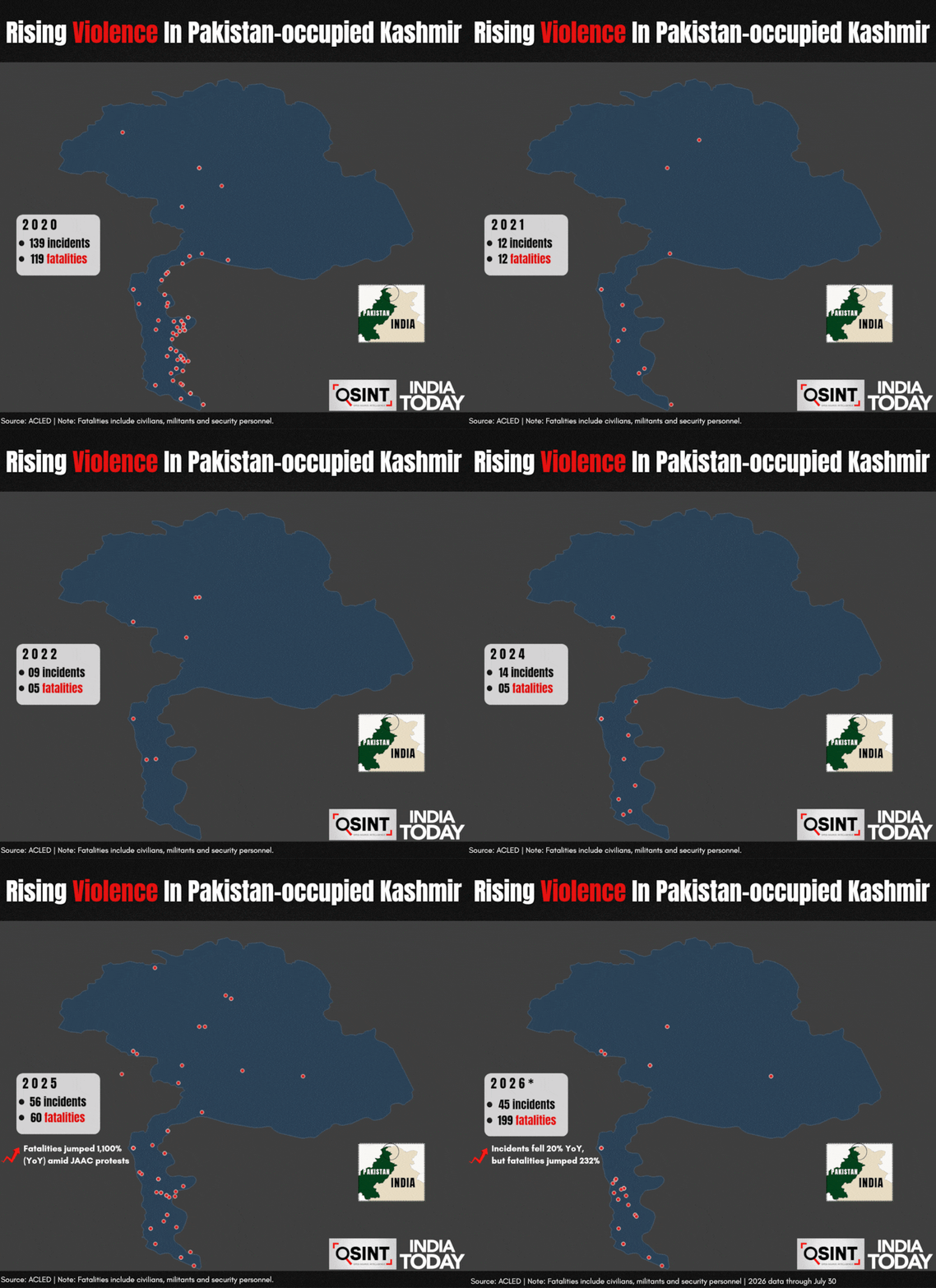
JAAC, which describes itself as “a coalition of traders, lawyers, students and civil society groups,” emerged as it demanded subsidised flour, electricity priced at local hydropower rates, and governance reforms. Its 38-point charter also called for ending what it described as "ruling elite privileges" and abolishing reserved assembly seats for refugees from Indian-administered Kashmir.
The unrest began over rising electricity tariffs and flour prices in 2023 before escalating during the 2024 Muzaffarabad march. The violence continued, with fatalities rising from five in 2024 to 60 in 2025 and 199 already in 2026.
Rather than negotiate, Islamabad increasingly framed the protests through a security lens. Pakistan's Defence Minister Khawaja Asif described the protesters as "enemies like India" while denying any talks with them.
India has criticised that approach. MEA spokesperson Randhir Jaiswal said Pakistan's establishment had "continue[d] to unleash ruthless force against peaceful civilians in Pakistan-occupied Jammu and Kashmir," accusing it of responding to political dissent with repression instead of addressing public grievances. He said the crackdown reflected the establishment's "absolute disdain" for the people of PoJK and urged the international community to hold Pakistan "accountable for its atrocities."
Amnesty also rejected Islamabad's justification. "The ban cannot be used as an excuse to mete out deadly violence against protesters," it said, urging Pakistan to "lift the ban on this protest movement and stop weaponising anti-terror laws to silence and arbitrarily detain JAAC members and supporters."
- Ends
Published By:
bidisha saha
Published On:
Aug 4, 2026 18:45 IST