1 month ago
Deal or no deal, US President Donald Trump's shifting rhetoric around the Iran peace deal kept markets, oil prices and investors reacting constantly, while the uncertainty itself increasingly appeared to be working in his favour.
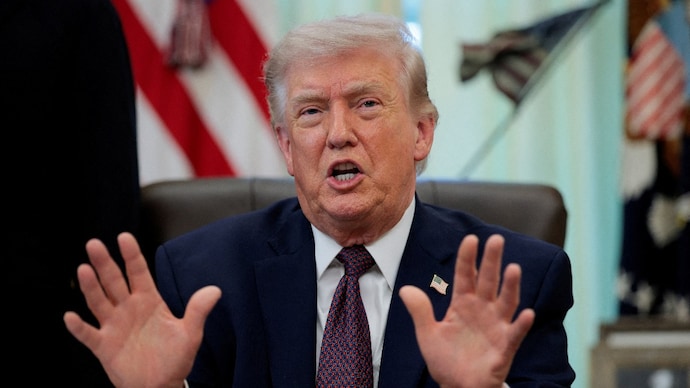
US President Donald Trump (Photo: Reuters)

New Delhi,UPDATED: May 25, 2026 11:22 IST
US President Donald Trump recently said a peace deal with Iran was close. He then went on to say there was “no rush” to finalise one.
In a span of barely 24 hours, the US President first declared that an agreement with Tehran had been “largely negotiated”, triggering a rally across global markets, before later insisting restrictions linked to the conflict would remain until Iran fully complied with American conditions.
So which is it, deal or no deal? Nobody really knows, and this uncertainty has become a defining feature of the West Asia conflict, with Trump shifting the goalposts almost daily.
While there's nothing new about the US president changing his statements, there is another layer to the story that most people are missing: how his statements are moving markets. Because every shift in Trump’s rhetoric is having an impact on oil, stocks and investor sentiment in real time.
According to news agency Reuters, the latest proposed Iran framework could reopen the Strait of Hormuz, one of the world’s most critical oil routes, while restarting negotiations around Tehran’s nuclear programme.
Markets reacted immediately with a strong rally. Oil prices fell sharply after Trump suggested a breakthrough was near, as traders bet disruptions around one of the world’s most critical oil shipping routes could finally begin easing.
Asian markets climbed as investors interpreted the comments as a sign that the conflict may be moving toward de-escalation.
Then Trump changed the tone again.
Hours later, Trump changed the tone again, saying there was “no rush” to finalise the agreement and stressing that restrictions linked to the conflict would remain in place until Iran fully complied with US conditions.
That swing between optimism and caution increasingly became a defining feature of Trump’s geopolitical messaging. And Wall Street has reacted every single time.
MOVING MARKETS, NOT DEALS
In recent weeks, financial analysts and ethics experts in the US have started raising broader questions about how Trump’s statements on tariffs, trade wars and geopolitical conflicts repeatedly created major swings across markets.
The scrutiny intensified after reports highlighted profits linked to Trump-associated trades during periods of heightened volatility. A report earlier this month cited growing concern among Wall Street experts over perceptions of conflicts of interest and the possibility of political messaging influencing financial markets.
There was no evidence of insider trading or illegal activity. But the broader concern became harder to ignore.
At various points over the past several weeks, Trump projected confidence that negotiations were nearing a breakthrough, hinted at harsher military pressure if talks failed, warned Tehran against “testing” the United States and simultaneously insisted diplomacy remained the preferred path forward.
The negotiations themselves were undeniably serious.
The discussions involved sanctions relief, maritime security, Iran’s nuclear programme and future access through the Strait of Hormuz, the narrow waterway that carries a major share of the world’s oil and liquefied natural gas supplies.
But despite Trump repeatedly suggesting a deal was near, several major disagreements remained unresolved.
THE IRAN REALITY CHECK
One of the biggest sticking points continued to be Iran’s enriched uranium stockpile.
Trump and senior US officials insisted Tehran could not retain material Washington believed could eventually support nuclear weapons capability. Secretary of State Marco Rubio recently described the negotiations as “significant progress, although not final progress”, a noticeably more restrained assessment than Trump’s repeated declarations that an agreement could arrive soon.
Iran, meanwhile, said the US narrative was moving much faster than reality. A senior Iranian source told news agency Reuters that Tehran had not agreed to hand over its enriched uranium stockpile, directly contradicting assumptions emerging from parts of the US narrative around the negotiations.
Iranian-linked media outlets also publicly disputed Trump’s repeated claims that the framework was nearly complete. After Trump described the agreement as “largely negotiated”, Iran’s Fars News Agency pushed back sharply, calling parts of the US narrative “inconsistent with reality”.
That widening gap between rhetoric and reality became one of the defining features of the negotiations.
At times, the Trump administration’s Iran strategy appeared to operate in two parallel modes simultaneously: one projecting imminent peace, the other warning that the process remained fragile and incomplete.
TRUMP’S ART OF STRATEGIC CHAOS
Like his diplomacy with North Korea during his first term, Trump’s Iran strategy increasingly resembled a rolling public negotiation where threats, optimism and uncertainty were all deployed together, often within the same news cycle.
One moment, a breakthrough appeared close. Hours later, the tone shifted again.
Supporters argued the unpredictability created leverage and kept adversaries off balance. Critics argued it created confusion, especially when every presidential statement appeared capable of moving oil prices, equities and broader investor sentiment almost instantly.
That scrutiny intensified after reports around Trump-linked trading gains during recent periods of market volatility triggered fresh debate on Wall Street over conflicts of interest and the growing overlap between political messaging and market movement.
There was no evidence of insider trading or illegal activity.
But deal or no deal, Trump increasingly appeared to be benefiting from the volatility surrounding the negotiations.
Every shift in tone moved markets. Oil prices swung, stocks reacted and investors scrambled to reposition themselves after every new headline from Washington.
The uncertainty kept Iran guessing, kept markets moving and kept global attention fixed on Trump’s next statement.
One moment, peace appeared close. The next, the goalposts shifted again.
And while the Iran deal itself remained uncertain, the market reaction around Trump never really slowed down.
- Ends
Published By:
Koustav Das
Published On:
May 25, 2026 11:22 IST