3 weeks ago
Last Updated:January 17, 2026, 15:54 IST
Scientists discovered 7 mummified cheetahs and 54 skeletons near Arar, Saudi Arabia, dating back up to 1800 years, offering unprecedented insights into ancient cheetah populations.

Scientists discovered 7 mummified cheetahs and 54 skeletons near Arar, Saudi Arabia, dating back up to 1800 years, offering unprecedented insights into ancient cheetah populations. (Ahmed Boug/Communications Earth and Environment via AP)
Scientists have uncovered the naturally mummified remains of cheetahs in caves in northern Saudi Arabia, an extraordinarily rare find, as reported by the Associated Press.
The discovery includes seven cheetah mummies and the skeletal remains of 54 other cheetahs at a cave site near Arar. Radiocarbon dating indicates the animals lived between about 130 and more than 1,800 years ago.
Mummification, which slows decay and preserves bodies after death, is most famously associated with ancient Egypt. But it can also occur naturally under specific conditions—such as in deserts, glaciers or bogs. In this case, scientists believe the caves’ dry air and stable temperatures played a key role in preserving the cheetahs.
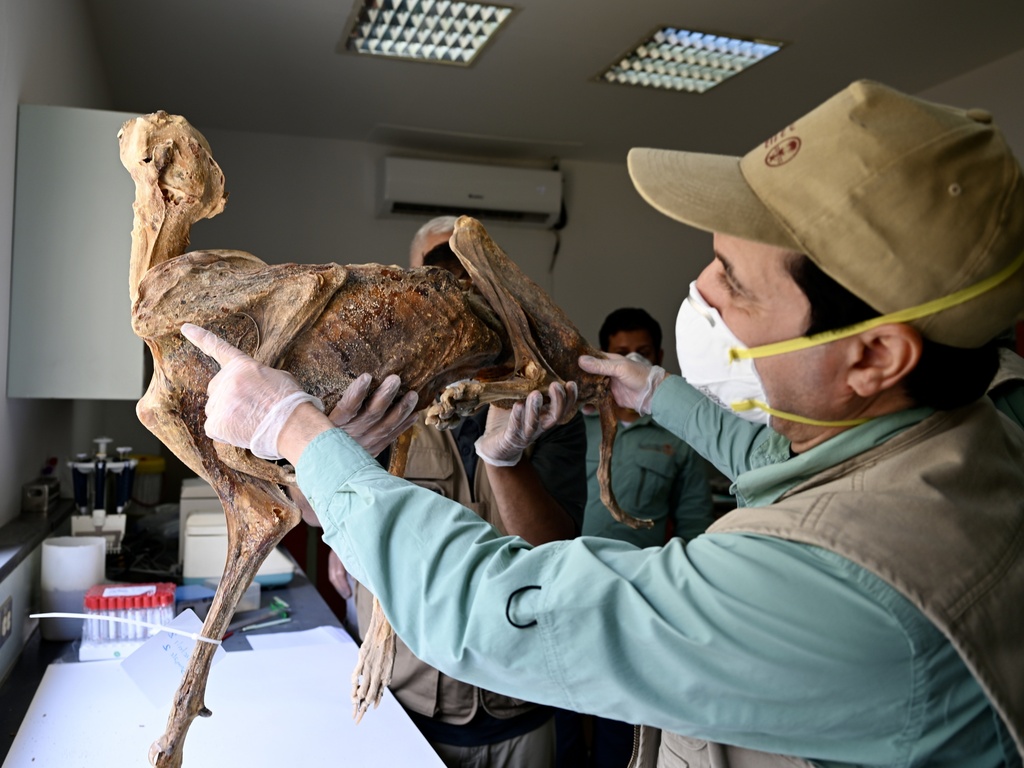
The mummified animals show cloudy eyes and shrunken limbs, giving them the appearance of dried husks. “It’s something that I’ve never seen before," said Joan Madurell-Malapeira of the University of Florence, who was not involved in the research.
Exactly how the cheetahs became so well preserved remains uncertain. Researchers suggest that, besides the favourable environment, the bodies may have been protected from scavengers such as birds and hyenas are an essential factor in preserving large animals, which are rarely found in such an intact condition.
The findings, published Thursday in the journal Communications Earth and Environment, are described as unprecedented for the region. “To find such intact evidence of cheetahs that lived long ago in this part of the world is entirely without precedent," said study author Ahmed Boug of Saudi Arabia’s Center for Wildlife, in an email.
Cheetahs once ranged widely across Africa and parts of Asia. Today, they occupy only about 9% of their historical range and have not been seen in the Arabian Peninsula for decades. Scientists cite habitat loss, hunting and declining prey as the main causes of their disappearance.
For the first time, researchers were also able to analyse DNA from naturally mummified large cats. Genetic tests showed the ancient cheetahs were most closely related to modern populations in Asia and northwest Africa insights that could inform future conservation and possible reintroduction efforts in regions where cheetahs have long vanished.
First Published:
January 17, 2026, 15:54 IST
News world ‘Entirely Without Precedent’: In A First, Mummified Cheetahs Found In Saudi Caves
Disclaimer: Comments reflect users’ views, not News18’s. Please keep discussions respectful and constructive. Abusive, defamatory, or illegal comments will be removed. News18 may disable any comment at its discretion. By posting, you agree to our Terms of Use and Privacy Policy.
Read More