4 weeks ago
US President Donald Trump's constant threats of annexing Greenland have finally moved Europe to send a military team to the island. Though termed a reconnaissance mission, the commitment of just 37 personnel amid Trump threats might reveal Europe's military seriousness. Is Europe capable of resisting armed aggression without help from the US?
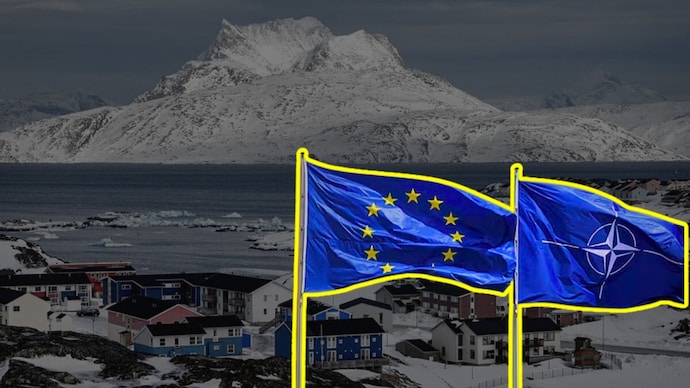
Trump's sabre-rattling on Greenland has demonstrated Europe's unpreparedness to counter large-scale armed aggression. (Image for Representation: File)
Greenland is where the West's frosty ties are turning into an internecine feud. Europe is taking a united stand against US President Donald Trump's threats of Greenland's "acquisition". Major European powers are backing Denmark's control over Greenland, and revealing their resolve by committing troops. The numbers are awe-inspiring. The UK is sending one military officer, the Netherlands is matching that number, and Finland and Sweden are sending two personnel each.
For now, European countries are calling it a "reconnaissance mission", which involves the UK, Germany, Sweden, Norway, Finland, and the Netherlands. Nato countries Poland, Italy and Turkey have turned down the request to send military personnel to Greenland.
Now, that's Nato for you, minus the US. And that is why Trump has been goading the US's European allies all this while to commit more money, commit more forces. The number of troops being committed to Greenland's defence reveals Europe's military seriousness. It was only after the Russia-Ukraine war that some of the NATO countries started bolstering their military capabilities.
Trump says Greenland is strategic to American security interests, claiming increased Chinese and Russian ships near the territory. Denmark's Arctic commander said there was no Russian or Chinese ship near Greenland.
Meanwhile, the US-Europe standoff over Greenland took a trade and tariff turn. Trump imposed 10% tariffs on European countries, including Denmark, Norway, Sweden, France, Germany, the UK, the Netherlands and Finland. He warned the tariffs would rise to 25% from June 1. Countering Trump's move, the European Parliament paused a landmark transatlantic trade pact that was signed in July.
Denmark's Arctic commander, Major General Soren Andersen, ruled out an armed confrontation among Nato allies, calling such a scenario "hypothetical", according to Reuters. "I don't see a Nato ally attacking another NATO ally," he said.
But talking of the European commitment to defend Greenland, what steps have the European nations taken? And is Europe, or more appropriately, the Nato alliance, bereft of its strongest contributor — the US — capable of standing up to armed aggression?
SO WHAT HAS NATO MINUS THE US CONTRIBUTED TO DEFENDING GREENLAND?
The current deployment of European troops to Greenland is taking place as part of Operation Arctic Endurance, a Nato military exercise led by Denmark, but without the presence of the alliance's largest contributor, the US.
The operation was announced in the wake of escalating pressure by the Trump administration over the status of Greenland, an autonomous territory of Denmark, with US President Donald Trump claiming that it's enough for Greenland to be under the sovereignty of a Nato ally, advocating instead for outright United States ownership of Greenland, in order to ward of perceived Russian and Chinese threats.
As for the purpose of Operation Arctic Endurance, Danish Defence Minister Troels Lund Poulsen, was reported by Politico as saying, "Security in the Arctic is of crucial importance to the Kingdom and our Arctic allies, and it is therefore important that we, in close cooperation with allies, further strengthen our ability to operate in the region," and, "The Danish Defence Forces, together with several Arctic and European allies, will explore in the coming weeks how an increased presence and exercise activity in the Arctic can be implemented."
So it can be concluded that Arctic Endurance is for all intents a military exercise to probe the feasibility of future military deployments by European nations.
As for what kind of troops have been deployed to Greenland so far, Denmark has been the largest contributor. The country already has around 150 troops stationed in Greenland under the command of its Joint Arctic Command.
Alongside the regular troops, there is also the elite 14-member Sirius Dog Sled Patrol, which conducts long-range reconnaissance patrolling and enforcing Danish sovereignty in the Arctic wilderness of northern and eastern Greenland.
Their equipment, however, consisting of M1917 Enfield bolt action rifles renders them unsuitable for military action. In addition, the Danish Air Force has also contributed a number of C-130 Hercules transport aircraft to assist in deploying the other European troops.
Alongside Denmark, France, as reported by BFM TV, sent a contingent of 15 soldiers drawn from its 27th Mountain Infantry Brigade, with French President Emmanuel Macron stating that "an initial team of French soldiers is already on site and will be reinforced in the coming days by land, air and sea assets."
Germany contributed a contingent of 13 soldiers as part of a reconnaissance team drawn from the Bundeswehr, the German Armed Forces, as reported by the German newspaper, Bild. The Norwegian defence minister, Tore Sandvik confirmed to Norwegian newspaper Verdens Gang that the country had dispatched two military personnel to take part in Arctic Endurance.
Similarly, the Netherlands and Finland have also dispatched two soldiers each to take part in the operation, with Dutch defence minister Ruben Brekelmans stating to Dutch broadcaster NOS that more personnel would likely be sent to Greenland on a short-term basis. Meanwhile, the UK has sent one military officer to Greenland, at Denmark's request. Sweden also dispatched a number of troops as announced by its Prime Minister Ulf Kristersson on X, although the number remains unspecified.
This brings the total number of European troops deployed to Greenland's defence, apart from the Danish troops already stationed there, to an awe-inspiring estimated 37.
Poland, Turkey and Italy, which field some of the most powerful militaries in Nato, have abstained from deploying troops to Greenland. The Polish media outlet Wirtualna Polska reported that in a press conference, Prime Minister Donald Tusk stated that Poland would not send troops to Greenland. Similarly, Italy also refused, with Italian magazine Panorama reporting the country's defence minister, Guido Crosetto, as saying that the overall operation was "irrational" and similar to some kind of "joke".
IS EUROPE UP TO THE TASK OF DEFENDING GREENLAND, AND ITSELF?
Operation Arctic Endurance is not aimed at defending Greenland but serves as a reconnaissance mission to assess the feasibility of larger troop deployments if needed in the future. According to the Danish Armed Forces, it involves exercise activities to enhance military presence with allies, focusing on Arctic operations and security.
Larger deployments would fall under Operation Arctic Sentry, a proposed Nato mission to boost surveillance and deterrence around Greenland. It remains in discussions, with German Defence Minister Boris Pistorius noting it could be "months away" due to Arctic challenges and limited experienced troops, as reported by Radio Free Europe/Radio Liberty.
That said, is Europe, or Nato minus the US, capable of defending its sovereignty against armed aggression? Post-Cold War, European militaries slashed budgets, assuming no large wars in the future and relying on US military prowess. According to the Strategic Studies Institute, spending cuts from the Cold War's end until Russia's 2014 Ukraine invasion reduced Europe's military capacities.
This complacency persisted despite US demands during Trump's first administration for Nato allies to meet spending targets. According to BBC News, Trump urged allies to pay their fair share in 2017. The continent was rudely awakened when Russia's 2022 invasion of Ukraine, which exposed its unpreparedness for long attritional wars without US aid, as Trump's administration signalled disinterest in European defence.
According to a study by the German Council on Foreign Relations, Europe would struggle to deploy even 50,000 troops in the event of a war. Meanwhile, according to multiple media reports, Ukraine and Russia have deployed at least half a million troops each.
Europe, as a whole, is waking up and pouring resources on military modernisation. In 2025, France pledged an additional 6.5 billion euros over two years, doubling the defence budget to 64 billion euros by 2027. This equates to 2.3% of the French GDP in 2025, rising to 3% by 2027. Poland is modernising its forces for potential Russian conflict, planning a 500,000-strong army by 2039. According to TVP World, it aims for 5% GDP defence spending in 2026.
Finland has been maintaining high military preparedness since WWII, with 280,000 wartime troops and 900,000 reserves. According to PubAffairs Bruxelles, it spends 2.1% of its GDP on defence. Germany is expanding the Bundeswehr via increased budgets and selective conscription from 2026. According to War on the Rocks, it targets 260,000 active troops by 2035.
Yet, Europe remains incapable of independent defence against continental threats. According to Reuters, the US has set a 2027 deadline for Europe to lead Nato's conventional capabilities, with the Institute for Strategic Studies estimating at least $1 trillion would have to be spent to replace US capabilities.
"Europe must prepare for the worst-case scenario, where the security architecture of the whole continent will be reshaped..." said Finland-based military analyst Emil Kastehelmis on X. "I hope Europe won't end up thinking that the current problems will go away by waiting a few years and wishing for a more positive administration next time. It is not just about Trump, it's the mindset, where the old security structures no longer have the same value as before," he added.
"Si vis pacem, para bellum" is a Latin adage often attributed to a writer within the Roman Empire to describe the empire's military stance. It roughly translates to: If you want peace, prepare for war. However, for many of the nations that now comprise the vast lands of that ancient empire, it seems this lesson might have been learnt only too late. It could be a reconnaissance mission to Greenland, but coming against the threat from Trump, the commitment of a handful of soldiers shows continental Europe's seriousness to matters of defence.
- Ends
Published By:
Shounak Sanyal
Published On:
Jan 19, 2026
Tune In