1 month ago
The second anniversary of Sheikh Hasina's exile to India, after her regime was overthrown in a bloody agitation, is all about her return to Bangladesh. Her return will not only give the Awami League a future, but preserve the legacy of Mujibur Rahman and the ethos of the 1971 Muktijuddho (Liberation War). We do not know how it will unfold, but we know how it will end.
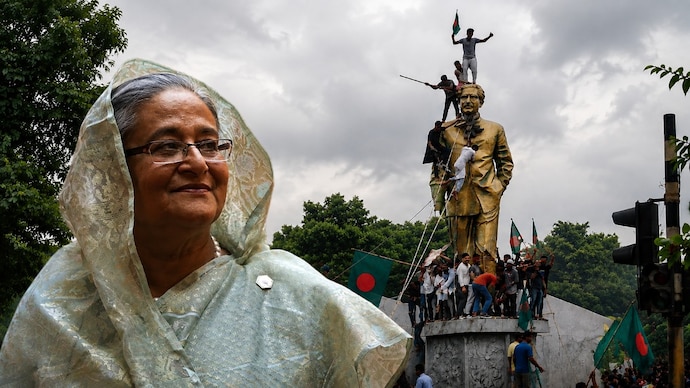
After Sheikh Hasina fled to India in 2024, statues of her father, Sheikh Mujibur Rahman, were pulled down in Bangladesh. (Images: File)
When Sheikh Hasina landed at the airport in Dhaka, there was no relative to receive her. But, as she would recount years later, she "received the love of millions of people." That was May 17, 1981. Hasina had taken an Indian Airlines flight to return to Bangladesh, ending six years of political exile in India. History has placed Hasina at the same crossroads, after 45 years. When Hasina returns to Bangladesh this time, it will be something no other political leader has attempted, and will be a victory in itself.
Hasina's second exile in India began exactly two years ago — on August 5, 2024. Then the Prime Minister of Bangladesh, she got just two hours to pack up and take a helicopter as a murderous mob of tens of thousands marched towards her official residence in Dhaka. She didn't even get the time to record a departing message for her people.
On Wednesday, the second anniversary of her exile in India, Hasina is set to make her "first public appearance", addressing the media via video in the evening. There's a gag on the Bangladeshi media from airing her speech, but in the age of social media, such bans have the lifespan of a bubble.
These two years, living in a safehouse in New Delhi, Hasina hasn't held any public meetings or given any video interviews. Most of her media interactions have been via emails. In recent interviews, Hasina has expressed her resolve to return to Bangladesh by the end of this year.
The return of the 78-year-old leader is crucial for the Awami League(AL), a party co-founded by her father and leader of the 1971 liberation movement, Bangabandhu Sheikh Mujibur Rahman. The AL, which commands loyalty of around 40% of the country's voter base, is believed to imbibe the foundational ethos of Bangladesh. It is that principle for which hundreds of thousands of Muktijoddhas sacrificed their lives during the Liberation War of 1971.
The assassination of Mujib on August 15, 1975, by members of the army is considered a murder attempt on the AL itself. However, being a mass people's party, the AL was revived after Hasina returned in 1981. But Hasina's fleeing Dhaka on August 5, 2024, is akin to a political suicide on behalf of the AL.
The electoral process is the lifeblood of any political party, and the Awami League was barred from the general election that was held in February this year. However, more than the ban, it was Hasina's escape, amid allegations of having ordered a massacre, that dealt the party a body blow.
It is only in the return of its netri (leader) that the Awami League will find its redemption.
WHY SHEIKH HASINA'S RETURN TO BANGLADESH WILL BE HISTORIC
"I may be killed. I may be arrested. I may be sent to prison," Hasina told news agency AFP in July. "I am fully aware of my fate. Still, I want to go back because my people are calling me," she said in the email interview.
In November 2025, Bangladesh's Crimes Tribunal (ICT) sentenced Hasina to death in a trial held in absentia. She was accused of orchestrating the killing of 1,400 protesters during the agitation in July-August 2024.
India Today Digital has reported how the anti-Hasina agitation, which began as an anti-quota protest, was hijacked by political elements and Islamic fundamentalist forces.
Hasina's return will be unique because no political leader facing a death sentence has willingly returned to their native country from exile.
What is also spectacular is that Hasina will be returning without any known sovereign pledges or guarantees.
However, like Hasina, the government of Prime Minister Tarique Rahman seems prepared for her return.
"She [Sheikh Hasina] says she will come. So let her come; we are ready," Zahed Ur Rahman, Tarique's adviser for information and broadcasting, was quoted as saying by Dhaka-based news outlet, Prothom Alo, on Tuesday.
The PM's aide said that Hasina will be arrested the moment she sets foot in the country.
A FATHER'S DAUGHTER: HASINA WILL BE WALKING IN MUJIB'S FOOTSTEPS
Will Hasina be arrested? Hasina has been arrested earlier too, and she might emerge as a bigger hero from jail just like her father did.
Mujibur Rahman was jailed by Pakistani President Yahya Khan in March 1971 and a military tribunal handed him the death sentence for waging war against Pakistan. However, after Pakistan's defeat in the 1971 war against India, Mujib was released from jail in January 1972. His stature grew manifold.
Two antagonistic forces — one that believes that the country's origins lie in the communal history of the 1947 Partition and the other that traces its origins to the secular assertion of 1971 — have been fighting in Bangladesh ever since its liberation from Pakistan 55 years ago. Mujib is a rallying point for the secularists and the attack on his statues and residence, Dhanmondi 32, by extremists after Hasina fled Bangladesh reveals the fight between the two forces.
However, it is highly unlikely that a politician of Hasina's stature would be executed. What is more probable, like Hasina herself fears, is that there could be attempts on her life.
When Benazir Bhutto returned to Pakistan in 2007, a suicide bomber hit the vehicle she was travelling in during the homecoming rally and killed 128 people. Benazir luckily survived. Former Filipino president Benigno Aquino wasn't that lucky. He was shot dead on the tarmac in Manila by an assassin as he returned from exile. His assassination was blamed on dictator Ferdinand Marcos, and a public uprising over Aquino's killing led to the fall of his regime.
Hasina herself has survived at least 19 assassination attempts, including a 76-kg bomb planted at a rally in Gopalganj in 2000 by Islamist outfit HuJI and a grenade attack in 2004 in Dhaka in which 24 people were killed.
WHAT WILL SHEIKH HASINA TRY TO ACHIEVE IN BANGLADESH?
Hasina is a calculative politician, and she has had a history of outsmarting her rivals from the very beginning.
Brought in as a dummy head by veterans of the Awami League that was rife with infighting, Hasina emerged as its biggest leader. She has played her international diplomacy cards well and secured the most for Bangladesh.
It was during her period of rule as the PM from 2009 after winning the 2008 general election that Bangladesh saw rapid development and millions were pulled out of poverty. Hasina, surrounded by a coterie of the vile and corrupt, emerged as an authoritarian ruler. In the last two years of her rule, the government had become infamous for corruption, suppression of dissent and custodial torture and deaths.
Bangladesh's struggle in the post-Hasina years might have blunted some of those memories. However, no one would be giving Hasina a carte blanche. She will have to face the consequences of her actions.
But what will Hasina try to achieve upon her return to Bangladesh?
Her primary goal would be to get the Awami League to participate in an inclusive general election. For that she will have to mobilise people, hold marches and rallies and do it all from jail if needed. There will be no shortcuts and the 78-year-old politician knows that.
Hasina, saying that she would surrender before a court, threw the ball in the government's court. It is for the Tarique Rahman administration to decide how it wants to take the game forward.
In 1981, when Hasina landed at the airport in Dhaka, she was greeted by thousands of cheering Awami League supporters. It was Tarique's father, Ziaur Rahman, who was the President then. Hasina feared arrest, but wasn't arrested. Forty-five years apart, it will be for the son to take a decision that will shape Bangladesh's politics.
On her part, Hasina has taken the decision.
Just like General Douglas MacArthur, who vowed "I shall return" after escaping from the Philippines in a torpedo boat in 1942, and returning to accept Japan's surrender in World War II in 1945 on the battleship USS Missouri, Hasina will be returning to fight the biggest of her battles.
Hasina, however, knows that she is aboard a war-worn battleship. How the battle will unfold is not known. What is known is that she will be resuscitating the Awami League and the legacy of Mujibur Rahman, in life and in death. That's why Hasina's return to Bangladesh will be her biggest victory. She owes that not just to the future, but to the past as well.
- Ends
Published By:
Sushim Mukul
Published On:
Aug 5, 2026 12:18 IST