 3 weeks ago
Pakistan has a substantial military footprint in Saudi Arabia and key roles in its security alliances, but has not visibly activated those commitments as Houthi attacks intensify. With Saudi oil and food routes under pressure, the crisis is putting Pakistan's defence role -- and the gap between signed pacts and operational response -- under scrutiny.
Saudi under Houthi fire: Where is Pakistan’s military muscle now?
Over the past two weeks, Yemen's Iran-backed Houthis have launched a sustained campaign of missile and drone strikes against southern Saudi Arabia, hitting civilian areas, energy facilities and military sites in Abha, Khamis Mushait, Jizan, Najran and Taif. Saudi officials reported 73 civilian injuries in the initial wave in early September, with at least 13 more wounded in subsequent strikes, alongside fires at oil installations and temporary disruptions to operations. Saudi Civil Defence issued a record number of emergency alerts across Mecca, Jeddah, Yanbu and other western and southern regions on September 14 and 15 -- the highest single-period total on record.
AN EMERGING CRISIS FOR ASIAN OIL MARKETS
Saudi Arabia is likely to face difficulty maintaining seamless oil supply through October and November, raising the prospect of regional supply strain and renewed inflationary pressure.
As flows through the kingdom's Red Sea export hub at Yanbu are disrupted, major global buyers will likely be pushed towards the spot market to secure alternative crude.
Compounding the pressure, Saudi Arabia's 1,200-kilometre East-West Pipeline, which carries an estimated 4 to 5 million barrels of oil per day, or roughly 4 to 5 per cent of global supply, from the Eastern Province to the Red Sea port of Yanbu, was shut down on September 11 after drone strikes on pump stations in the Riyadh and Medina regions.
Saudi and Iraqi officials have attributed those strikes to drones launched from Iraq, linked to Iran-aligned militias, rather than to the Houthis.
The pipeline outage is a separate front from the Houthi campaign, but it compounds the same underlying vulnerability: with the Strait of Hormuz effectively closed since the outbreak of the US-Israel war on Iran, Yanbu had become Saudi Arabia's primary bypass route, and its capacity is now doubly constrained -- by the pipeline shutdown on one end and Houthi control of the Bab al-Mandeb corridor on the other.
A LOOMING FOOD BOTTLENECK
Jazan Port is a critical node for Saudi food imports, with specialised terminals for packaged and frozen goods, a temperature-controlled reefer facility with 1,739 connections for cold storage, and cargo throughput that reached 317,000 tonnes in the first quarter of 2026.
With the Bab al-Mandeb corridor choked, Jazan faces the prospect of severe shortages in food, animal feed and groceries in the weeks ahead.
THE BAB-EL-MANDEB CRISIS
In a rapid advance in mid-September, Houthi forces seized Mayyun (Perim) Island along with the Hanish Islands in the southern Red Sea, giving the group effective control of the Bab al-Mandeb Strait -- a chokepoint that, together with Iran's closure of the Strait of Hormuz, now leaves roughly a third of global seaborne oil trade running through waters controlled or threatened by Iran-aligned actors.
This significantly raises the risk to Saudi oil exports that had been rerouted via the Red Sea after the Hormuz disruption, and could further constrict supply through September and October.
DEFENCE PACTS SIGNED BY SAUDI ARABIA
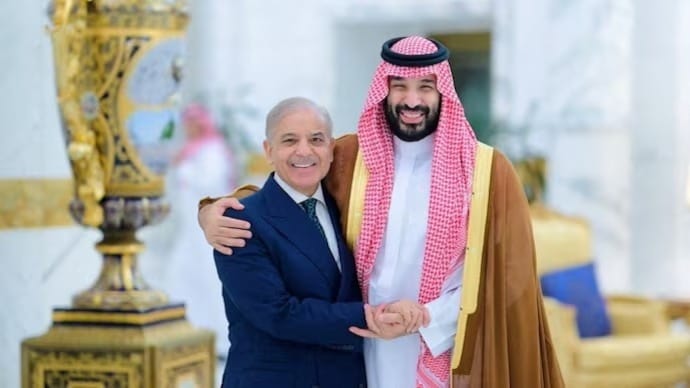
On August 7, Saudi Crown Prince Mohammed bin Salman, Turkish President Recep Tayyip ErdoGan and Pakistani Prime Minister Shehbaz Sharif signed the Mecca Joint Defence Agreement in Mecca.
The pact states that an armed attack on any one of the three states "shall be regarded as an attack against them all", and is intended to strengthen collective deterrence and deepen defence cooperation.
It builds on the bilateral Strategic Mutual Defence Agreement signed by Saudi Arabia and Pakistan in September 2025.
Officials from all three countries have described the pact as purely defensive, not aimed at any specific country, and open to future signatories, with a secretariat established in Riyadh.
Yet more than five weeks after signing, as Houthi missiles and drones struck Saudi territory and the group seized territory along the Bab al-Mandeb Strait, neither Pakistan nor Turkey has visibly activated the mutual-defence clause in any operational way.
No joint task forces, coordinated air patrols under the trilateral framework, or formal invocation of collective response have been reported.
That gap between the treaty's NATO-styled Article 5-like language and the absence of tangible allied military action has drawn increasing scrutiny.
A senior Turkish official has reportedly pushed back on this criticism, telling Middle East Eye that the pact's mutual-defence commitments are "not yet legally operative".
Under Turkey's constitution, the president cannot ratify security agreements without parliamentary approval, a process Ankara reportedly plans to begin in October.
Pakistan's government must likewise secure parliamentary ratification, the official said, while Saudi Arabia's system allows ratification by royal decree.
The official argued this is a procedural rather than a political failure, and that institutional mechanisms for threat assessment and coordinated response are still being built.
HOW LARGE IS PAKISTAN'S MILITARY FOOTPRINT IN THE KINGDOM?
1. The Mecca Joint Defence Agreement
Pakistan has long maintained a military presence in Saudi Arabia under bilateral training and advisory arrangements. Under the 2025 Strategic Mutual Defence Agreement, Pakistani media have reported approximately 8,000 additional troops deployed in 2026, on top of earlier contingents, along with a squadron of roughly 16 JF-17 Thunder multirole fighters (jointly produced with China), two squadrons of military drones, and a Chinese-supplied HQ-9 long-range surface-to-air missile system.
All equipment is reportedly operated by Pakistani personnel, with Saudi Arabia financing the deployment's operational and logistical costs, including per-soldier compensation paid in Saudi riyals.
Despite this substantial and growing footprint, none of these assets have been publicly reported as engaged in intercepting the Houthi missiles and drones now striking southern Saudi Arabia, raising the question of what, precisely, Pakistan's deployment is postured to do.
2. Islamic Military Counter Terrorism Coalition (IMCTC)
The IMCTC is a Saudi-initiated counter-terrorism framework headed by retired Pakistan Army General Raheel Sharif, who has commanded the coalition since 2017. The alliance, which includes 43 Muslim-majority states, among them Bangladesh, maintains a joint operations centre in Riyadh and focuses on countering violent extremism through ideological counter-messaging, media strategy, disrupting terrorist financing, military capacity-building and intelligence sharing.
Its mandate centres on non-state terrorist organisations rather than interstate or proxy conflict.
The Houthis are designated a terrorist organisation by Saudi Arabia and several other states, yet the IMCTC has not been visibly mobilised as an operational instrument against the group's current campaign -- underscoring the narrower scope of its mandate, but also raising questions about why an organisation built and commanded around counter-terrorism has stayed on the sidelines of an attack Riyadh itself frames in those terms.
It is also worth noting that Raheel Sharif's command sits atop a coalition that includes Bangladesh -- a state whose 1971 independence war was fought specifically against the Pakistan Army's command structure.
Analysts have pointed to that history as one reason any renewed structural subordination to Pakistani military leadership, however limited or symbolic, is likely to draw domestic political scrutiny in Dhaka, even as Islamabad itself has been notably restrained in projecting hard power in defence of Saudi Arabia.
Pakistani domestic media gave the Mecca agreement extensive coverage at the time of signing in August, but coverage of the pact has been comparatively muted since the Houthi escalation began, even after Saudi authorities issued a rare security alert covering Mecca, Islam's holiest city.
3. Multinational Maritime Defense Coalition (MMDC)
The MMDC is a newly established, Saudi-led naval alliance created to secure shipping and energy corridors across the Red Sea, the Bab al-Mandeb Strait and the Gulf of Aden. Saudi Arabia formally unveiled the coalition in late July, following a surge in maritime tensions and a Houthi-declared naval blockade against Saudi-linked shipping.
Thirteen countries completed full accession as founding members, with several more in the process of joining.
The coalition is commanded by Saudi Rear Admiral Abdullah bin Salem Al-Shehri, with Pakistan Navy Commodore Rashid Sheikh appointed as its first Deputy Commander -- a position confirmed when the coalition entered its operational phase in early September. Bangladesh is also among the coalition's signatories, again placing its naval personnel within a Saudi-Pakistani-led command structure -- a dynamic likely to invite the same historical comparisons drawn around the IMCTC.
As with the Mecca Agreement itself, Turkey's role in the MMDC has been constrained by the same ratification question: Foreign Minister Hakan Fidan has said the underlying trilateral pact is not yet legally operative, since Turkey's constitution requires parliamentary approval before the president can bind the country to new security commitments, leaving Ankara's practical contribution to Red Sea security, for now, largely undefined.
For Saudi Arabia, the crisis is therefore testing more than its ability to keep oil and food supplies moving. It is also putting its expanding network of defence partnerships under scrutiny. Pakistan has a substantial military footprint in the kingdom and occupies key positions in Saudi-led security structures, while Turkey is yet to complete the legal process needed to activate its commitments.
But as Houthi attacks intensify and the kingdom's strategic chokepoints come under pressure, the gap between signed agreements and visible military response is becoming increasingly difficult to ignore. The coming weeks could show whether these partnerships can translate from paper commitments into an operational security architecture.
- Ends
Published By:
Sayan Ganguly
Published On:
Sep 17, 2026 20:28 IST