1 month ago
The Houthis have overrun Yemen's western coast to command the strategic Bab el-Mandeb Strait. The Iran-backed militia now has America's only military base in Africa within its drone and missile strike range. This even as Saudi Arabia intensifies its airstrikes targeting the Houthis.
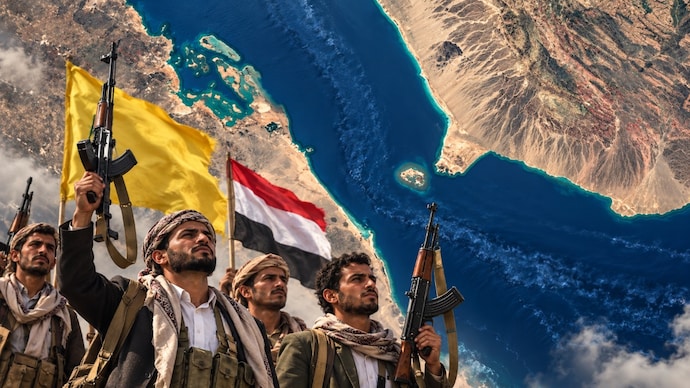
The Houthis seized the Mayun Island in Bab el-Mandeb, tightening their grip on the Red Sea. (Image: AP/ Google Maps)
Yemen's war has spilled over, reached Saudi Arabia and has arrived at the Bab (gateway) of global shipping. Armed with rifles and AI, and donning slippers, the Houthis have swept through strategic positions along Yemen's Red Sea coast and beyond. Such has been their blitzkrieg that the Iran-backed militia has brought Camp Lemonnier in Djibouti, the only American military base in Africa, within range of its attack drones and ballistic missiles.
The Iran-backed Houthi militia has captured Mayun Island, which is in the middle of the Bab el-Mandeb. They have seized the strategic port of Mocha and swept through the positions held by the Saudi Arabia-backed forces of the internationally recognised government along Yemen's western coast. The Houthi seizure of the strategic locations gives the group a commanding position in and around the Bab el-Mandeb Strait, one of the world's most important shipping and energy-trade routes in the Red Sea.
Even as Saudi-backed Yemeni forces launched counterattacks, and Riyadh's jets carried out 129 strikes across seven provinces within 48 hours, the Houthis claimed to have struck a Saudi military base with ballistic missiles and drones.
Most alarmingly, the Houthi advance has brought the Iranian militia about 30 km from Djibouti's coast and placed Camp Lemonnier, America's "only enduring" military base in Africa, within "striking distance" of its drones and ballistic missiles.
Meanwhile, more than 82,000 Yemenis have been displaced since the beginning of September, with over 2,000 crossing the narrow waterway to Djibouti, according to the Organisation for Migration, news agency Associated Press reported.
The fighting in Yemen had remained relatively calm and contained after a United Nations brokered truce halted the exchange of fire on a large scale in 2022. That relative calm began unravelling in July before the Iran-backed Houthis opened several fronts against Yemen's internationally recognised government after the commencement of the war in the Middle East (Western Asia).
The Houthi captures of Mocha and Mayun have attached the war in Yemen to the bigger war in the oil-rich region and triggered concerns over Saudi security, global oil supplies and the ongoing confrontation between Iran and the US.
HOUTHIS CAPTURE ISLAND INSIDE RED SEA GATEWAY
Mayun, also known as Perim, is a small volcanic island in the middle of the Bab al Mandeb Strait, which connects the Red Sea with the Gulf of Aden and the Indian Ocean. The Bab is crucial for trade between Asia and Europe.
The island divides the narrow waterway into two shipping channels. Reuters reported that the strait is about 29 km wide at its narrowest point, making it one of the world's most vulnerable maritime chokepoints. For context, the Strait of Hormuz is about 33-km wide at its narrowest point.
The Houthi advance onto Mayun Island has brought the Iran-backed militia about 32 km from Djibouti's coast and less than 130 km from Camp Lemonnier, the main American base in Africa.
A July 2025 analysis in Manara Magazine, the publication arm of the Cambridge Middle East and North Africa Forum, said Camp Lemonnier was within "striking distance of Houthi unmanned air vehicles and missiles."
Camp Lemonnier, the US's only permanent military base in Africa, hosts more than 4,000 military and civilian personnel and supports counterterrorism, drone and maritime security operations. Djibouti also hosts military facilities belonging to China, France and Japan.
A March 2026 assessment by the Washington-based public policy think tank, Critical Threats Project, warned that the Houthis "could also target" Camp Lemonnier as part of a wider Red Sea campaign. However, it assessed that Djibouti's support for Palestine and its refusal to allow the US to use its territory for strikes against the Houthis had reduced the group's incentive to attack the base. However, that assessment was published in March, and the Houthis' recent capture of positions has significantly altered the threat landscape.
The American base is situated beside Djibouti's international airport and is further south of Mayun Island.
The takeover nevertheless places the Houthis in a position to observe, threaten or potentially interfere with vessels navigating the Bab al Mandeb. The group has said it is targeting Saudi shipping and does not intend to threaten commercial vessels belonging to other countries.
FALL OF MOCHA OPENS THE WAY FOR HOUTHIS
Mayun Island was captured a day after the Houthis took Mocha, the historic port overlooking the southern Red Sea.
During the assault on Mocha, an audio message resembling a Yemeni commander's voice reportedly ordered his troops to retreat, with the Houthis using artificial intelligence to clone them and confuse soldiers. Separately, an Anthropic threat report indicated that a weapons development cell in Houthi-controlled northern Yemen had used its Claude chatbot to work on guidance software for advanced missiles.
Later, Yemeni government soldiers withdrew from Mocha and other coastal positions as the Houthis made their biggest territorial gains since the 2022 truce. Civilians fleeing the advance told the Associated Press that government forces had pulled back and urged civilians to flee.
Sultan al Arada, a member of Yemen's Presidential Leadership Council and governor of Marib, described the reverses as "painful and regrettable". He said the withdrawn forces were "currently regrouping and will return to battle."
SAUDI INTENSIFIES AIRSTRIKES TO PREVENT HOUTHI ADVANCE IN YEMEN
Following the Houthi advances, Yemeni government forces launched air attacks on positions held by the Iran-backed forces around Mocha, Dhubab and along the road connecting the two towns, Yemen's government-run Saba news agency reported.
Qatari broadcaster Al Jazeera's correspondent in Yemen reported that Saudi Arabia was carrying out air attacks, primarily against advancing Houthi formations. Houthi military spokesperson Yahya Saree claimed that Saudi warplanes had conducted 129 raids over Taiz, Marib, Hodeidah, al Jawf, Saada, Amran and Hajjah within 48 hours.
Saree alleged that F15 and Typhoon aircraft had taken off from Saudi bases at Khamis Mushait and Taif. "These attacks on our people will not go unanswered, God willing," he said, reported Al Jazeera. Riyadh has not officially confirmed carrying out the strikes.
The Yemeni-government-aligned Resistance Forces said more than 500 of its fighters had been killed on the western coast during the past four weeks. It claimed that more than 1,000 Houthis had been killed in Hodeidah and Taiz, although the figures could not be independently verified, reported the Associated Press.
HOUTHI MISSILES REACH SAUDI ARABIA
The Houthis also claimed to have attacked a Saudi military base at Sharurah with ballistic missiles and drones. Saudi authorities said another Houthi projectile struck Jazan, injuring two people and damaging a mosque, vehicles and several buildings. Earlier attacks on Abha, Khamis Mushait, Jazan and Najran wounded 73 people and struck civilian and economic facilities, according to Saudi officials, reported Al Jazeera.
All four cities are in southern Saudi Arabia, relatively close to the Yemeni border and within reach of missiles and drones launched from Houthi-controlled areas.
Meanwhile, the Red Sea littoral states have watched the Houthis tighten their grip in the region over the past week.
Also, Houthi military spokesperson Yahya Saree on Monday said fighting against Saudi-backed forces would continue until the siege of Houthi-controlled areas in Yemen was lifted.
So, Saudi Arabia entered the war in Yemen in 2015 to restore the government ousted from Sanaa by the Houthis. More than a decade later, the Houthis control the Yemeni capital, most of the country's north and strategic positions along the Red Sea. Now, missiles are again reaching southern Saudi Arabia, while Houthi militants take positions overlooking the Bab el-Mandeb and have a major American base within drone and missile range. And, most importantly, Riyadh has been pulled back into the war it had spent years trying to leave behind.
- Ends
Published By:
Sushim Mukul
Published On:
Sep 14, 2026 15:30 IST