1 month ago
From declaring his love for inflation to inventing words like 'covfefe' and 'PANICAN', US President Donald Trump has spent years reshaping language to suit his political message, creating a catalogue of absurd Trumpisms that continue to bewilder critics and amuse supporters. Here are a few memorable ones.
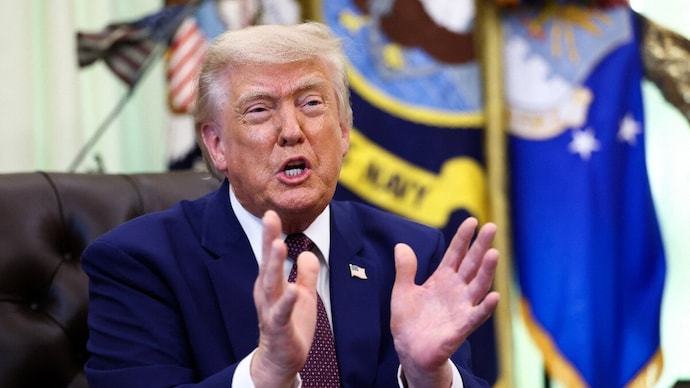
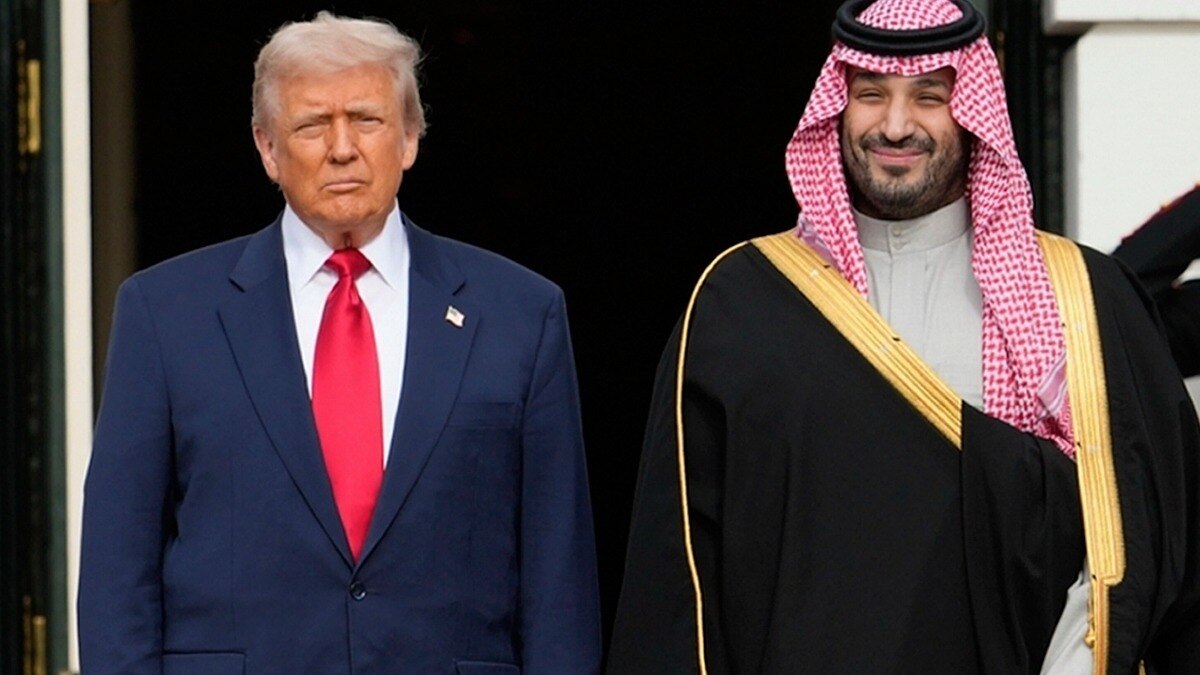
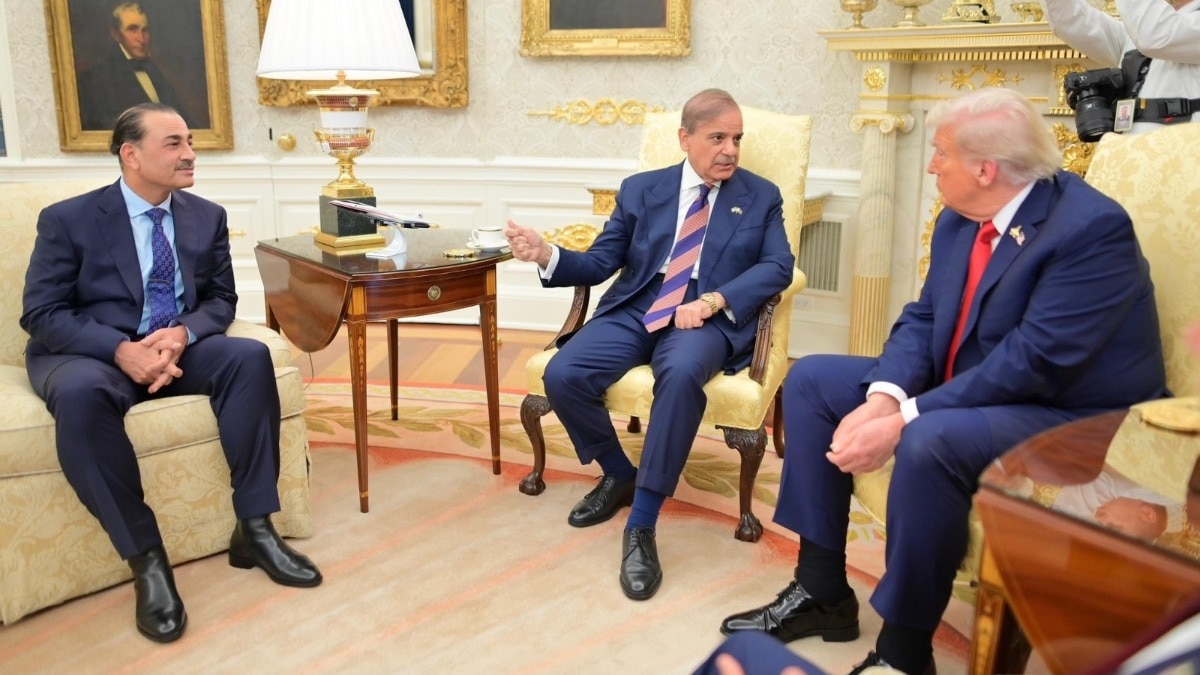
US President Donald Trump has never been content with using words the way everyone else does. (Image: Reuters)
Donald Trump has a penchant for inventing words and springing oddities that shock the world on what would otherwise be an ordinary Tuesday. Yet even allowing for differences in perspective, Trump often seems to operate from an entirely different dictionary than the rest of us. Consider his recent declaration that he "loves" inflation despite US consumer prices hitting a three-year-high, or his suggestion that a ceasefire means combatants are merely shooting at one another in a more "moderate" manner.
Politicians are often accused of bending language to suit their purposes, but Trump has turned the practice into something of a persona. Over the years, he has repeatedly coined new words, attached fresh meanings to familiar terms, and popularised a collection of memorable phrases that have come to be known as "Trumpisms". These remarks frequently leave supporters, critics and even dictionary writers wondering whether they heard him correctly.
Whether discussing inflation, ceasefires, tariffs or geopolitics, Trump has displayed a remarkable talent for reinterpreting everyday language in ways that are baffling, amusing and, at times, politically convenient. Here are some of the most notable examples.
'I LOVE INFLATION'. WHY DID TRUMP SAY THAT?
Inflation in the US has reached its highest level in the last three years. According to the latest Bureau of Labor Statistics, US consumer prices rose 4.2% in May, up from 3.8% in April — marking a three-year high since April 2023. Driven by a 0.5% monthly CPI rise from the February 2026 US-Iran war and the shutdown of the Strait of Hormuz, inflation spiked from a pre-conflict 2.4%, while core inflation hit 2.9%.
Despite the strain on household purchasing power and rising business costs, Donald Trump brushed off concerns at the White House on Wednesday. "I love it. The numbers were great. You know what I really love? I love the inflation," Trump told reporters after being questioned on the issue.
Claiming US forces seized "millions of barrels" of Iranian oil, he promised prices would "come down like a rock" once the war ends. "When this conflict is over you will see oil drop to where it was before," he added, citing a goal to return to the $1.85 per gallon petrol prices he saw in Iowa. Trump later told the New York Post his comments were taken out of context and meant inflation was "much lower than anticipated."
That being said, it's doubtful that Trump's constituents would agree with their President's reading of the situation, seeing how vulnerable the car-dependent US population is to volatile petrol prices.
WHEN TRUMP SAID CEASEFIRE IS 'MODERATE SHOOTING'
A ceasefire is a formal, temporary agreement between opposing forces to halt active combat and suspend military actions. Its primary purpose is to create a secure window for peace negotiations, deliver humanitarian aid, or de-escalate tensions. Simply put, both sides are expected to stop trying to kill each other, with violations risking the collapse of the agreement.
Trump, however, has offered a different interpretation. Last week, when asked whether the shaky ceasefire with Iran was holding, he suggested the definition varies by region: "It's a different part of the world, you know. I'd say in that part a ceasefire is when you're shooting in a more moderate manner."
He also downplayed recent Iranian missile strikes on Kuwait, saying there was "a reason" for the exchange and that Iran had been "slightly provoked". Trump added that the US military "nipped it in the bud very quickly."
Trump's unorthodox definition of a ceasefire comes even as Iran has demanded that the US and Israel immediately stop all hostile actions — including operations in Lebanon — and provide security guarantees as a precondition for continuing negotiations. Not "moderate shooting", a complete halt to all actions of the hostile kind.
DON'T BE A PANICAN: WHEN TRUMP MEANT TO REASSURE
On tariffs, Trump once again demonstrated his flair for inventive language. In April 2025, he unveiled sweeping new import tariffs aimed at reshaping global trade and bringing manufacturing back to the United States.
The measures, later dubbed the "Liberation Day" tariffs, rattled financial markets and sent global stocks tumbling amid fears of higher consumer prices. Economists, business leaders and even several prominent Republicans, including Senators Ted Cruz and Rand Paul, Congressman Pete Sessions and conservative commentator Ben Shapiro, warned that the tariffs could trigger a recession and inflict lasting damage on the economy.
Rather than address those concerns directly, Trump chose to mock his critics, branding them "PANICANs" — a term of his own invention for those he believed were overreacting. In a post on Truth Social, he wrote: "Don't be Weak! Don't be Stupid! Don't be a PANICAN (A new party based on Weak and Stupid people!)." He followed it up with a rallying call: "Be Strong, Courageous, and Patient, and GREATNESS will be the result!"
The word appears to be a portmanteau of "panic" and "American", or perhaps "Republican", reducing anyone concerned about the tariffs to a caricature of weakness and fear.
The irony, however, is that the fate of the tariffs ultimately had little to do with "PANICANs." In February this year, the US Supreme Court struck down the Liberation Day tariffs as unlawful and ordered the administration to refund businesses that had paid them.
COVFEFE: NO, TRUMP DIDN'T MEAN COFFEE
One of Trump's most famous linguistic inventions came in May 2017 with a late-night tweet that read: "Despite the constant negative press covfefe".
The mysterious word, almost certainly a typo for "coverage", was deleted after several hours, but not before it had already gone viral. Trump never gave a straight explanation, later joking during a press conference that "covfefe" had a secret meaning that only "a few people" understood.
The incident spawned countless memes, merchandise, and even a brief attempt by some to add the word to the dictionary. It remains one of the defining moments of Trump's unpredictable social media style and his ability to turn an apparent mistake into a cultural phenomenon.
TRUMP'S NICKNAME FACTORY
In addition to re-writing definitions and creating words out of thin air, Trump is also well known for assigning memorable nicknames to both allies and adversaries.
During the 2016 Republican primaries alone, he branded Senator Ted Cruz "Lyin' Ted", former Florida governor Jeb Bush "Low-Energy Jeb", and now Secretary of State Marco Rubio "Little Marco". The labels were often simple, repetitive and easy to remember, helping Trump reduce complex political opponents to a single perceived weakness.
The practice continued beyond the Republican primary. Democratic rival Hillary Clinton became "Crooked Hillary", a nickname Trump used relentlessly throughout the 2016 election campaign. President Joe Biden was recast as "Sleepy Joe", while Senator Elizabeth Warren was dubbed "Pocahontas" in a reference to her claims of Native American ancestry. More recently, former UN ambassador Nikki Haley found herself branded "Birdbrain", while Florida Governor Ron DeSantis was labelled "Ron DeSanctimonious".
Trump's penchant for nicknames has not been confined to domestic politics. North Korean leader Kim Jong-un became "Rocket Man" during a period of heightened tensions over Pyongyang's missile programme. Years later, after the two leaders entered into direct diplomacy, Trump shifted to the more respectful "Chairman Kim". Former Canadian Prime Minister Justin Trudeau has also been mocked by Trump as "Governor Trudeau", a jab tied to his repeated suggestions that Canada should become America's "51st state".
Donald Trump has never been content with using words the way everyone else does. Throughout his political career, the US president has repeatedly coined new expressions, redefined familiar terms and attached memorable labels to friends and foes alike. From the infamous "covfefe" tweet to describing a ceasefire as "shooting in a more moderate manner," Trump's unconventional use of language has more or less become a defining feature of his public persona.
- Ends
Published By:
Shounak Sanyal
Published On:
Jun 11, 2026 14:30 IST