 1 month ago
Ajay Srivastava, Founder of GTRI, and Garima Kapoor, Chief Economist at Elara Capital, share insights on India-EU FTA winners, the one-year wait for gains, and challenges from ESG and carbon rules. The looming Carbon Border Adjustment Mechanism (CBAM) poses a substantial threat, particularly to steel and aluminium exports, while the rupee is expected to remain under near-term pressure.
By Alpha Desk January 29, 2026, 12:57:47 PM IST (Published)
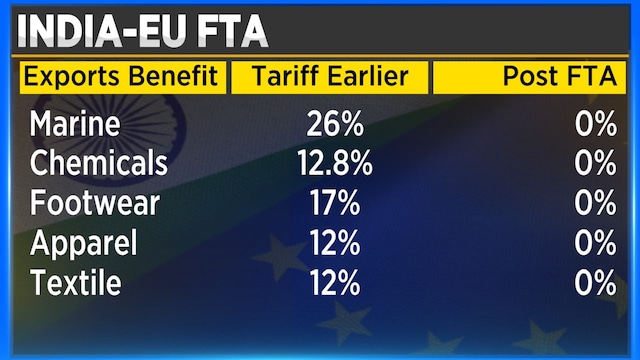
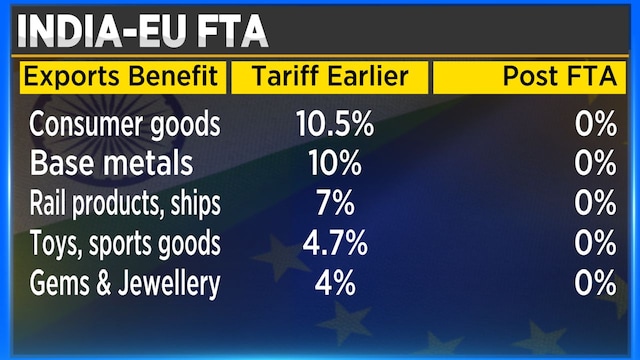
Ajay Srivastava, Founder of the Global Trade Research Initiative (GTRI), said the India–European Union free trade agreement (FTA) could significantly lift exports of textiles, leather, and marine products by putting Indian firms on an equal footing with competitors such as Bangladesh and Vietnam in the European market.
However, he cautioned that the timing matters. Exporters have already taken a hit from weak demand in the US, while gains from Europe will only come once the agreement is implemented. Srivastava, said the near-term mismatch remains a concern, noting that “the gains from EU will be at least one year away.”
Still, the long-term potential for labour-intensive industries looks meaningful. India has struggled to compete in Europe due to higher tariffs compared with countries like Bangladesh and Vietnam.
Zero-duty access could help Indian exporters regain lost ground in garments, textiles and leather, sectors that also benefit from low import dependence and a weaker rupee.
Read Here | India–EU FTA likely to boost two-wheeler exports and premium segment: TVS Chairman
However, Garima Kapoor, Chief Economist and Head of Research at Elara Capital, cautioned that the gains from the FTA are unlikely to be broad-based. She pointed out that the EU is a difficult market with stringent compliance norms related to environmental, social, and governance (ESG) factors, traceability, and certifications, which come at a high cost.
"The gains are likely to accrue significantly disproportionately higher to those companies who already have reasonable presence in Europe," Kapoor explained. She suggested that investors should focus on companies like Gokaldas Exports or KPR Mill which are already established in the European market.
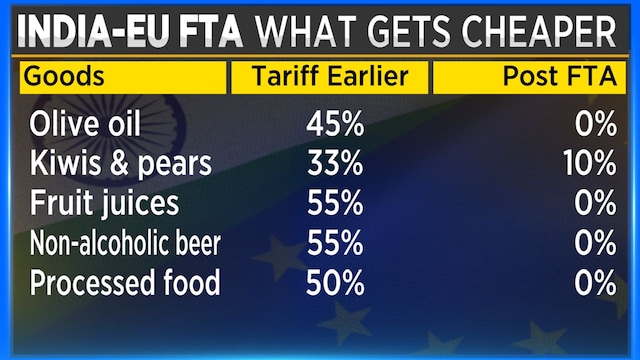
Shrivastava concurred, acknowledging that the EU is a high-quality market. While he noted that over a thousand Indian companies are already certified and another thousand are in the queue, he warned, "EU believe too much into ESG, environment, sustainability and they can put a spanner on any country's exports any point of time."
Read Here | India-EU FTA puts Indian steel in a sweet spot as EU's carbon tax looms: EU Trade Commissioner
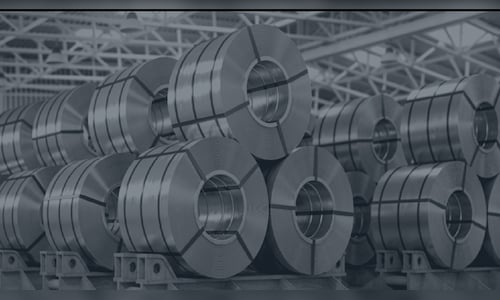
A significant overhang for the deal is the EU's Carbon Border Adjustment Mechanism (CBAM), or carbon tax. Kapoor expressed disappointment that India was unable to negotiate any relaxation on this front. She warned that the cost implications for steel and aluminium exports could be significant, estimating a potential price impact of 20-30%. The effect could eventually cascade to other sectors like auto components.
"Given the way European market functions… I see very limited scope that we may be able to grab any significant relaxation in the near term, which of course is not very positive for our emission-intensive exports," she said.
Shrivastava added that in the next few years, CBAM would likely cover all industrial products, while a separate 'deforestation act' could impact agricultural products. This could create an imbalanced scenario where EU products enter India tariff-free, while Indian exports face these additional taxes.
Discussing the impact of the rupee's depreciation, Shrivastava explained that the traditional narrative of a weaker currency boosting exports no longer holds for most sectors like electronics and pharmaceuticals, which have high import dependency.
However, for labour-intensive sectors with low import content, there is a clear gain. Yet, he pointed out that rising export figures are not materialising, suggesting that any currency advantage is being offset by increased competitiveness from other nations.
For the entire discussion, watch the accompanying video
Catch all the latest updates from the stock market here
Also, catch the latest Budget 2026 expectations updates here
Catch all the latest updates from the Q3 earnings here