1 month ago
While America celebrates 250 years of independence, Iran prepares a massive farewell for Ayatollah Khamenei as the two countries negotiate a fragile peace after months of war.
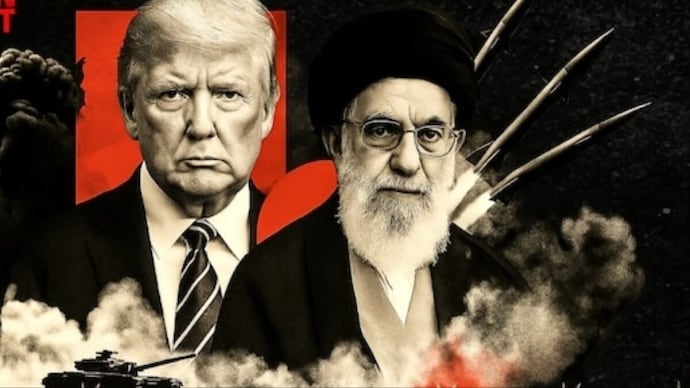
This week, Iran and the US face off in a battle of crowds.

New Delhi,UPDATED: Jun 29, 2026 13:49 IST
Two massive ceremonies are set to play out concurrently across the globe later this week, one in the world’s oldest democracy, the other, in an Islamic theocracy.
July 4 will see the United States celebrating its Semiquincentennial, the 250th anniversary of the Declaration of Independence. Kicking off the week-long festivities, President Donald Trump said he would speak ‘at the greatest show of all’ on the Mall on the Fourth of July.
The Iranians have bigger plans— over 35 million Iranians will show up for the funeral of Ayatollah Khamenei, beginning on July 3 and ending on July 5.
This will likely be the largest gathering on earth, eclipsing the record 10 million Iranians who gathered for the 1989 funeral of the first Supreme Leader Ruhollah Khomenei. His successor, Ali Khamenei was the longest serving head of state in West Asia when he was assassinated in Israeli-US airstrikes on February 28 this year.
The intense aerial bombardment, over 13,000 sorties, mounted by the US and Israel, made a public funeral event fraught with risk. A shaky ceasefire has been in effect between Iran and the US since April 8 and on June 17, Trump and his Iranian counterpart Masoud Pezeshkian signed an MoU to end the war. Negotiations are underway to permanently end to the war.
Meanwhile, Iran’s date choices for the funeral —July 3 and 4 for the ceremonies and July 5 for the final funeral procession in the holy city of Qom — are no accident. As history shows, Tehran has timed its messaging to Washington DC.
On November 4, 1979, 66 Americans were captured when Iranian students stormed the US embassy in Tehran.
Iran ended the 444-day hostage crisis on January 20, 1981, the day President Jimmy Carter exited the White House. Carter had tried his best to rescue the hostages, including mounting a rescue attempt that ended in disaster— a US helicopter and transport aircraft, part of a large rescue team, crashed in the Iranian desert killing five US service personnel in April 1980.
The Iranian hostage crisis paralysed the Carter Presidency, killed his chances of re-election and hastened the ascent of Ronald Reagan. The choice of the date was Tehran’s parting kick. They wanted to deny Carter a victory.
Forty-five years later, it is Trump’s turn to deal with the Iranians. Trump’s five-week war with Iran severely weakened it, but achieved none of its principal objectives of either changing the regime or getting it to surrender highly enriched uranium, rolling back its nuclear program, ending its support for Iranian proxies or scrapping its ballistic missile program. Iran has instead blockaded the Strait of Hormuz through which 25 per cent of global energy flows.
The Iranian regime is now controlled by the hardliners in the Islamic Revolutionary Guards Council (IRGC). For the IRGC, the Ayatollah’s funeral is an opportunity to send out multiple messages.
It is yet not clear where Khamenei will be buried, in his hometown Mashad, or in the golden-domed $2 billion Ruhollah Khomenei mausoleum in Tehran— but the regime’s messaging will be on point.
The first message — resilience. The Iranian regime has survived one of the most intense bombing campaigns of the 21st century and is here to stay. It has lost billions in infrastructure, warships and airplanes, but has managed to stalemate the most powerful military.
The second and most important message, the regime has not only survived, but is also popular. Crowds signal legitimacy and popularity. No one knows this better that Trump, who in 2017, criticised the media for fact-checking claims that his inaugural drew larger crowds than Barack Obama’s 2009 inauguration.
It endured the biggest street protests since 1979— first the 2017 Mahsa Amini protests, and more recently, in December 2025, against the economic downturn. Both protests were brutally suppressed by the Iranian regime.
But when the dust has settled on the two events, the Iranian question will continue to haunt the US President. Iran is a conundrum even Ronald Reagan, whom Trump called ‘the best President of my lifetime’, failed to effectively manage.
Reagan oversaw the end of the Cold War and the disintegration of the USSR, but Iran proved a tough nut to crack. The actor-turned-President began by publicly continuing the Carter-era ban on weapon sales to Iran, but his administration secretly sold arms to Tehran. The Iran-Contra affair, between 1981 and 1986 severely dented Reagan’s presidency.
In March 1987, Reagan took full responsibility for the affair. In a nationally televised address he said that ‘what began as a strategic opening to Iran, deteriorated, in its implementation, into trading arms for hostages.’
Reagan escaped without an impeachment in the Iran affair and in fact bounced back with soaring popularity ratings, reason he was called the ‘Teflon President’.
Trump will need some of that Teflon coating. The US economy continues to grow even though rising inflation is a concern. Trump’s popularity ratings are hovering between 37 % and 41 %, one of the lowest for a second-term US President.
He is staring at the biggest challenge of his Presidency, the November 3 mid-term polls. If the Democrats get a majority in the Senate or the House of Representatives, or both, they could clip Trump’s wings for the next two years. The polls will decide the trajectory of Trump’s presidency.
- Ends
Published By:
Sayan Ganguly
Published On:
Jun 29, 2026 13:49 IST