1 month ago
Last Updated:March 13, 2026, 18:51 IST
A direct Iranian strike on the Western Wall, considered the holiest site by Jews, would be viewed as a profound assault on Jewish identity and history


Covered in prayer shawls, Jewish men participate in a blessing during the holiday of Passover, at the Western Wall in the Old City of Jerusalem in 2025. (AP File)
The ongoing conflict between Israel and Iran has allegedly reached near the Western Wall or the Kotel in Jerusalem. On March 12, a missile launched by the Iranian regime reportedly landed within a few hundred metres of the Old City of Jerusalem, threatening the Western Wall, the Al-Aqsa Mosque, and the Church of the Holy Sepulchre, claimed Israel.
If the Western Wall were to be directly hit by an Iranian strike, the consequences would be catastrophic across religious, social, and geopolitical dimensions.
Western Wall matters to Jews, Christians and Muslims
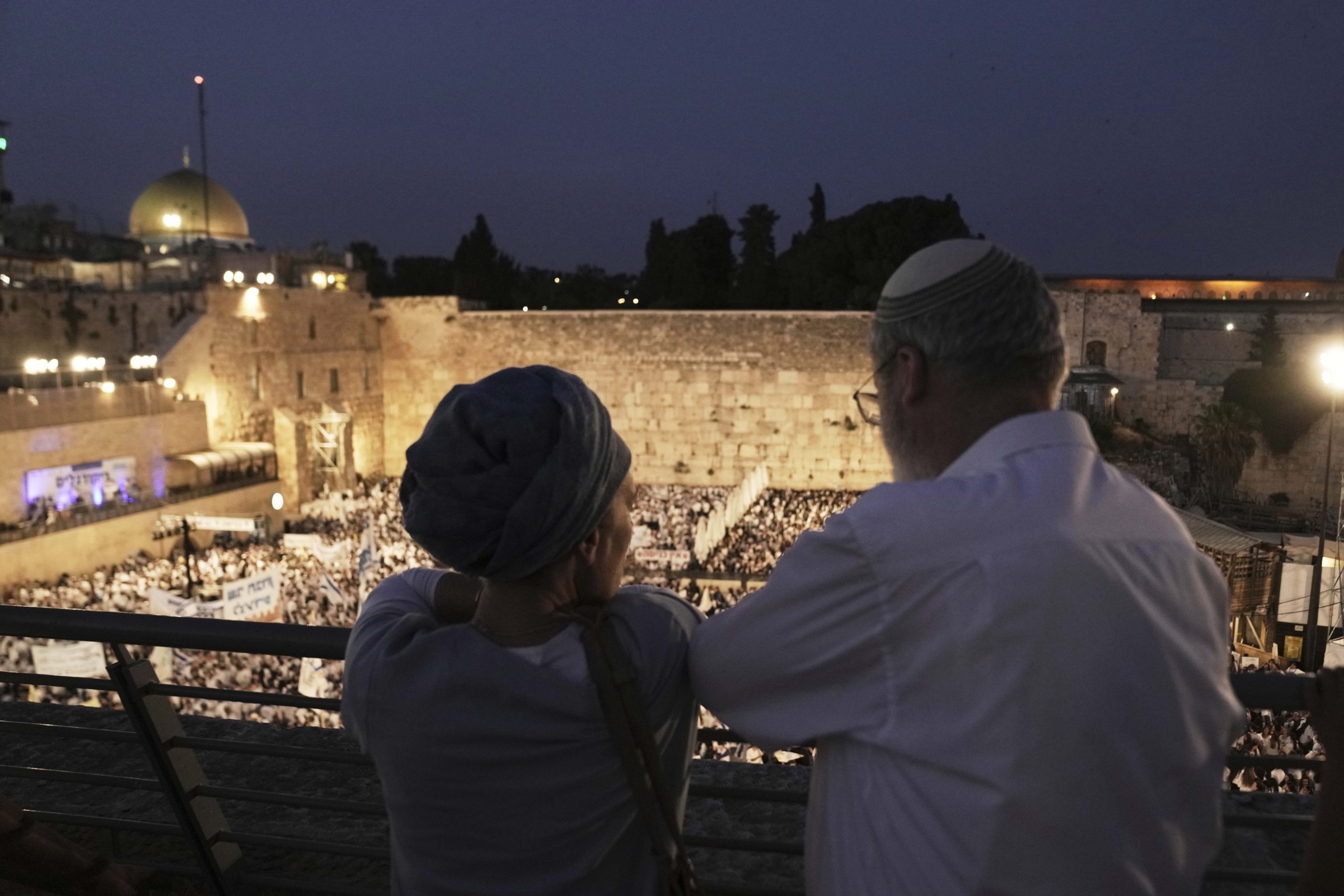
The Western Wall is located in the Old City of Jerusalem, on the western flank of the Temple Mount.
It is the holiest place where Jews are permitted to pray because of its proximity to the site of the Holy of Holies in the ancient Second Temple. The wall is a surviving section of the massive retaining walls built by Herod the Great around 19 BCE to support the expanded Temple Mount platform.
Many believe the Shekhinah (Divine Presence) never departed from the wall, making it a unique place where prayers are thought to have special power.
Known as the Buraq Wall (Ḥāʾiṭ al-Burāq), it is revered in Islam as the spot where the Prophet Muhammad tied his winged steed, al-Buraq, during his Night Journey.
In Christianity, it is valued as a tangible link to the Second Temple where Jesus frequently visited and taught.
It is a centuries-old custom for visitors to write personal prayers or wishes on slips of paper and wedge them into the wall’s crevices.
The visible section in the prayer plaza is about 57 metres long and 19 metres high, though the entire retaining wall extends much further—nearly 488 metres—much of it hidden underground.
To show respect, men typically wear a head covering (kippah) and visitors often walk backwards when leaving so as not to turn their back on the holy site.
Has the Western Wall been attacked in any war?
March: An Iranian missile landed in close proximity to the Old City’s sacred complex. Previous incidents in early March also saw missile fragments or warheads falling near sites like the Sultan’s Pool, less than a kilometer from the Temple Mount. Due to the immediate threat of further strikes, the Israeli Foreign Ministry confirmed that prayer services at all major holy sites in Jerusalem were halted temporarily. While this specific strike near the Old City did not report immediate casualties, other Iranian missile attacks during this period have been deadly. For example, a strike on March 1, 2026, in Beit Shemesh (west of Jerusalem) killed at least nine people and destroyed a synagogue.
August 2025: The site was vandalised with graffiti messages.
August 2022: A Palestinian gunman fired on a bus near the Western Wall, wounding eight people.
1929 & 1948–1967: Historically, the site saw severe riots in 1929, and from 1948 to 1967, it was under Jordanian control, during which Jewish access was barred.
Religious and cultural impact of an Iranian strike
A direct Iranian strike would be viewed as a profound assault on Jewish identity and history, according to reports in foreign media.
Because of the site’s extreme proximity to the Al-Aqsa Mosque and the Dome of the Rock, any strike powerful enough to damage the Western Wall’s massive stones (some weighing over 500 tons) would almost certainly destroy these Islamic holy sites as well, say experts.
Many believe the Shekhinah (Divine Presence) never leaves the wall; its physical destruction would cause unprecedented grief and spiritual trauma for millions of Jews and Christians worldwide, say reports.
Geopolitical and social escalation
Damage to the shared holy compound would likely trigger massive riots and instability across the Islamic world, as both sides might blame the other for the destruction.
Such an event would likely lead to an immediate and severe escalation of the current ‘Iran War’, with Israel and its allies potentially pursuing even more aggressive military objectives.
bodies like the United Nations would face intense pressure to intervene, though the “status quo" of the Old City would be permanently shattered.
Current security situation
Following recent missile barrages, the Home Front Command has implemented emergency protocols, including the temporary closure of religious sites and synagogues to protect worshippers, reports stated.
While typically a site of constant prayer, the Western Wall plaza has been largely deserted recently due to public gathering restrictions and the ongoing threat of further Iranian strikes.
With agency inputs
First Published:
March 13, 2026, 18:26 IST
News explainers Iran’s Missile Near Israel’s Western Wall? Why Strike On Jews’ Holiest Site Could Be Catastrophic
Disclaimer: Comments reflect users’ views, not News18’s. Please keep discussions respectful and constructive. Abusive, defamatory, or illegal comments will be removed. News18 may disable any comment at its discretion. By posting, you agree to our Terms of Use and Privacy Policy.
Read More