 1 hour ago
Polls open in elections for Israeli parliament
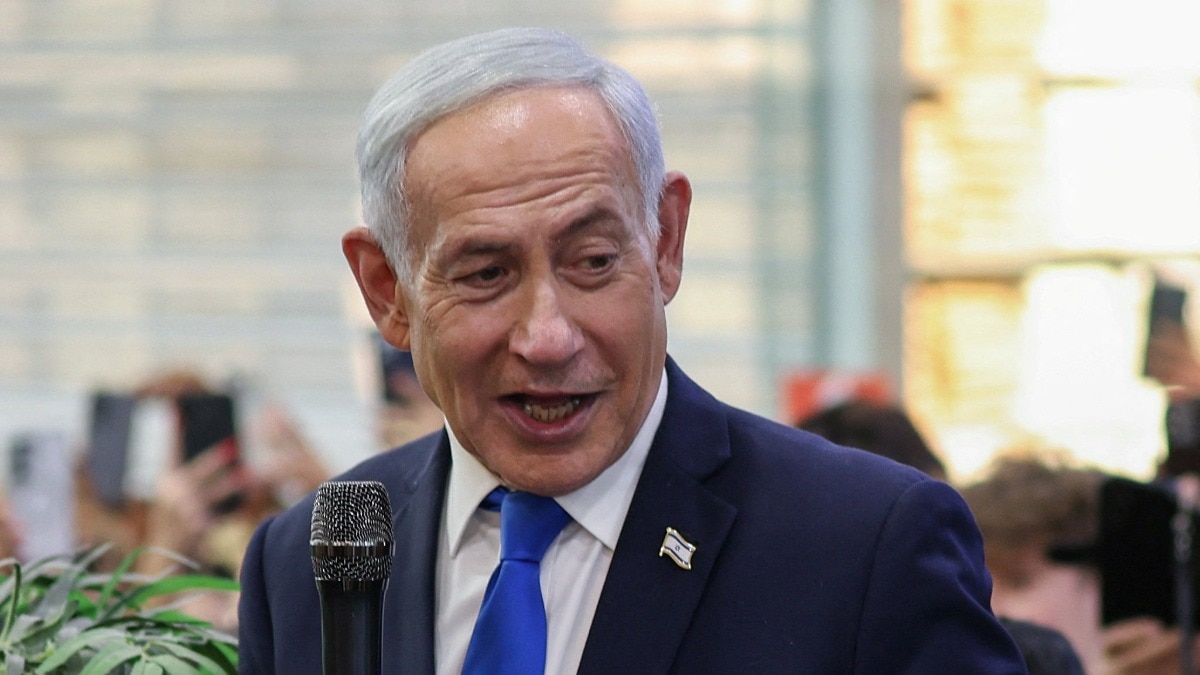
Hello and welcome to our coverage of the Israeli elections. Polls have opened in the first election since the Hamas-led attacks of 7 October 2023, Israel’s subsequent destruction of Gaza, and the launch of its war with the US against Iran.
Most polling shows prime minister Benjamin Netanyahu’s coalition will lose its majority in the 120-seat Knesset, but the opposition bloc will probably also fall short of the 61 seats needed to form a government.
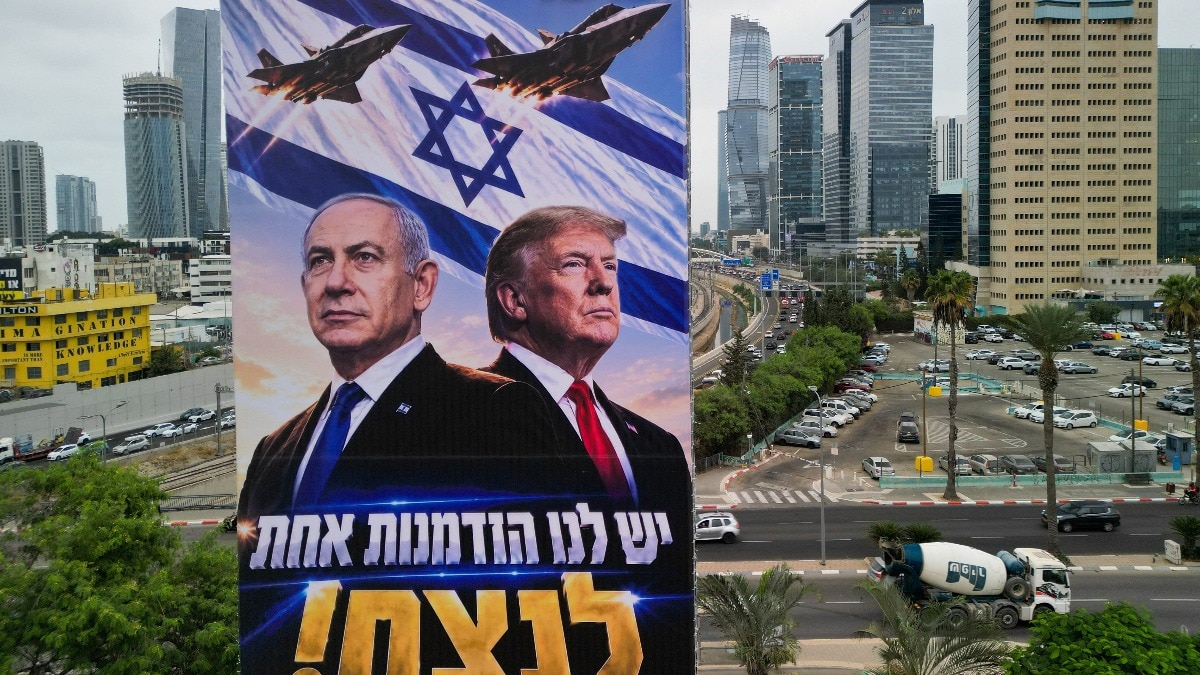
For Netanyahu, 76, who has led the most far-right government in Israel’s history, the stakes are both political and personal. He is on trial for corruption in three separate cases, despite interventions from Donald Trump, who called for a pre-emptive pardon in the long-running saga and even wrote to Israeli president Isaac Herzog on Netanyahu’s behalf. The cases are ongoing.
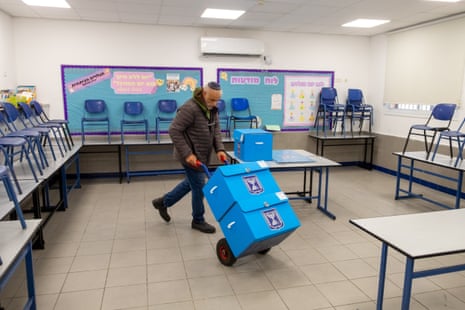
It was on Netanyahu’s watch that Hamas militants broke out from Gaza three years ago to kill nearly 1,200 people, the majority of them civilians, on the deadliest day in Israel’s history. This election is widely seen as a referendum on Netanyahu’s leadership since those attacks.
The IDF’s globally condemned assault on Gaza, which has killed at least 75,000 people and been deemed a genocide by a UN commission, academics, legal scholars and Israeli and international rights groups, has left Israel a pariah on the world stage.
Three years of regional conflict followed the 7 October attacks, including this year’s war on Iran, which sparked an ongoing global energy crisis and has killed thousands of people, mainly in Lebanon and Iran.
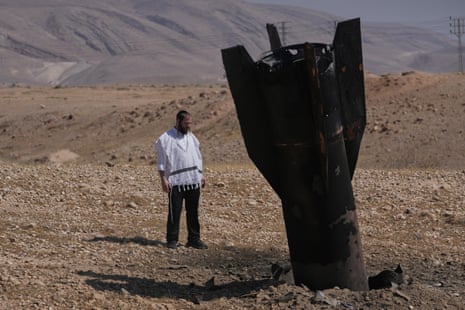
What is more, under Netanyahu’s government there has been an unprecedented, aggressive surge of deadly extremist settler violence to bolster Israeli control in the occupied West Bank, as settler militants and their political backers – who have propped up Netanyahu’s government – exploited their seat at the cabinet table and expanded with impunity.
Indeed, settlement expansion has been a key feature of Netanyahu’s re-election campaign. However, it is also a driving force behind Israel’s growing international isolation, with many of its traditional allies condemning “settler terrorists” and announcing plans to impose sanctions.
Key events
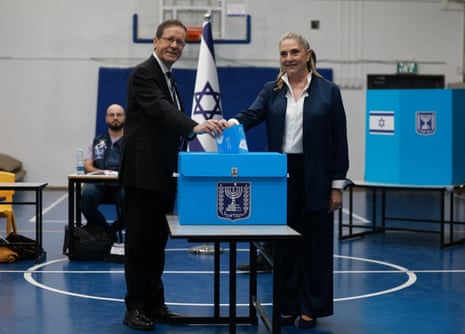
Israel’s president Isaac Herzog has voted in Jerusalem.
Herzog will play a crucial role in the days to come. After the final tally is in, he will consult party leaders on whom they want as prime minister and then invite the candidate he believes has the best chance of forming a government to try to form a coalition.
That nominee has up to 42 days to form a government.
Emma Graham-Harrison
Families bereaved in the 7 October attacks began election day with a protest at 6.29 am, the same time Hamas launched its attack just over three years ago.
They gathered in the Tel Aviv plaza that has become known as “hostages square”, because it was the centre of demonstrations demanding the return of over 200 captives from Gaza.
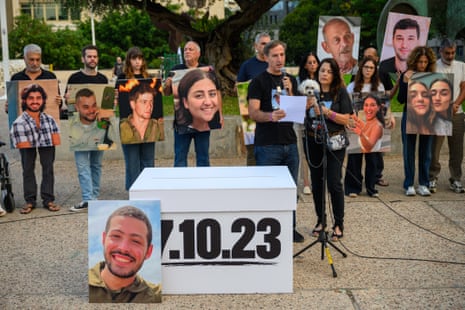
Holding pictures of their loved ones, they observed a minute of silence, then called on voters to remember the losses and betrayals of that day as they choose the next government.
“Three years after the massacre, our loved ones will not be voting today. Go out and vote – remember them at the ballot box. This is what these elections are about!” the group said in a statement.
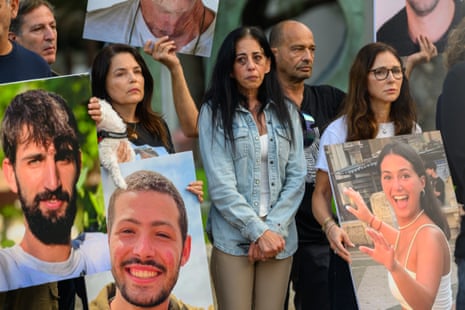
They are not explicitly backing any political party, but one of their key demands is a State Commission of Inquiry into the attacks.
Prime minister Benjamin Netanyahu has strongly resisted the prospect of an impartial probe, and it has become a rallying point for the opposition parties trying to unseat him.
Two days before the vote, relatives of the dead released a video making the same demand.
‘There’s a lot of racism, a lot of hatred’: Far right gains predicted as Israel heads to the polls
Emma Graham-Harrison
Four decades ago, when the extremist rabbi Meir Kahane won a single seat in Israel’s Knesset, other legislators passed a law to prevent him running again, left the chamber when he rose to speak and worked together to block discussion of his ethnonationalist proposals.
These ranged from mass expulsions of Palestinians to apartheid provisions such as segregated beaches and the criminalisation of sex between Jews and gentiles.
This month, Kahane’s political heirs may claim more Knesset seats in national elections than the remains of the once mighty Labor party, home of Yitzhak Rabin, Shimon Peres and Golda Meir.
At an election rally this week, Israel’s national security minister, Itamar Ben-Gvir, mixed calls for ethnic cleansing and jokes about starving Palestinian prisoners with a proud anecdote about his conviction in 1998 over bumper stickers that read “Rabbi Kahane was right”.
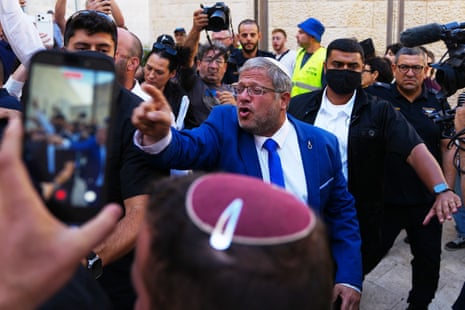
A poll for the Israel Hayom newspaper, published on 16 October, forecast his Jewish Strength party would win nine seats in the 27 October election. The Democrats, successor to the Labor party led by former general Yair Golan, were predicted to claim eight seats.
Ben-Gvir’s rise is one of the more extreme manifestations of a broad shift to the right among Jewish citizens of Israel. It is particularly pronounced among the young and will shape the country’s next government, regardless of who becomes prime minister after closely fought elections.
More than 500,000 Israelis have reached voting age since the last election in 2022, and three-quarters of first-time Jewish voters define themselves as right or centre-right, a recent poll for Channel 12 television found (it did not survey Palestinian citizens of Israel).
The generation voting for the first time came of age after the Oslo process collapsed, when the prospect of negotiating a political resolution to the Israel-Palestine conflict seemed to be fading.
They were teenagers during the Hamas attacks on 7 October 2023, which resulted in the deaths of about 1,200 people, the majority of them civilians. Militants took 251 living hostages and dead bodies to Gaza, leading to a two-year hostage crisis.
Erez Uzan, vice-chair of the Young Democrats, said:
There’s a lot of people, especially young people, who think that there is no solving the conflict, that we’ll always be at war. There’s a lot of racism, a lot of hatred, but most of all, there’s fear.”
Bucking global trends, young Israelis are more rightwing than older generations and are likely to vote in a new Knesset with more rightwing members than the current chamber, said Dahlia Scheindlin, a political analyst and public opinion researcher.

Consistently rightwing ultra-Orthodox and nationalist religious communities make up a growing proportion of Israel’s Jewish population but still account for only around a quarter of the electorate, so demographics alone do not explain the growing age gap on political issues.
“All Israelis, and particularly younger people, have been living in a political environment where not only is the government rightwing but the general terms of debate are really populist and ultra-nationalist. That’s all they know. They’re socialised into it,” Scheindlin said.
There’s been a real downplaying of anything to do with democracy, universal values or human rights. Those are seen as weak, if they’re discussed at all, possibly as bad as betrayal. And very few politicians talk about peace, concessions, negotiations, Palestinian self-determination, or even Palestinian wellbeing.”
The far right is on the rise globally, but Israeli politics that “revolve round constant conflict” heighten the appeal of ethnonationalist messages, Uzan said.
“We grow up in fear, seeing war all around us – and that leads to a certain perspective. In the last 20 years, our leadership in the centre-left camp has avoided talking about security issues,” Uzan said, adding they had ceded that ground to the right.
The rise of the far right and religious fundamentalism, combined with Netanyahu’s assault on institutions protecting Israel’s partial democracy (Palestinians living under Israeli military rule in the occupied West Bank do not have the rights of citizens), mean many Israelis on the centre and left see this vote as existential.
David Harel, the president of the Israel Academy of Sciences and Humanities, says the country’s current path leads towards a bleak future as a corrupt, impoverished pariah state, dominated by messianic fundamentalists maintaining a “violent, cruel occupation”.
“We are already in ‘stoppage time’. If we lose this time, there will be no second chance. The country we love so dearly will breathe its last. Plain and simple!” he told a rally in the northern city of Haifa.
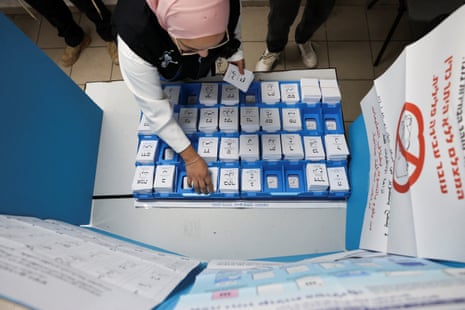
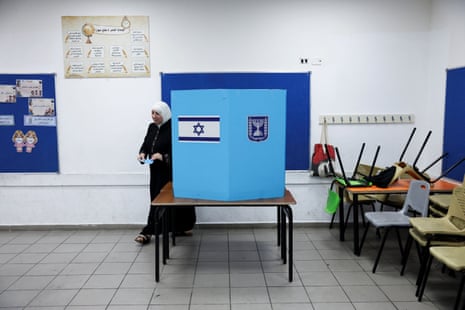
There are more than 12,000 polling station opening across the country. In Jerusalem, some voters were lined up before polls even opened at 7am, ready to cast their ballots.
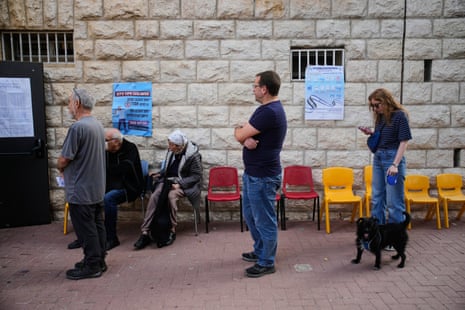
Just over 7 million Jewish Israelis and 1.7 million Palestinian citizens of Israel will be voting in the elections on Tuesday.
Unpolished, anti-Bibi, but evasive on peace: who is the Israeli opposition candidate Gadi Eisenkot?

Peter Beaumont
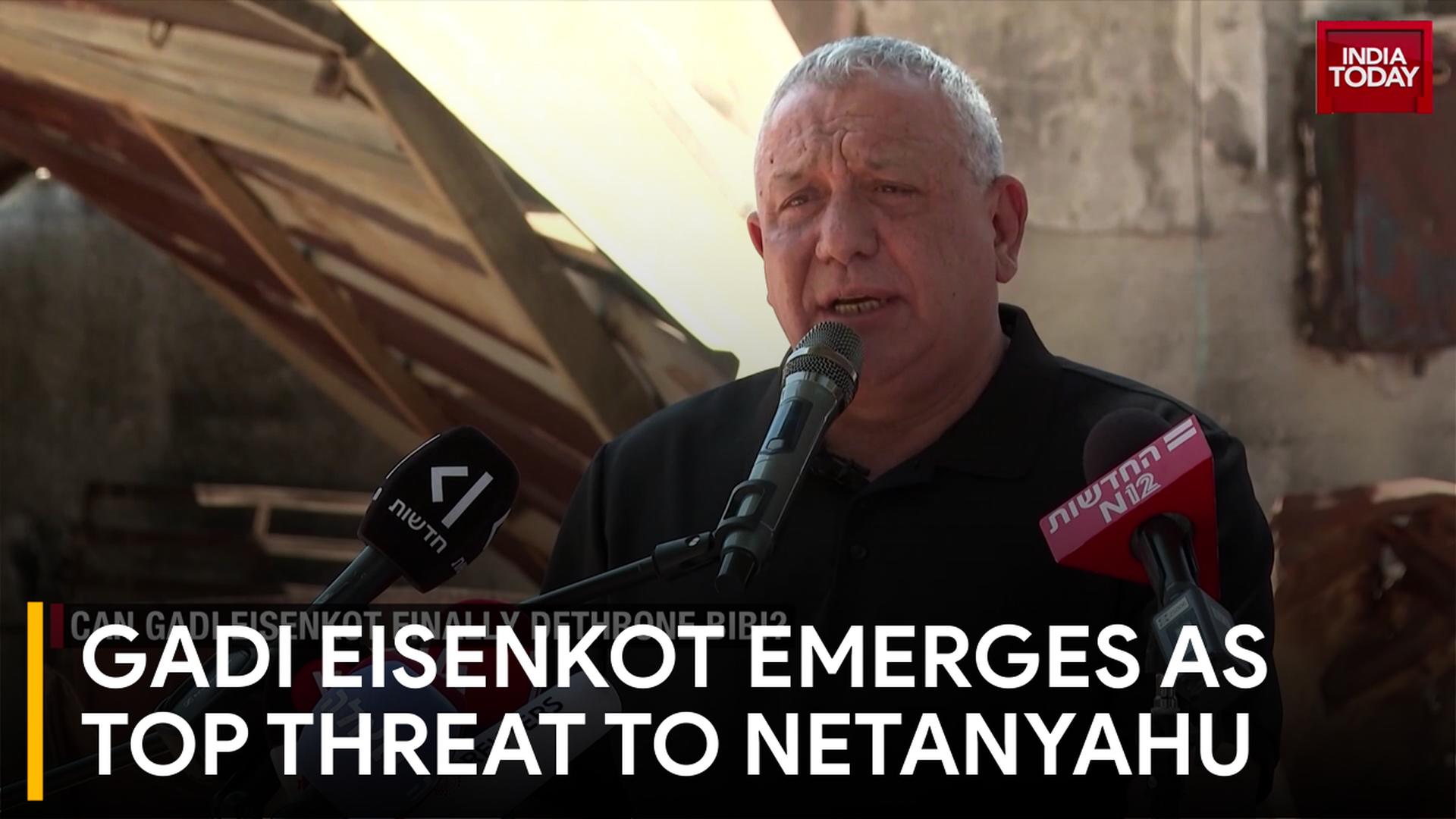
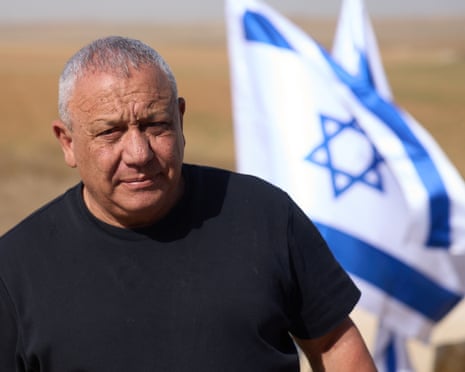
He has been called the man who is everything that Benjamin Netanyahu is not. Gadi Eisenkot, a former general and the main opposition candidate in Israel’s elections, is unpolished where Netanyahu is slick.
To Israelis he is both menschy (decent) and schlumpy (unkempt), his crumpled appearance contrasting with Netanyahu’s hair rinse, makeup and obsessive need to control his media depiction. In the Israeli commentator Anshel Pfeffer’s framing, he is the anti-Bibi among a roster of wanna-Bibis.
And in an era of Israeli politics that has been defined by betrayals, dirty tricks and public and private smears, Eisenkot’s brand is rectitude. He only entered politics four years ago, and the name of his party – Yashar – means “straight” or “honest”.
But on key issues, an Israel under Eisenkot may not look very different, as he has been non-committal on crucial issues – including the two-state solution and Israeli settlement of the occupied West Bank.
For many voters, Eisenkot’s appeal is less about ideology than the vibe around him. Key to his appeal, said Dahlia Scheindlin, an Israeli pollster and political analyst, is his “very modest background”. While Netanyahu is the son of a Polish-born academic, Eisenkot’s family were Mizrahi Jews from Morocco. He joined the army as an infantryman, and worked his way through the ranks to become the Israeli military’s chief of staff.
But what precisely does Eisenkot believe in? On the domestic front, he is pushing for a full investigation of the intelligence failures that allowed Hamas’s deadly 7 October 2023 attack. More divisive is his support for the end of the military draft exemption for the ultra-Orthodox, long a source of friction in Israeli society.
On the biggest issues, not least a two-state solution that would create a Palestinian state – he is ambiguous.
“I’ve never said that the solution is two states for two peoples,” Eisenkot said on the campaign trail. “There is a very deep religious-national conflict here, and anyone who thinks an agreement can be reached now is gravely mistaken.”
On the broader issue of Jewish settlements in the West Bank, Eisenkot is also evasive. He opposes the planned E1 settlement block that is seen as a potential obstacle to any future Palestinian state, but he supports settlement in general.
Where Eisenkot separates himself from the current government, is over Netanyahu’s decision to place the far-right, pro-settler minister Bezalel Smotrich in charge of the occupied West Bank, where there has been a surge of settler violence, prompting widespread international condemnation and sanctions. Eisenkot has said he would immediately “reverse” that situation and put the army back in charge of the West Bank.
“What Eisenkot and the rest are basically saying,” said Prof Yossi Mekelberg of the Chatham House thinktank, “is we’ll be better CEOs. We’ll manage the country better, not take it in a different direction … They are not really talking about the Palestinian issue.”
Eisenkot is unequivocally not a dove in his views on the use of military force. As Israel’s northern front commander during the 2006 second Lebanon war, he was the architect of the notorious Dahiya doctrine, promising that Israel would wield “disproportionate power … and cause immense damage and destruction” – a policy that would see its fullest expression in the current Gaza war.
On Gaza, he has been more of a military realist, insisting two years ago that Israel was unlikely to win “total victory” over Hamas, and calling for a strategy that prioritised the lives of hostages still held by Hamas. His son Gal Meir Eisenkot, 25, died of his wounds in late 2023 after an operation in Gaza to recover the bodies of Israeli hostages.
But while observers say an Eisenkot administration would be likely to crack down on settler violence in the West Bank, they wonder if it would go much further.
Read Peter’s full profile of Eisenkot here:
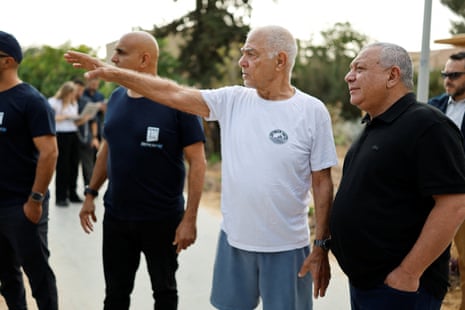
Gadi Eisenkot, Netanyahu’s main challenger in Tuesday’s elections, has already been out greeting voters at a polling station in Ofakim, in Israel’s south.
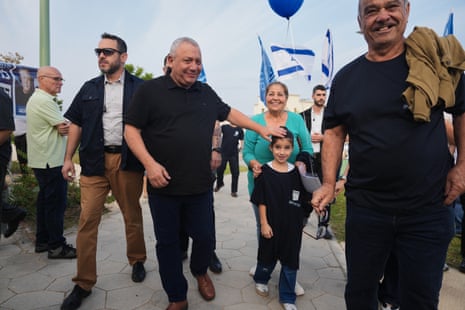
The former army chief of staff spent four decades rising through the ranks of Israel’s military. He now leads the largest opposition party – Yashar.
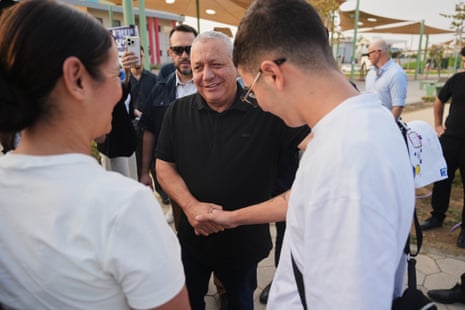
Ofakim was one of the communities that was attacked by Hamas on 7 October 2023. Eisenkot’s visit was likely aimed at reminding voters of the security failures ahead of that attack, and of Benjamin Netanyahu’s refusal to launch a state commission of inquiry into them.
Explainer: What you need to know about the most consequential election in Israel’s history
Emma Graham-Harrison
In Jerusalem
Israel is holding its first election since the 7 October 2023 Hamas attacks, the deadliest day in the country’s history, which resulted in the deaths of about 1,200 people, the majority of them civilians.
Since then Israel has pursued a war of annihilation in Gaza, launched two inconclusive wars with Iran, and intensified a campaign of state-backed ethnic cleansing in the occupied West Bank.
Domestically the coalition formed by Benjamin Netanyahu has taken aim at democratic institutions, including the supreme court. Many Israelis have described this election as the most consequential in their country’s history.
Here, Emma runs through everything you need to know – from the key players and issues, to when we can expect the results:
Polls open in elections for Israeli parliament
Hello and welcome to our coverage of the Israeli elections. Polls have opened in the first election since the Hamas-led attacks of 7 October 2023, Israel’s subsequent destruction of Gaza, and the launch of its war with the US against Iran.
Most polling shows prime minister Benjamin Netanyahu’s coalition will lose its majority in the 120-seat Knesset, but the opposition bloc will probably also fall short of the 61 seats needed to form a government.
For Netanyahu, 76, who has led the most far-right government in Israel’s history, the stakes are both political and personal. He is on trial for corruption in three separate cases, despite interventions from Donald Trump, who called for a pre-emptive pardon in the long-running saga and even wrote to Israeli president Isaac Herzog on Netanyahu’s behalf. The cases are ongoing.
It was on Netanyahu’s watch that Hamas militants broke out from Gaza three years ago to kill nearly 1,200 people, the majority of them civilians, on the deadliest day in Israel’s history. This election is widely seen as a referendum on Netanyahu’s leadership since those attacks.
The IDF’s globally condemned assault on Gaza, which has killed at least 75,000 people and been deemed a genocide by a UN commission, academics, legal scholars and Israeli and international rights groups, has left Israel a pariah on the world stage.
Three years of regional conflict followed the 7 October attacks, including this year’s war on Iran, which sparked an ongoing global energy crisis and has killed thousands of people, mainly in Lebanon and Iran.
What is more, under Netanyahu’s government there has been an unprecedented, aggressive surge of deadly extremist settler violence to bolster Israeli control in the occupied West Bank, as settler militants and their political backers – who have propped up Netanyahu’s government – exploited their seat at the cabinet table and expanded with impunity.
Indeed, settlement expansion has been a key feature of Netanyahu’s re-election campaign. However, it is also a driving force behind Israel’s growing international isolation, with many of its traditional allies condemning “settler terrorists” and announcing plans to impose sanctions.