1 month ago
Israel passed a death penalty law, the West Bank burns nightly and Greater Israel talk grows louder. The pattern is no longer deniable and the world's response remains, at best, a polite expression of concern.
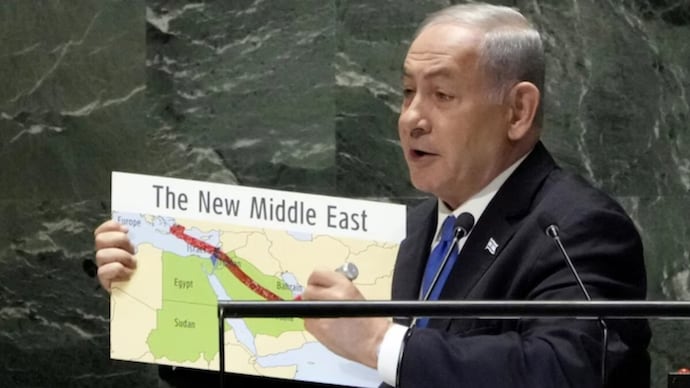
Israeli Prime Minister Benjamin Netanyahu addresses the 78th session of the United Nations General Assembly with a map showing Palestine as a part of Israel. (Image: File)

UPDATED: Mar 31, 2026 22:46 IST
Israel made history last week. That is what Security Minister Itamar Ben Gvir said as he celebrated with champagne on the floor of the Knesset, noose shaped lapel pins gleaming on the jackets of his colleagues. The history in question was a new law mandating the death penalty by hanging for Palestinians convicted of deadly attacks in Israeli military courts. Prime Minister Benjamin Netanyahu voted in favour. The bill passed 62 votes to 48. The celebration, by all accounts, was genuine.
The law is not subtle in its design. Palestinians convicted in Israeli military courts of killings deemed acts of terrorism face execution within 90 days of conviction, extendable to 180. A judge may commute the sentence to life imprisonment only in vaguely defined exceptional circumstances. The prosecution does not even need to request it. The death penalty is simply the starting point.
Critics were swift to point out what the law actually means in practice. Jewish Israelis are theoretically subject to it too, but the trigger clause requires that the killing was intended to "negate the existence of the State of Israel." Human rights groups noted with little surprise that this framing targets Palestinians almost exclusively. The Association for Civil Rights in Israel called it unconstitutional and discriminatory by design and filed an immediate petition with the Supreme Court. The United Nations Human Rights Office called on Israel to repeal it, warning it violated the prohibition on racial segregation and apartheid.
For the more than 9,300 Palestinians currently held in Israeli prisons, the law does not rewrite existing sentences overnight. It is not retroactive. But for the thousands still in the middle of military court proceedings, the landscape shifted sharply. Those courts carry a conviction rate of 96 per cent. The death penalty is now the default outcome for qualifying charges. The escape hatch is narrow and poorly defined. Amnesty described the law as a public display of cruelty and discrimination, noting it arrived just weeks after Israel dropped all charges against soldiers accused of sexually assaulting a Palestinian detainee.
The law did not arrive in isolation. While the Knesset voted, the West Bank endured another week of what the United Nations Office for the Coordination of Humanitarian Affairs now describes as a sustained campaign of settler violence. More than 1,697 Palestinians were displaced in the first three months of 2026 alone, already surpassing the total for all of 2025. Human Rights Watch documented five Palestinians shot dead by settlers in just 11 days in March. Homes were torched, vehicles burned, funerals attacked. Israeli forces, when they arrived at all, were frequently late.
The Israeli government allocated an additional 50 million shekels for security equipment at illegal settlement outposts, covering drones, night vision goggles and generators. At least 191 illegal outposts have been established under the current government. Settlers use livestock to assert control over agricultural land. The infrastructure of displacement is methodical and well funded.
This is the context in which Greater Israel, long dismissed as a fringe aspiration, now demands serious examination. The term refers to Israeli control over the entirety of the land between the Jordan River and the Mediterranean Sea, with no viable Palestinian state. What once sounded like a slogan increasingly resembles a policy checklist. Legal barriers to settlers purchasing West Bank land have been removed. Military operations now enter areas that were under Palestinian Authority jurisdiction under previous agreements. Land registries have been opened to settlement expansion.
Over 600 prominent diaspora Jews signed a letter describing the violence as morally shameful and a strategic threat to Israel's future. More than 2,000 Israeli artists and 600 academics, including a Nobel laureate, added their voices. The majority of Israeli society, as one Hebrew University academic put it, stands against settler violence. The government, however, does not appear to be listening to the majority.
The United States, for its part, said it was concerned. Secretary of State Marco Rubio suggested Israel would maybe act. That single word, maybe, with a shrug attached, tells you everything about where the pressure to stop actually stands.
- Ends
Published By:
indiatodayglobal
Published On:
Mar 31, 2026 22:46 IST
Tune In