1 month ago
As the US leads fresh strikes on Iran, Israel has adopted an unusually low profile despite long pushing Washington towards military action. Analysts say the strategy buys Israel time to rebuild its defences, avoid direct retaliation and preserve diplomatic space, even as calls to "finish the job" persist at home.
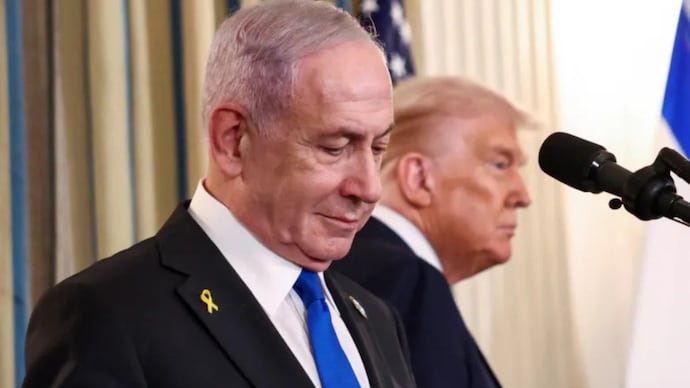
Why Netanyahu is watching the US-Iran conflict from the sidelines (Photo: Reuters)
As the United States and Iran edge closer to a wider conflict with fresh rounds of strikes, Israel has taken an unusually low profile. The silence is striking because Prime Minister Benjamin Netanyahu had long pressed Donald Trump to confront Tehran militarily, playing a key role in the run-up to earlier US-Israeli operations.
After all, it was Netanyahu who had successfully sold the idea of eliminating Ayatollah Khamenei and Iran's top leadership in a single blow, paving the way for the joint US-Israeli strikes on February 28 and the war that followed.
Even ahead of the latest escalation, Israel shared fresh intelligence with the Pentagon about an alleged Iranian assassination plot targeting Donald Trump, a move that, among a host of other factors, ultimately pushed the US President towards the ongoing military action.
Yet, with Washington now leading the attacks on Iran, Israel has stepped back from the public stage. So, what explains this shift?
A SAFER DISTANCE FROM IRAN'S FIRE
Israel's strategy of staying on the sidelines has, for now, spared it from becoming the primary target of Iranian retaliation, while other regional players hosting US military bases -- such as Bahrain, Kuwait, Jordan and Oman -- have borne the brunt of Tehran's retaliation.
This gives Israel valuable time to quietly replenish its already strained air-defence systems. Notably, in the latest round of strikes, the US has also avoided using Israeli territory as a launch pad.
But the balancing act may not last. With tensions between the US and Iran capable of spiralling into a wider war with a single misstep by Tehran -- or a direct attack on Israel -- Netanyahu knows his country may not be able to stay on the sidelines indefinitely.
THE 'FINISH THE JOB' VOICES
However, Israel's muted public posture does not necessarily reflect a lack of appetite for renewed military action.
According to The New York Times, calls to "finish the job" have persisted in Israel since the ceasefire with Iran in April. Many within the country's security establishment believe the campaign ended before Israel could strike key Iranian energy infrastructure and other strategic targets that, in their view, might have severely weakened the Islamic Republic.
"Everybody in the defense establishment and the government is rooting for another shot," Nimrod Novik, a former adviser to ex-Israeli Prime Minister Shimon Peres and now a fellow at the Israel Policy Forum, told The New York Times.
"There's an old IDF slogan -- just one more hill, and victory is assured," he said, while cautioning that history has rarely borne out that assumption.
Novik also told The New York Times that much of the Israeli public would be willing to endure more missile attacks and disruptions to daily life if it meant permanently eliminating what they see as the Iranian threat.
WHY NETANYAHU IS HOLDING BACK
At the same time, analysts quoted by The New York Times cautioned that another war would come at a significant economic cost for Israel, while any expanded campaign against Iran's infrastructure would likely inflict greater suffering on Iranian civilians than on the country's leadership.
The newspaper also reported that Netanyahu's relative silence during the latest round of hostilities reflects a broader strategic calculation.
Analysts told The New York Times that Israel cannot afford to be seen internationally as the country pushing for another war, especially amid the widespread perception that Netanyahu played a major role in drawing US President Donald Trump into the earlier conflict.
For now, that has left Israel pursuing what many see as the least risky option: waiting while Washington and Tehran remain locked in a cycle of strikes and counterstrikes.
Another reason cited by analysts is that if Israel were to launch airstrikes on Iran, it would also have to use the airspace of Jordan, Syria and Iraq, broadening the theatre of engagement and further escalating the regional crisis.
A WARNING BENEATH THE SILENCE
Even so, Netanyahu has made it clear that Israel will respond with far greater force if it comes under attack.
"I will say this to the leaders of Iran: Do not count on it being quiet if you attack us," he said at a conference in Dimona, southern Israel, a city that was hit by Iranian missiles in March.
"Do not count on a rerun. Because it will not be a rerun, and that was already powerful enough. This will be a different event, much more powerful."
Yet, the waiting game carries risks of its own. Danny Citrinowicz, a retired Israeli military intelligence officer specialising in Iran, told The New York Times that while the US and Iran exchange missiles, drones and threats, Tehran could be quietly advancing its nuclear programme beyond international scrutiny.
With inspectors from the Atomic Energy Agency still barred from Iran, he said, Israel must increasingly rely on its own intelligence network to gauge Tehran's intentions.
- Ends
Published By:
Sayan Ganguly
Published On:
Jul 16, 2026 12:08 IST