 1 hour ago
Italy’s government is sending 500 soldiers to Milan and vowed a “firm response from the state” after protests against the cost of living descended into clashes with police, vandalism and looting. Further demonstrations are planned on Saturday.
The government of the far-right prime minister, Giorgia Meloni, is also planning to swiftly approve tougher new security measures, including extending preventive detention for minors, cracking down on youth gangs and banning gatherings for people deemed a threat to public order, Italian media reported on Tuesday.
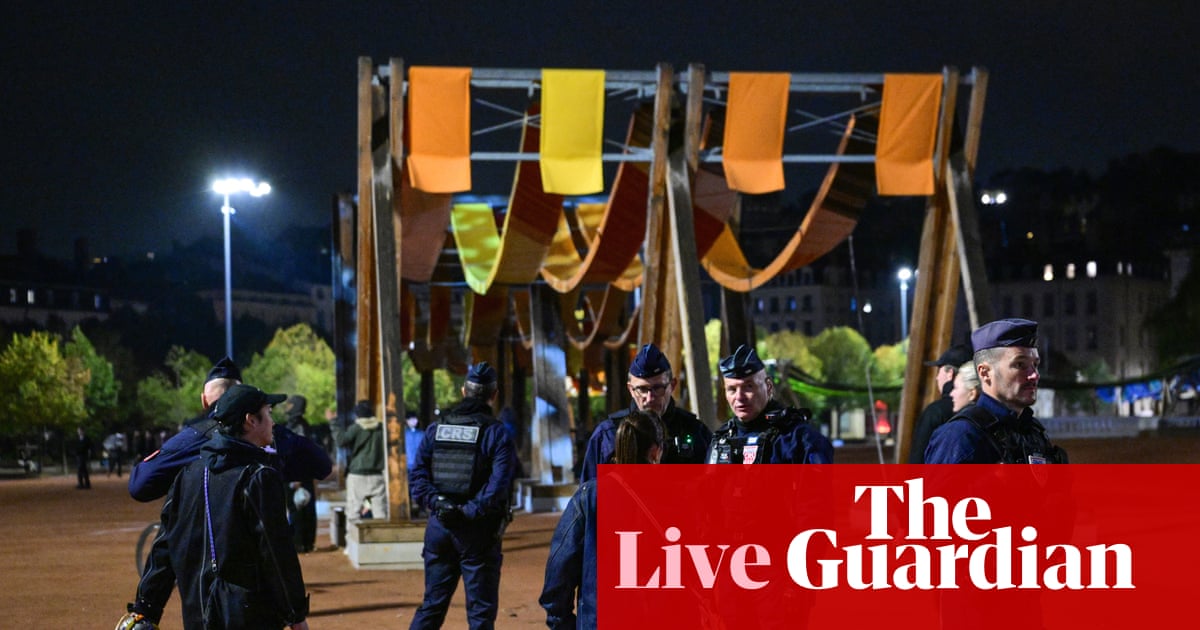
In France, the interior minister, Laurent Nuñez, said on Tuesday some military forces would be deployed during protests planned for this Saturday, “mostly to free police and gendarmes in their mission to maintain order”.
The French prime minister, Sébastien Lecornu, told parliament that the police presence during Saturday’s demonstrations would be “massive” and that his goal was for an “immediate return to order” after last weekend’s violent riots.
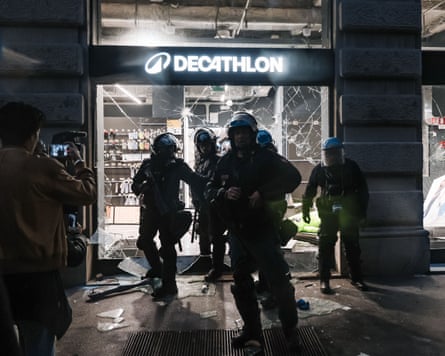
Police in Milan, in northern Italy, detained 271 young people after hooded youths set bins ablaze, ransacked shops and smashed windows, including in the area surrounding the city’s cathedral, during the unrest on Saturday and Sunday.
Police used teargas and water cannon to disperse the violent groups, who were on the fringes of an initially peaceful protest. Of those detained, 32 have been arrested, including 23 minors and 13 foreign nationals, police said on Monday. A further 28 people were reported to judicial authorities.
Images of Saturday’s clashes in France, including mobs looting shops and public buildings set on fire, prompted several countries including the US, China and Germany to issue travel advice for their citizens. Nearly 2,400 people were arrested in one of France’s most violent recent bouts of unrest.
French authorities on Monday announced partial curfews in several cities, including Paris, Bordeaux, Lille and Nice, and after a night of relative calm, Lecornu said on Tuesday that new curfews would be imposed where they were needed.
Authorities in Paris renewed Monday night’s curfew, which would apply from 11pm on Tuesday until 6am on Wednesday to the Place de la République, where many of the weekend clashes took place, and in the central Les Halles shopping district.
Paris police ordered a temporary ban on people carrying cans or bottles of petrol or gas, and banned masks and helmets in some areas. A man was also arrested in connection with the burning down of the historic town hall in Limoges.
The Italian press agency Ansa reported that one of the security measures being considered in the country was aimed at second-generation immigrant youths, known as maranza – a slang term used to describe gangs of young people, usually from marginalised areas.
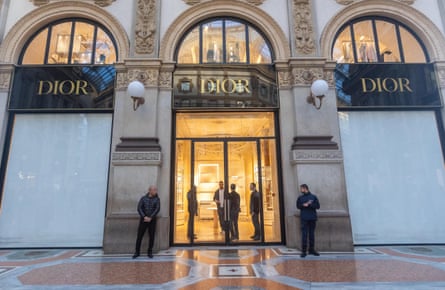
Many luxury stores in Milan’s fashion district have stayed closed amid fears of further unrest. Brands including Chanel, Tiffany and Dior removed merchandise from their windows as a precaution.
Other stores ransacked included the sports retailers Decathlon and Arc’teryx and the mobile phone operator Vodafone, footage showed.
“The government will respond firmly to these attacks on the state, including through measures aimed at curbing violence by minors,” the foreign minister, Antonio Tajani, who also serves as deputy prime minister, said after Meloni chaired a meeting with top security officials on Monday.
Meloni’s coalition, which is facing a general election next year, is reportedly planning tougher penalties for road blockades after days of protests in southern Italy by lorry drivers over fuel prices.
skip past newsletter promotionafter newsletter promotion
Meanwhile, Milan is bracing for further protests on Saturday after a new movement, called 17 October, emerged on social media. It said it would organise demonstrations there and in other Italian cities each Saturday afternoon “until this government of thieves collapses”.
“You are the violent ones,” the group said. “You, who denied us a future. Now, we are claiming that future ourselves.”
Opposition politicians often accuse the government of using security as a propaganda tool, arguing that Italy’s leaders do little to address core issues such as education, housing and living conditions in marginalised areas.
There were also tensions during protests at the weekend over the high cost of living in other northern Italian cities, including Bologna, Brescia, Bergamo and Turin, where 28 protesters were arrested, police said.
Thousands also rallied in Lisbon and other Portuguese cities on Tuesday evening, hours after police dismantled housing protest camps at dawn and arrested 55 people.
Demonstrators in Portugal are protesting soaring housing costs, seeking to align themselves with similar actions in neighbouring Spain, where tents have been set up in central Madrid for weeks.
In Lisbon, thousands of people gathered in the central Rossio square, where protesters voted by a show of hands to re-establish their tent camp from Wednesday.
“They forced me on to the streets to shout”, read one placard. Another declared: “Lisbon is not for sale”.