1 month ago
Healey criticises Reeves for being 'unwilling' to fund defence by enough, and Starmer for being too weak to over-rule her
Here is one of the key extracts from the letter.
This new era for defence required further investment through the defence investment plan. The excellent and extensive cross-government work that completed in January – overseen by you, me and the chancellor – confirmed the scale of the challenge and the rising demands on defence.
Since then, you have been unable, and the Treasury has been unwilling, to commit the resources that the nation needs to defend the country at this time of rising threats.
This is a double hatchet job. John Healey is criticising Rachel Reeves for being too stubborn to increase defence spending by the amount he wants, and Keir Starmer for being too weak to over-rule her.
Key events
Ed Davey, the Lib Dem leader, has said that John Healey’s resignation should be a wake-up call for the government. He said:
Healey’s resignation is a wake-up call for Starmer and Burnham.
Stop repeating the mistakes of the Conservatives and get serious about funding our armed forces properly.
We cannot afford years more political chaos while our national security is put at risk.
And these are from Emily Maitlis, one of the hosts of the News Agents podcast, on Healey’s resignation.
BREAKING: John Healey I have been told that John Healey only got the full offer on Monday afternoon - No 10 tried to rush and publish the Defence investment Plan on Thursday. Healey was clear that rushing through the plan was too risky for defence and personnel, as the plan needed to be properly finalised and was too important. Chiefs said that £13.5B - which was only £10b real cash, the rest being treasury trickery - would not end hollowing out and would delay key transformation
I understand that John Healey had agreed the Strategic Defence Review on the basis it MIGHT NEED TO BE ACCELERATED if things changed. NATO as we know has said we have to be ready for conflict by 2030 - meawhile Russian aggression is at record highs, wars on two continents etc. The PM recognised this in Munich. But the deal the PM offered didnt even put a date on 3%.
This is from Deborah Haynes, defence and security editor at Sky News, on John Healey’s resignation.
BREAKING: The Treasury only offered the Ministry of Defence an extra £10bn in real cash for its investment plan over four years - the actual settlement was an additional £13.5bn but £3.5bn of that was regarded by military chiefs as treasury trickery. John Healey told the Prime Minister the promised funding was not enough to keep the UK safe.
Healey says he would have to take decisions that could make UK 'less safe' if he accepted PM's defence plans
Here is a summary of all the points in John Healey’s resignation letter.
Healey said the version of the long-awaited defence investment plan (DIP) that he saw on Monday this week would see defence spending rise to just 2.68% of GDP by 2030. (See 12.44pm.)
He criticised Rachel Reeves, the chancellor, for being unwilling to give defence more, and Keir Starmer for being unwilling to over-rule her. (See 12.30pm.)
He said he was resigning because he did not think defence was getting enough and, under these plans, he would have to take decisions that could make Britain “less safe”. He said:
You know what defence needs. You made the argument for this powerfully in your speech at the Munich Security Conference back in February. Without a DIP that meets the moment in this way, I am being forced to make decisions that would reduce the readiness of our forces and increase the risk to personnel on operations, and could make the country less safe.
After explaining to you that I would not be able to accept a DIP settlement that does not give our forces the resources they need, I am now left with no other option than to submit my resignation as your defence secretary.
He reminded Starmer that, in a speech last week, Starmer said: “It is our intelligence assessment, and the assessment of other countries in Nato, that there could be an attack by Russia on Nato as soon as 2030.”
Healey said he was resigning “with great regret and reluctance”.
He said he was proud of some of his achievements as defence secretary.
I am proud of what we have done in less than two years as a Labour government. We’ve stepped up to lead internationally for Ukraine with the coalition of the willing and Ukraine Defence Contact Group, established Britain as a leading voice for Europe in NATO, raised defence investment to 2.5% of GDP three years earlier than anyone expected, launched the deepest defence reforms in 50 years, won the biggest UK defence export deals for decades, published a first-of-its-kind Strategic Defence Review, gave our Armed Forces the biggest pay rise in nearly 20 years, boosted military morale, fixed over 1,200 of the worst forces family homes, reset relations with European allies and signed major defence agreements with Germany, Norway and France.
You have led this as PM, earning wide respect at home and abroad. Like me, I know you are exceptionally proud of our Forces and all of those who work in UK defence.
He said that Starmer is facing “exceptional challenges”. He ended his letter saying:
I wish you all continuing strength in the exceptional challenges you face as prime minister. As always, our Labour government will continue to have my fullest support.
This was the only reference in the letter to the leadership challenge that Starmer if facing after next week’s Makerfield byelection. Healey’s resignation is likely to be seen as evidence that Starmer’s authority as PM is weakening. But there is no evidence that Healey would get a better defence settlement under Andy Burnham, or any other of the potential replacement leaders, and Healey’s resignation does not particularly help any of Starmer’s rivals.
Andy Burnham’s campaign has released a statement saying that when he spoke about “some recompense” for the Waspi women (see 11.50am), he was not talking about financial compensation. As the Times reports, a Burnham spokesperson issued a statement this morning saying:
Andy has always recognised the unfair way in which state pension equalisation was introduced.
As mayor of Greater Manchester, he supported Waspi women in the city-region with early access to concessionary travel, providing some recompense to them within affordability limits.
He accepts the final decision has been made in relation to financial compensation but has indicated an openness to considering similar schemes on the Greater Manchester model.
Healey says defence spending only set to rise to 2.68% of GDP by 2030 under proposed defence investment plan
Here is the key passage in the letter. In it, John Healey says the version of the long-awaited defence investment plan that he saw on Monday this week would see defence spending rise to just 2.68% of GDP by 2030.
He says:
We came into government, recognising Britain faced a new era of threat which demanded a new era for defence. The SDR [strategic defence review] we jointly commissioned set the 10-year vision to transform our armed forces, strengthen alliances, invest in the technology that is changing warfare and back British industry to make defence an engine for growth.
This new era for defence required further investment through the defence investment plan. The excellent and extensive cross-government work that completed in January – overseen by you, me and the chancellor – confirmed the scale of the challenge and the rising demands on defence.
Since then, you have been unable, and the Treasury has been unwilling, to commit the resources that the nation needs to defend the country at this time of rising threats.
Since then, the demands on defence have increased still further, as have the UK commitments you have rightly made to allies. Conflict in the Middle East, with the UK now leading the multinational Strait of Hormuz military mission; High North security, with the UK now leading Nato’s Arctic Sentry mission; increased Russian activity towards the UK and Nato nations and increased attacks in Ukraine, with the Paris agreement confirming a British deployment to Ukraine after a ceasefire.
We have worked to secure a defence investment plan that does two things. First, deal with the increasing operational demands on defence now and step up the SDR actions to meet the increasing threat. Second, set a clear path to meet the new Nato commitment you agreed to spend 3.5% of GDP in 2035 through the next spending review.
As we have regularly discussed, I am certain that a headmark date for 3% of GDP on defence in 2030 is what Britain must set. This commitment would have strong cross-party support. Other European allies are stepping up in this way.
I know how hard you have worked to get to this point. And in funding the DIP, I fully recognise the strain this places on colleagues in other departments, both now as you have required spending switched into defence and in the future. I am very grateful to those colleagues who have supported this, and I appreciate how difficult their choices will have been.
As I’ve outlined to you, there are credible ways of meeting the mid-term funding challenges, working multi-nationally and as other European nations are doing, to allow us to protect our ability to deliver the missions of our Labour government.
However, your DIP financial settlement – which I was first given in full on Monday afternoon this week – falls well short of what is required for defence and the country at this dangerous time. The extra support is backloaded when the pressure of operations and imperative to speed up readiness to fight is in the first two years and it rises to just 2.68% of GDP in 2030, when we will reach 2.6% next year with the investment we are already making.
The government still has not published the final DIP. At the weekend there were reports it might come today, and then there were reports that it might come tomorrow. In the Commons yesterday Lindsay Hoyle, the speaker, said that an announcement like that on a day when the Commons was not sitting would be “an utter disgrace and an utter kick in the face” to MPs. Ministers subsequently made it clear the DIP would not be published tomorrow.
Healey says spending increase in defence investment plan 'falls well short of what is required'
Healey says the version of the defence investment plan (DIP) he was shown on Monday “falls well short” of what is required. He says:
However, your DIP financial settlement – which I was first given in full on Monday afternoon this week – falls well short of what is required for defence and the country at this dangerous time.
The extra support is backloaded when the pressure of operations and imperative to speed up readiness to fight is in the first two years and it rises to just 2.68% of GDP in 2030, when we will reach 2.6% next year with the investment we are already making.
Healey criticises Reeves for being 'unwilling' to fund defence by enough, and Starmer for being too weak to over-rule her
Here is one of the key extracts from the letter.
This new era for defence required further investment through the defence investment plan. The excellent and extensive cross-government work that completed in January – overseen by you, me and the chancellor – confirmed the scale of the challenge and the rising demands on defence.
Since then, you have been unable, and the Treasury has been unwilling, to commit the resources that the nation needs to defend the country at this time of rising threats.
This is a double hatchet job. John Healey is criticising Rachel Reeves for being too stubborn to increase defence spending by the amount he wants, and Keir Starmer for being too weak to over-rule her.
Here is John Healey’s resignation letter.
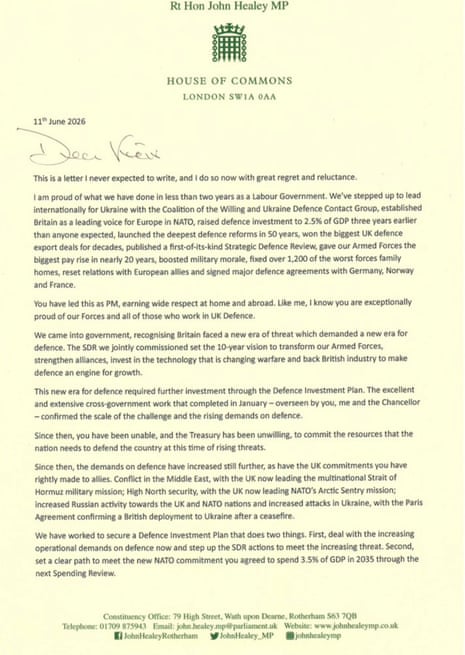
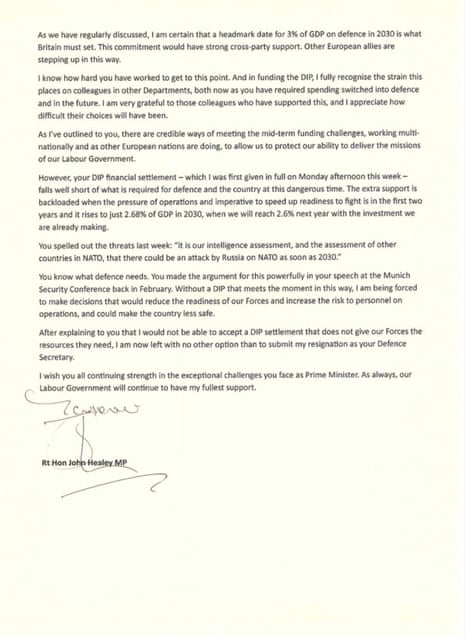
John Healey has resigned as defence secretary over Treasury refusing to give defence investment he says it needs
Reuters has snapped this.
HEALEY TO STARMER: YOU HAVE BEEN UNABLE, AND THE TREASURY HAS BEEN UNWILLING, TO COMMIT THE RESOURCES THAT THE NATION NEEDS TO DEFEND THE COUNTRY AT THIS TIME OF RISING THREATS
Irish and UK governments, and NI's executive, agree to work together to 'prevent abuse' of common travel area
The UK and Irish governments and the Northern Ireland executive have discussed protecting the common travel area and stronger enforcement to “prevent abuse”, the Irish government has confirmed.
Northern Ireland secretary Hilary Benn, Irish justice minister Jim O’Callaghan and Stormont’s justice minister Naomi Long spoke by phone on Wednesday.
Today in a statement the Irish government’s Department of Justice said:
The invisible border on the island of Ireland is among the most tangible gains of the peace process and is essential to the continuing normalisation of relationships.
Minister O’Callaghan discussed the importance of cross border cooperation in protecting the common travel area [CTA] for both Ireland and the UK yesterday by phone with the Northern Ireland minister for Justice, Naomi Long and the secretary of state for Northern Ireland, Hilary Benn.
They discussed stronger co-operation and enforcement to prevent abuse of the common travel area.
Minister O’Callaghan emphasised that significant Border Management Unit doorstop operations now take place at Dublin airport. The number of people landing without documentation has reduced significantly since 2023.
Northern Ireland minister for justice Naomi Long and secretary of state for Northern Ireland, Hilary Benn, agreed to work with Minister O’Callaghan to prevent abuse of the CTA.
The rioting in Belfast has been triggered by a brutal knife attack that happened on Monday night. The suspect is a Sudanese national who arrived in Belfast from Dublin, taking advantage of the CTA to cross the border without being stopped. He applied for asylum and was granted leave to remain three years ago. The stabbing has prompted claims that the CTA leaves a “loophole” in border controls that is being exploited by asylum seekers.