1 hour ago
Black-and-white 'Kalema' flags have appeared across Bangladesh during the FIFA World Cup season, raising an alarm in security circles. Analysts said it points to the rising footprint of foreign extremist groups in Bangladesh.
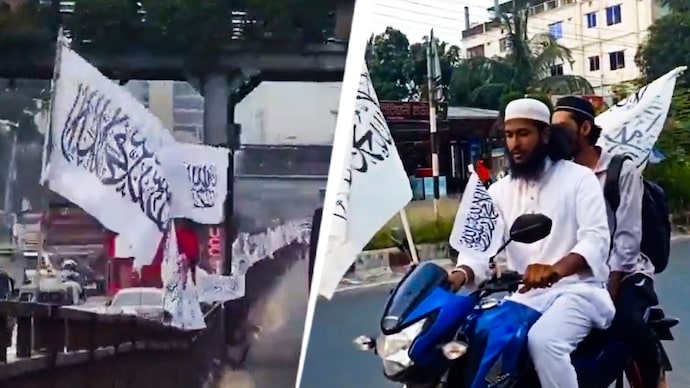
Bangladesh has seen a spurt in motorcycle processions and rallies carrying Kalema flags
Amid the FIFA World Cup frenzy, a familiar sight has returned in Bangladesh - rooftops and flagpoles draped in Brazilian and Argentinian flags. Along with them, black and white flags bearing the Kalema (the Islamic declaration of faith) have mysteriously appeared along busy roads and residential neighbourhoods. It has raised an alarm in Bangladesh, as such flags have been associated with terror outfits such as al-Qaeda and the Islamic State. It is also concerning for neighbouring India, with experts suggesting that it points to the rising footprints of foreign extremist groups in Bangladesh.
These flags, with Arabic inscriptions, were first spotted on a flyover in the capital Dhaka on June 17. Since then, these flags have sprung up across Mirpur, Chattogram, Cox's Bazar and Faridpur, according to a report in Dhaka Tribune. Visuals of motorcycle processions and rallies carrying similar flags have also been circulated widely on social media, putting the police and security agencies on tenterhooks.
Bangladesh is going backwards fast with these white TTA flags everywhere. Pushing extremism will only bring more poverty, violence and failure to your country. Stop copying Taliban style and focus on education and progress instead of destroying your future with blind pic.twitter.com/hpUfA2u3zX— True Patriot (@TruePatriot7868) June 29, 2026
WHAT ARE THE KALEMA FLAGS SEEN IN BANGLADESH?
Two distinct types of flags have been seen. Both carry the same Arabic text - 'La ilaha illallah', meaning there is no deity worthy of worship except Allah. On one flag, the text is black against a white background. On the other, the text is white against a black background.
The first is the Taliban flag. The other has been used by terror outfits like al-Qaeda, the Islamic State, and Hizb ut-Tahrir, a banned outfit that has swiftly expanded its operations following the 2024 unrest.
Last year, the Hizb ut-Tahrir held a 'March for Khilafat' in front of Dhaka's main mosque, drawing over 2,000 people. The outfit, which was banned by the previous Sheikh Hasina regime in 2009, has long pushed for the establishment of a global caliphate.
It is, however, not known if the Hizb ut-Tahrir is behind the rallies, and the sudden mushrooming of Kalema flags. The development has sent Bangladeshi security circles into a tizzy.
In some places, the marchers identified themselves as 'Tawhidi Janata', a loosely organised Islamist group that aims to defend Islamic monotheism. Over the past two weeks, several rallies have been held under this banner. Interestingly, the Palestinian flag was also seen in one of the processions.
Last year, groups allegedly belonging to 'Tawhidi Janata' were involved in attacks on shrines, Sufi institutions and Baul gatherings in Bangladesh.
Recently, the Israeli envoy to India, Reuven Azar, warned of increasing Hamas activity in Bangladesh and Pakistan. It is no secret that Bangladesh has a long history of sympathy for the Palestinian people. However, giving space to foreign jihadist narratives is a matter of concern, Azar has warned.
The past year has also seen a surge in interactions between Hamas leaders and Pakistan-based terror groups.
M Sakhawat Hossain, a former adviser to the previous interim government, said security agencies should zero in on who is behind the campaign and the motive behind it.
In the past few days, flags bearing the Kalema have also appeared on Facebook and online marketplaces. Several religion-based pages on Facebook have also promoted the flags.
In Dinajpur, organisers of a similar procession posted on Facebook that their march was a protest against persecution of Muslims in different parts of the world.
"We want to present Islam to the people and instil the Kalema in their hearts. We also want people to avoid the frenzy over the football World Cup," Mufti Abu Bakar Siddique, one of the organisers, told the media.
An undated video has also emerged of Hefazat-e-Islam leader Mufti Harun Izhar, in which he is heard urging the youths to place the Kalema flags everywhere. The outfit is a tightly-knit coalition of a dozen or so Islamist organisations.
In the video, Harun Izhar argued that if such flags were treated as a symbol of militancy, then the flags of Argentina and Brazil should also be brought down. "If this is militancy, then the Argentina and Brazil flags must also be taken down," Izhar says in the video.
SHOULD INDIA BE CONCERNED?
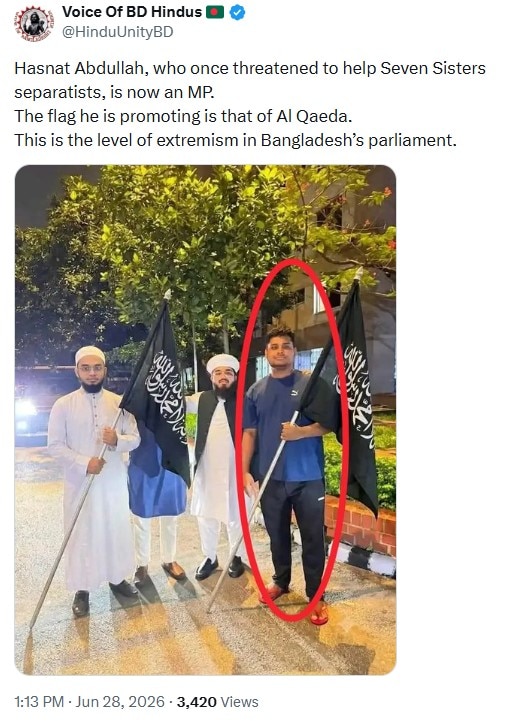
Recently, Bangladeshi MP Hasnat Abdullah, known for his anti-India rhetoric, was seen with the al-Qaeda flag. Abdullah, among the key leaders behind the 2024 uprising, had recently threatened to "cut off" the Seven Sisters from India.
While no action has been taken so far, Bangladesh security agencies are closely monitoring the situation and have started a probe into the motives behind the sudden display of Kalema flags.
"It seems a group is trying to bring some behaviour or culture of foreign extremist groups into the mainstream. It appears they are trying to gain the moral support of ordinary religious people in the name of the Kalema," a Bangladeshi counterterrorism official told bdnews24.
Security analysts have warned that such developments could push Bangladesh further towards extremism, risking trade and diplomatic ties.
For India, which shares a porous 4,000 km border with Bangladesh, the developments are concerning. Under the previous Muhammad Yunus regime, radical outfits got a free run, and several hardline Islamists were released from prison. Outfits like the Hizb ut-Tahrir ramped up recruitment and expanded their reach.
Associate professor and criminology expert Dr Touhid Hoque of Dhaka University has cautioned that the campaign could be a "rehearsal" for an extremist group to signal its presence and influence.
It remains to be seen how the new regime under Prime Minister Tarique Rahman deals with this fresh challenge that could well have cross-border implications.
- Ends
Published By:
Abhishek De
Published On:
Jun 30, 2026 12:37 IST