 1 month ago
Labour MP Jonathan Brash says Starmer should go to end 'pyschodrama' distracting from Labour's achievements
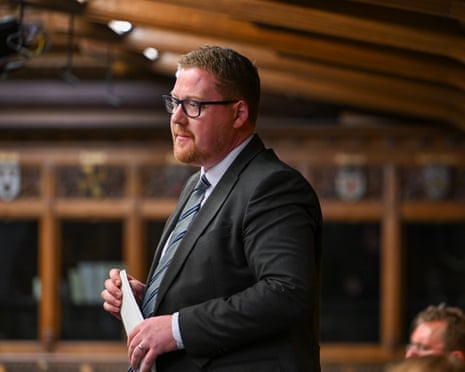
The Labour MP Jonathan Brash, who was elected in 2024 for Hartlepool (Peter Mandelson’s old seat), has told GB News that he thinks Keir Starmer should resign.
He claimed that Starmer’s resignation was now inevitable, and that the distraction provided by the Mandelson scandal was making it hard for the government to do its job.
He said:
I’ve got to be clear, I am completely fed up to the back teeth of this psychodrama in Westminster, the own goals that are coming from the heart of this government.
Meanwhile, we’ve got fantastic Labour councillors, canvassers, activists up and down the country, working hard and delivering for their constituencies, like mine in Hartlepool, facing local elections in the shadow of this absolute mess. They just need to get a grip.
I’m completely fed up about it, and I think it’s got to the point now where I genuinely think that, as far as the prime minister is concerned, it’s not a case of if, it’s when.
Asked why Starmer should resign, Brash said:
Why? Because ultimately, we’ve become completely consumed by this turmoil at a time when that is not what the British public are focused on …
I just think we need to get a handle on this, because people out there are worried about their cost of living, they’re worried about their NHS, they’re worried about crime on their streets, and we’re completely consumed by this scandal, and it’s completely unacceptable …
It’s our responsibility to always be where the British public are.
Brash said that he was “very frustrated, very fed up” about the fact that the many “fantastic” things the government was doing, including investment in his constituency, were not getting attention because of Westminster scandals.
He also said he did not accept that replacing Starmer would hurt Labour electorally.
The reality is we have to focus on what the British people care about, and we’re being consumed by the psychodrama.
Only a handful for Labour MPs have, like Brash, publicly called for Starmer to go. But many more voice similar views in private.
Key events Show key events only Please turn on JavaScript to use this feature
Polanski says Greens should reform their policy process, amid fears too many of their pledges won't survive Daily Mail scrutiny
And, on the subject of the Greens, Zack Polanski, the leader, has said that he wants to change the way the party makes policy.
The Greens are the most democratic of all the main UK parties, because policy is voted on by members at the party’s conference and there is no mechanism for the leader to ignore or sideline what has been decided by activists, as happens in other parties.
Speaking to Sam Blewett for a Politico story, Polanski said:
Our policy making process came about when we had something like 20,000 members. We just hit 226,000, so in terms of how the conference process works, I think the obvious place I would start is – it’s not working as well as it should at the moment.
Polanski did not say in any detail how he would like to change the system, although he said he would like to see more power given to individuals “elected by the membership” to set policy.
Party officials told Politico that they were worried about a range of radical policies already on the books that could be designed “for the Daily Mail to ring us up about” and that they would wanted to cull some of these at the party conference in the autumn.
Jennie Formby, Labour’s former general secretary, says she has joined Greens
Jennie Formby, a former Labour general secretary, has defected to the Green party, in the latest sign that allies of Jeremy Corbyn are moving in large numbers to Zack Polanski’s party. Kiran Stacey has the story.
Labour MP Jonathan Brash says Starmer should go to end 'pyschodrama' distracting from Labour's achievements
The Labour MP Jonathan Brash, who was elected in 2024 for Hartlepool (Peter Mandelson’s old seat), has told GB News that he thinks Keir Starmer should resign.
He claimed that Starmer’s resignation was now inevitable, and that the distraction provided by the Mandelson scandal was making it hard for the government to do its job.
He said:
I’ve got to be clear, I am completely fed up to the back teeth of this psychodrama in Westminster, the own goals that are coming from the heart of this government.
Meanwhile, we’ve got fantastic Labour councillors, canvassers, activists up and down the country, working hard and delivering for their constituencies, like mine in Hartlepool, facing local elections in the shadow of this absolute mess. They just need to get a grip.
I’m completely fed up about it, and I think it’s got to the point now where I genuinely think that, as far as the prime minister is concerned, it’s not a case of if, it’s when.
Asked why Starmer should resign, Brash said:
Why? Because ultimately, we’ve become completely consumed by this turmoil at a time when that is not what the British public are focused on …
I just think we need to get a handle on this, because people out there are worried about their cost of living, they’re worried about their NHS, they’re worried about crime on their streets, and we’re completely consumed by this scandal, and it’s completely unacceptable …
It’s our responsibility to always be where the British public are.
Brash said that he was “very frustrated, very fed up” about the fact that the many “fantastic” things the government was doing, including investment in his constituency, were not getting attention because of Westminster scandals.
He also said he did not accept that replacing Starmer would hurt Labour electorally.
The reality is we have to focus on what the British people care about, and we’re being consumed by the psychodrama.
Only a handful for Labour MPs have, like Brash, publicly called for Starmer to go. But many more voice similar views in private.
Lord Butler, who was cabinet secretary between 1988 and 1998, has joined the long list of former senior civil servants criticising the decision to sack Olly Robbins.
In an interview on Radio 4’s the World at One, Butler said that getting rid of Robbins was “not in the national interest”.
He told the programme:
I think that the Olly Robbins episode has done a great deal of harm to the relationship between the politicians and the civil service.
Things work better, obviously, when politicians and civil servants work together harmoniously with mutual respect in the national interest
And this is an episode which will make this more difficult.
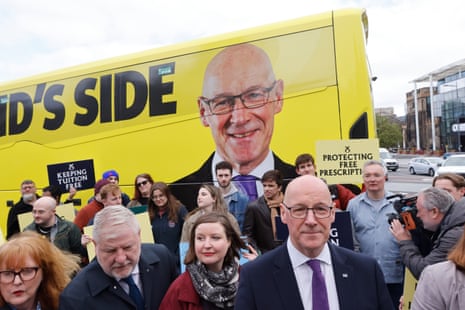
John Swinney, the SNP leader and Scottish first minister, has accused Keir Starmer of a “vacuum of leadership”.
Speaking at a campaign event in Edinburgh, he said:
As I look at the evidence of Olly Robbins yesterday – and whatever the trials and tribulations, the bits and pieces in this whole farce about Mandelson’s appointment to the most prestigious ambassadorial role in the United Kingdom, it’s crystal clear that there was political impetus behind this to make it happen. That’s on Keir Starmer.
Claiming there was an “appalling vacuum of leadership” under Starmer, Swinney said:
This is a political decision and it should be owned by the prime minister.
The only conclusion to that is the prime minister should resign.
Lib Dems call for inquiry into who was lobbying for Doyle to get diplomatic job
Ed Davey, the Lib Dem leader, has followed up his question to Keir Starmer at PMQs (see 12.22pm) by calling for an inquiry into who was lobbying for Matthew Doyle to be offered a diplomatic job. Davey said:
For Number 10 to ask the Foreign Office to find a plum diplomatic job for another Labour crony who was friends with a convicted sex offender – and to instruct that to be kept secret from the foreign secretary – is completely shocking.
On top of his catastrophic lack of judgment, Keir Starmer’s failure to answer simple questions about his own role [see 12.04pm] just isn’t good enough. The public deserves the truth, so we can move on from this scandal and make sure nothing like it can ever happen again.
The government needs to launch an inquiry by the cabinet secretary to find out who was doing this lobbying, why, and whether the prime minister knew about it or not.
Starmer claims 'no pressure' put on Foreign Office to approve Mandelson's vetting in PMQs clash with Badenoch
Keir Starmer claimed at PMQs that no pressure was put on the Foreign Office to approve the vetting of Peter Mandelson.
Speaking during his exchanges with Kemi Badenoch, the PM used quotes from Olly Robbins, the fomer Foreign Office permanent secretary, in his evidence to MPs yesterday to justify his claim.
He was speaking in response to a question from Badenoch who said that the appointment of Mandelson was a “done deal” as far as No 10 was concerned. She quoted Robbins telling the committee that No 10 wanted Mandelson in Washington as quickly as possible and that No 10 showed a “dismissive attitude to vetting”.
Starmer replied:
Sir Olly Robbins could not have been clearer in his evidence yesterday, he said this, ‘I didn’t feel under pressure personally in terms of my judgments’, his words.
He went on to say ‘I have complete confidence that recommendations to me and the discussions we had and the decision we made were rigorously independent of any pressure.’
On top of that, he was asked if any conversations led him to believe that Mandelson needed to take up the role regardless of vetting outcomes. He said: ‘I can say with certainty it was never put to me in that way.’
No pressure existed whatsoever in relation to this case.
What is unacceptable is that the recommendation of UKSV [UK Security Vetting] was not given to me before Mandelson took up his post.
In this instance, Starmer’s summary of Robbins’ evidence was selective. While Robbins did tell the committee that he felt confident that he personally was able to exercise his judgment independently in relation to the Mandelson vetting application, regardless of what No 10 wanted, he also gave a lot of evidence about how the department generally was under pressure to get the appointment finalised.
In an interview with Sky News this morning, Emily Thornberry, chair of the foreign affairs committee that took evidence from Robbins, suggested that she was not wholly convinced by Robbins’claim that he was not influenced by the pressure on the department.
She said;
If you’re a civil servant, your job as a civil servant is to facilitate what it is that politicians want you to do. So I think there was a bit of that [in this case].
And when I said I didn’t think that [Robbins] gave his full account, I think although he said he was under a huge amount of pressure, his evidence was that that pressure didn’t affect his decision. But I’m not sure about that.
We didn’t hear evidence of that, but I think … he thought, right, OK, let’s see what we can do in order to try to make the best of this difficult situation.
Capita losing contract to run Royal Mail's pension scheme, minister tells MPs
The new Royal Mail statutory pension scheme contract with Capita has been terminated, a Cabinet Office minister has said, after “they failed to deliver numerous milestones”. Nick Thomas-Symonds, the Cabinet Office minister, made the announcement in a statement to MPs. He said:
The security and dignity of those who have dedicated their careers to our public services are not negotiable, and they deserve a pension service that is reliable, efficient and secure.
But for these principles to be more than just words, they need to be underpinned by rigorous accountability and refusal to accept second best.
Explaining the reasons for the termination of the contract, he said:
I want to give the first update to the house on the Royal Mail statutory pension scheme. Following a failure to meet critical transition milestones and a lack of confidence in Capita’s ability to implement and transition to the new operating model in a timely fashion, I’m announcing today to the house that I have terminated the new Royal Mail statutory pension scheme contract with Capita.
Capita had an 18-month planning window to prepare for the transition. They failed to deliver numerous milestones, including a failure to implement the required IT automation. The Cabinet Office repeatedly flagged delays in transition milestones.
Some of the problems with Capita’s handling of the Royal Mail pension scheme have been highlighted by the Unite union.
On Thursday next week the Guardian is holding a debate about whether Labour can come back from the brink. The Guardian columnist, Gaby Hinsliff, will chair a panel of Guardian columnists including Polly Toynbee, Rafael Behr and Zoe Williams. It will take place at Conway Hall in London at 7.30pm and there are tickets available to attend in person, or to listen online. Details are here.
Morgan McSweeney, Starmer’s former chief of staff, to be questioned by MPs next Tuesday
Morgan McSweeney, the prime minister’s former chief of staff, has been summoned before the foreign affairs select committee as the Peter Mandelson vetting row continued to undermine Keir Starmer’s premiership, Pippa Crerar reports. As MPs attempt to unravel the facts, McSweeney is to appear next Tuesday to respond to allegations that Downing Street put huge pressure on the civil service to approve his appointment as the UK’s ambassador to Washington.
PMQs - snap verdict
It is hard to prove that a minister has lied to the House of Commons. That is partly because ministers tend to be wary about saying things in the chamber that are outright falsehoods (part of the reason why a lot of political communication is waffly), but mainly it is because the adjudicating body in these disputes (the Commons privileges committee) applies a high burden of proof, words are slippery and subject to different interpretations, and MPs can normally justify what they say. But it is quite easy to establish that a minister has done something reckless, foolish or unsavoury. That is because they do make these sorts of mistakes quite often, and in this case the adjudicating body is the public at large – more of a push-over than the privileges committee.
All of this is a long-winded way of saying it was very odd for Kemi Badenoch to structure her entire script around trying to show that “due process” was not followed in the Peter Mandelson vetting process. At PMQs last year Starmer said it was, which would lay him open to the misleading parliament charge (or at least the charge that he did not correct a misleading statement quickly) if Badenoch could prove her case. But she couldn’t.
She would have done much better finding other ways of attacking Starmer over Mandelson – perhaps by backing Mark Sedwill and calling for Olly Robbins to get his job back (see 8.35am), or focusing exclusively on Mandelson’s links to a Russian defence company, which was where she was at her best today. (See 12.13pm.)
Instead, Badenoch seemed to be banging away at “due process” because she is still trying to prove that she was right last week to make this an issue about parliament being misled. As explained yesterday, this is a mistake on her behalf – not least because Robbins’s evidence yesterday implied Morgan McSweeney was furious because the Foreign Office was following due process, and not just rushing the vetting asap.
Today was the third day in a row Badenoch was debating Mandelson in the Commons. Even those of us fascinated by the minutiae of this story will have found it a bit dull. This helped Starmer, and he was probably better and stronger on this topic today than he was on Monday. (He was not in the chamber yesterday, when it was left to Darren Jones to reply to Badenoch’s due process diatribe.)
Labour MPs did not seem very happy with any of this, but this was not an outing that made the situation any worse. And it is reported that it will probably be the last PMQs of this parliamentary session. Starmer will be relieved. Whether he will still be there at the end of the 2026-27 parliamentary session remains to be seen.