1 month ago
Australia to get no new, only old, Virginia-class submarines under Aukus
Australia will no longer receive any new Virginia-class submarines from the US, with all three of the Aukus vessels to be second hand.
The defence minister, Richard Marles, welcomed the new proposal alongside his US and UK counterparts yesterday.
Australia had been expecting to receive a mix of old and new Virginia-class submarines for its own use in the early 2030s as it prepares to adopt nuclear-powered submarines.
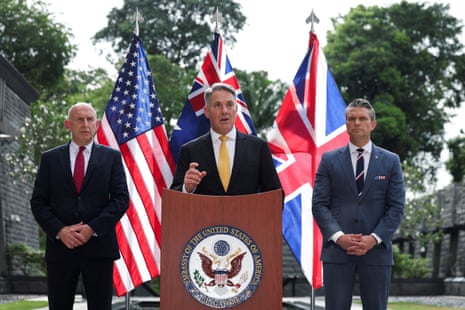
Marles announced the plan had changed in a joint statement on Saturday. It read:
The Deputy Prime Minister and Secretaries welcomed the proposed approach to streamline Australia’s acquisition of Virginia-class submarines (VCS), simplifying supply chain management, operational and maintenance requirements, and maximising cost efficiencies.
This approach would enable Australia to acquire three in-service VCS in lieu of a mixture of new and in-service VCS variants.
US shipyards have been under pressure as they struggle to boost manufacturing to their goal of building an average of 2.3 new submarines a year by 2032.
You can read more about Marles’ speech here:
Key events Show key events only Please turn on JavaScript to use this feature
Housing minister denies supply efforts will fall short
The Albanese government has rejected warnings it has overestimated the effect of its new infrastructure spending on housing supply.
Some industry groups have warned the government’s $2bn spending on new infrastructure, announced in the budget, may not meaningfully increase the number of new homes completed each year.
The housing minister, Clare O’Neil, has dismissed those claims, speaking on the ABC’s Insiders. Asked to guarantee completion rates for housing would not fall under the weight of new taxes, O’Neil said:
There’s a lot that goes into completion rates. What I can tell you is that government policy is going to lift those numbers by 420,000, based off what they would otherwise be. That’s what the Treasury modelling tells us.
The Treasury secretary, Jenny Wilkinson, separately this week said the budget’s broader tax changes were focused on changing the distribution of housing, and less targeted at increasing housing supply.
O’Neil did not directly answer when asked whether Wilkinson was correct.

Tom McIlroy
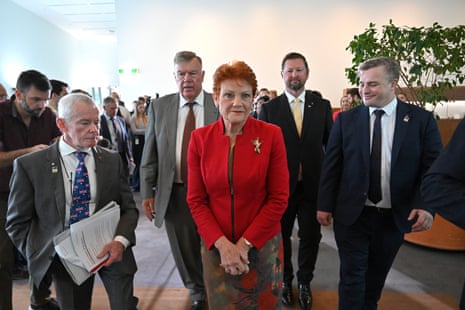
Hanson stands by no ‘good Muslims’ comments
Pauline Hanson has doubled down on her inflammatory comments about Islam, defending her plans to restrict migration and suggesting that there are no “good Muslims”.
When I look at countries like Britain or Canada or Germany or France, they got a hell of a problem over there, so I stick with what I said.
On banning migration from majority Islamic countries, the One Nation leader says people with radical ideology are not compatible with Australia’s way of life.
So, there’s certain countries I probably would ban them coming into Australia.
Australia to get no new, only old, Virginia-class submarines under Aukus
Australia will no longer receive any new Virginia-class submarines from the US, with all three of the Aukus vessels to be second hand.
The defence minister, Richard Marles, welcomed the new proposal alongside his US and UK counterparts yesterday.
Australia had been expecting to receive a mix of old and new Virginia-class submarines for its own use in the early 2030s as it prepares to adopt nuclear-powered submarines.
Marles announced the plan had changed in a joint statement on Saturday. It read:
The Deputy Prime Minister and Secretaries welcomed the proposed approach to streamline Australia’s acquisition of Virginia-class submarines (VCS), simplifying supply chain management, operational and maintenance requirements, and maximising cost efficiencies.
This approach would enable Australia to acquire three in-service VCS in lieu of a mixture of new and in-service VCS variants.
US shipyards have been under pressure as they struggle to boost manufacturing to their goal of building an average of 2.3 new submarines a year by 2032.
You can read more about Marles’ speech here:
Pauline Hanson says she could be prime minister
Tom McIlroy
Pauline Hanson tells Sky News she is actively considering moving to the lower house at the next election and that she could do the job of prime minister.
Hanson says a move back to the lower house, where she was first elected in 1996, is “a consideration by all means”.
One Nation have been surging in opinion polls, and is attracting support of more than 20%. The next election is expected in early 2028.
“But I am not making a decision now and I’m not going to tell anyone what I’m doing at this moment, because I haven’t clearly made up my mind,” Hanson said.
Asked if she wants to become prime minister, Hanson says she “won’t knock the job”.
I believe that I have the ability to do it. I’m not going to underestimate myself or say ‘no, I can’t do it’, because, you know, have a look at what we’ve got now, really, honestly, and that’s why we’re in a mess.
Hanson backs Taylor’s tax indexation plan
Tom McIlroy
The One Nation leader, Pauline Hanson, has supported Angus Taylor’s plans to index Australia’s tax thresholds, telling Sky News “they just keep moving all the time”.
Hanson says she wants to have a look at tax policy ahead of the next election, proposing an “overhaul” to “make it a fairer system”.
Those people who work overtime do their 40 hours a week or 38 hours a week, they’re working overtime, they’re taxed to the hilt, and I think we need to overhaul the whole taxation system.
Taylor’s plan is designed to combat bracket creep, and will cost at least $22.5bn.
Hanson says she is not across the detail of Labor’s plans on negative gearing, capital gains tax and trusts, admitting she has been campaigning this week. Labor has already introduced the legislation for the budget changes.
Hanson says she’s concerned the government is including tax cuts in the legislation, calling it “a ploy by the Labor party” to wedge the opposition and minor parties.
Continuing that report from Agence France-Presse: the British defence secretary, John Healey, said that the planned technology, a “range of cutting edge sensors and weapons systems” for underseas drones, “will rapidly give our forces the very most advanced battlefield technologies”.
The systems will be deployed on uncrewed underwater vessels, Healey added.
The protection of underwater infrastructure has been a major topic of discussion at Asia’s premier annual defence summit in Singapore.
“The seabed has become a major field of contest over the past 18 months,” Australia’s defence minister, Richard Marles, earlier told delegates.
We have witnessed a series of attacks against subsea critical infrastructure at a scale and frequency that is historically unprecedented.
There have been several incidents in the past two years of seabed cables being damaged by ships, both in the Baltic and around the Asian region.
Nearly all of Australia’s internet traffic flows through just 15 subsea cables, Marles pointed out.
Our ability to operate as a modern economy and a functioning state, all of it is critically dependent on infrastructure that is exposed, that cannot move.
As we’ve now seen demonstrated in the Baltic, [it] can be cut with an anchor in the middle of the night.
You can read more about Marles’s warning here, from reporter Ben Doherty:
Aukus nations to develop payloads for uncrewed undersea vehicles
The US, Australia and Britain are developing hi-tech payloads for uncrewed underseas vehicles under their trilateral security partnership, the Pentagon chief, Pete Hegseth, announced on Saturday.
As Agence France-Presse reports, Hegseth met his Australian and British counterparts on the sidelines of the Shangri-La Dialogue in Singapore, where they reviewed progress on the Aukus pact, aimed at bolstering their presence in the Indo-Pacific and beyond.
“Today, we’re pleased to announce the first Aukus Pillar 2 signature project, focused on fielding advanced uncrewed undersea vehicles, or UUVs,” Hegseth told reporters at a briefing at the US embassy in Singapore.
This signature project will deliver a suite of highly adaptable multi-mission UUV payloads designed to support undersea operations and maintain our collective advantage in the maritime domain.
Aukus’s Pillar 1 focuses on Australia’s acquisition of conventionally armed, nuclear-powered submarines, while Pillar 2 pools the talents of each nation’s defence sector to develop advanced military capabilities.
The pact is framed as supporting a “free and open Indo-Pacific”, though it is widely viewed as a bulwark against a rising China, which strongly opposes it.
Good morning
Hello, this is Luca Ittimani here, to take you through the day’s news as it unfolds on what is so far a sunny Sunday morning – in Sydney, at least.
Richard Marles has told a Singapore defence summit the “seabed is a battlefield”, as a new Aukus project was announced to protect undersea cables.
And Clare O’Neil will be speaking on the ABC’s Insiders program shortly, discussing Labor’s recent changes to the capital gains tax.
We’ll have more coming up – say tuned.