1 hour ago
Opposition parties accuse Healey of offering 'more of the same' in his first major speech as chancellor
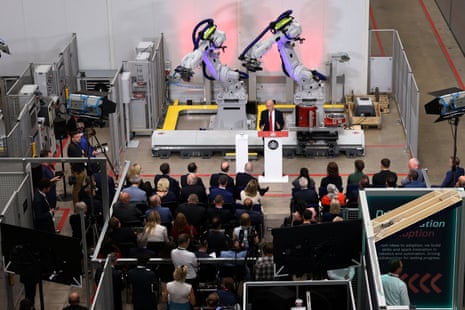
Opposition parties have criticised John Healey for sounding too much like Rachel Reeves in his speech.
This is from Andrew Griffith, the new shadow chancellor.
John Healey sounds increasingly like continuity Rachel Reeves. Warm words about growth will not make growth a reality or cover up the enormous damage Labour have done to businesses and family finances.
Healey failed to end uncertainty by ruling out more tax rises, failed to set out a serious plan to reform welfare, and failed to commit to funding defence properly – the very issue he resigned over as defence secretary. Even as Jaguar Land Rover cuts jobs, he offered no pause to Labour’s job-destroying employment red tape and no measures to get ruinously high energy bills down.
This is from Robert Jenrick, the Reform UK Treasury spokesperson.
On the day 4,000 people are losing their jobs, Healey gave a dire and dreary speech that will change absolutely nothing. John Healey is beginning to make even Rachel Reeves seem inspiring.
And this is from Ellie Chowns, the Green party’s Treasury spokesperson.
Once again Britain is promised a new economic vision for the future – and once again we are delivered more of the same, from another government unwilling to truly grasp the nettle on wealth inequality and deliver for our communities.
The Green party is clear that the biggest priority must be building economic prosperity that is sustainable, equitable, and genuinely meaningful – not simply chasing ever-more growth for its own sake, regardless of impact.
Key events
No 10 hits back at US ambassador to Israel, Mike Huckabee, after he accuses UK government of 'Jew hate'
At the weekend Mike Huckabee, the US ambassador to Israel, posted this on social media about the UK.
The Brits have lost it. The Jew hate of their government knows no boundaries and knows no facts
Huckabee was commenting on a tweet from the Israeli government criticising Ed Miliband, the foreign secretary, for comments about Israel’s record in Gaza.
Asked about Huckabee’s comment at the Downing Street lobby briefing, the PM’s spokesperson said:
We completely reject that assertion. We’re committed to protecting Jewish communities in the UK and continue to engage with community leaders and groups.
The government is investing almost £380m over three years, to protect Jewish communities, crack down on antisemitic extremism and hostile state activity, and tackle antisemitism in schools, universities and local communities.
The spokesperson would not say if the government had formally complained to the US authorities about Huckabee’s remark.
Jaguar Land Rover has announced thousands of job cuts in a “body blow for workers” as it grapples with tough trading conditions, Donald Trump’s tariff wars and the fallout from a cyber-attack. Rob Davies and Alex Daniel have the story.
Asked about this at the No 10 lobby briefing, the PM’s spokesperson said:
We understand that this will be an uncertain and concerning time for affected workers, their families and the wider communities.
And we know that current market conditions are challenging for the automotive sector globally. That’s why we’ve taken significant action to back the UK’s automotive industry by lowering electricity bills for manufacturers, providing £4bn of capital R and D funding to manufacture zero-emission vehicles and launching a £2bn electric car grant to encourage people to buy Evs.
The business secretary [Jonathan Reynolds] is in close contact with JLR and he will be meeting them early this week.
The spokesperson also confirmed that Reynolds has been “clear on his ruling out of any form of bailout”.
Hamish Falconer, appointed by Andy Burnham as minister for EU relations, has had his first official meeting with his EU opposite number, Maroš Šefčovič. In a social media post, Falconer says he wants “a more ambitious partnership”.
Opposition parties accuse Healey of offering 'more of the same' in his first major speech as chancellor
Opposition parties have criticised John Healey for sounding too much like Rachel Reeves in his speech.
This is from Andrew Griffith, the new shadow chancellor.
John Healey sounds increasingly like continuity Rachel Reeves. Warm words about growth will not make growth a reality or cover up the enormous damage Labour have done to businesses and family finances.
Healey failed to end uncertainty by ruling out more tax rises, failed to set out a serious plan to reform welfare, and failed to commit to funding defence properly – the very issue he resigned over as defence secretary. Even as Jaguar Land Rover cuts jobs, he offered no pause to Labour’s job-destroying employment red tape and no measures to get ruinously high energy bills down.
This is from Robert Jenrick, the Reform UK Treasury spokesperson.
On the day 4,000 people are losing their jobs, Healey gave a dire and dreary speech that will change absolutely nothing. John Healey is beginning to make even Rachel Reeves seem inspiring.
And this is from Ellie Chowns, the Green party’s Treasury spokesperson.
Once again Britain is promised a new economic vision for the future – and once again we are delivered more of the same, from another government unwilling to truly grasp the nettle on wealth inequality and deliver for our communities.
The Green party is clear that the biggest priority must be building economic prosperity that is sustainable, equitable, and genuinely meaningful – not simply chasing ever-more growth for its own sake, regardless of impact.
Healey's speech - snap verdict
There is nothing unusual about a chancellor refusing to rule out tax rises before a budget. It is normal for a chancellor not to comment on what is in the budget until it is delivered (apart from when they do rule out specific measures in advance, which happens more often than you might think). But, in his column in the Sunday Times yesterday, Rishi Sunak, the Conservative former PM and chancellor, argued on this occasion John Healey should rule out tax cuts now. Sunak argued that the rise in government borrowing costs means that the government’s headroom has been slashed, that Healey already has to find £4.7bn to fund the defence investment plan, and that as a result the country faces weeks of speculation about possible tax rises.
In his column, Sunak went on:
The uncertainty will deter investment and chill economic activity, the last thing needed if we are to foster the sense of optimism that Burnham rightly wants and the growth the country so urgently needs.
Chancellors are loath to tie their hands before a budget. I spent weeks before each fiscal event answering almost every question with, “You wouldn’t expect me to comment on that ahead of the budget.”
Yet Healey should reject such reticence. He should make clear that he’ll not increase taxes in the budget and that if adjustments need to be made, he’ll cut spending. That would provide the certainty needed in an increasingly uncertain world. Research shows that improving the budgetary position by spending cuts rather than tax rises is both more durable and better for growth.
When Kemi Badenoch keeps challenging the government to rule out tax rises in the budget, she is trying to cause trouble by generating a negative headline for the PM when he ignores her. By contrast, in his column, Sunak sounded like someone trying to constructive advice based on what might be good for the country.
If so, Healey did not take it. To be fair, in his speech today the chancellor clearly signalled that he is not about to embark on a big, tax-raising spree. (See 9.57am.) This was consistent with the message the Jonathan Reynolds, the business secretary (in the audience for the speech) gave in an interview on Sky News yesterday. “There is no taxation answer that will meet the British people’s expectations on social care or defense or public services,” Reynolds said. But a hint about controlling spending is not the same as a firm commitment not to put up tax, and so Healey’s refusal to rule out tax rises is a story. (It is already the lead on the Telegraph’s website.)
That would not matter much if there were other big stories in the speech. But there weren’t; it was quite dull, and while it conveyed seriousness, it did not project authority. Most of it not only could have been said by Rachel Reeves, the previous chancellor, but actually was said by her (in terms of the arguments being made, if not the words and phrases). As new PM, Burnham has successfully signalled that he is a change from his predecessor. Healey hasn’t.
Ministers told to axe many consultations, and tolerate more legal risk, so they can drive through change more quickly
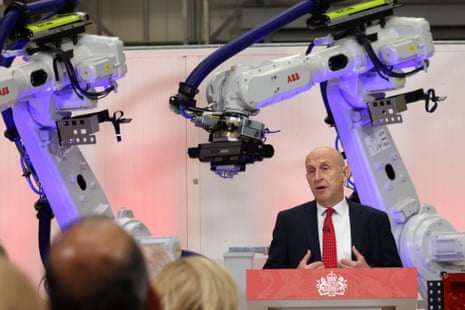
In his speech, towards the end, John Healey gave a bit more detail of how he intends to cut the burden of business regulation by 25%. (See 10.25am.)
He said that, as well as taking forward the recommendations of the Fingleton review to speed up the construction of nuclear power stations, he would apply those findings to some other sectors. He said there would be a review of the costs involved in rail infrastructure projects.
And he said he wanted to “end the consultation culture at the Treasury and beyond” by getting ministers to speed up decision making. He said new guidance has gone out today to ministers on this from the Treasury and the attorney general, Ellie Reeves.
The Treasury has now published this guidance, which has been sent to ministers as a letter from Healey, Reeves and Louise Haigh, the first secretary of state. It is potentially quite radical.
It starts by saying that in the past “administrative frictions” have stopped the government acting on behalf of the British public.
We want to be clear that the government will act with the full agency that sits with the executive, and which flows from our command of a majority in the House of Commons … We are also determined to overcome the administrative frictions that past administrations have allowed to accumulate, often with good intentions but which have served to slow the work of government, and which we must not allow to frustrate the speed of change.
Healey, Reeves and Haigh then go on to propose three changes.
Ministers are being told to reduce the amount of consultations they hold before decisions are taken and implemented. The letter says that “habitual, box-ticking consultation” has become a problem, and it says that “thousands” of unnecessary consultation requirements should be scrapped. It also implies formal consultation should be the exception, rather than the norm.
Consultation culture has turned a sensible mechanism for sourcing external input into an industry of dither and delay, which too often fails to hear from those whose perspectives are most relevant to the issue under consideration, and can drag policies to a lowest common denominator outcome.
We will end this trend by reasserting that there is no general duty of consultation, and that the default position should be that ministers reach decisions and proceed to act on them …
Habitual, box-ticking consultation does not serve people or business and is a distraction to government …
New general guidance will be circulated by officials and more detailed guidance on approaches to public participation will follow in due course. Within this parliament, we will then go further and seek to unwind the thousands of unnecessary consultation and reporting requirements that have come to litter the statute book.
Ministers are being told that a “high” risk of a policy being ruled unlawful should not necessarily stop a policy being implemented. The letter says No 10 wants ministers to feel that they are “trusted” to take decisions even when there is a legal risk, and advice to government lawyers is being changed accordingly. It says:
In support of this approach, we will this week update the legal risk guidance that is used by government lawyers, and which amongst other changes will be clear that it is wholly proper for ministers to take decisions where there is a tenable legal argument even where there is a high legal risk, as well as encouraging lawyers proactively to suggest alternative options where there is a significant barrier or risk to a proposed policy.
Ministers are being told that the government will extend the list of projects exempt from judicial review (JR), building on decisions already taken to stop infrastructure projects being blocked by JR.
The arguments in the letter echo complaints about Whitehall and the civil service more usually heard on the right. When Suella Braverman was attorney general, she also encouraged government lawyers to worry a bit less about the risk of government decisions being found unlawful in the courts. Braverman is now a Reform UK MP, and at its party conference last week Reform also suggested elected politicians were being obstructed by officials – but using much more extreme language.
Q: [From Katherine Forster from GB News] It sounds from what you are saying taxes are going to go up in the budget. And what do you think of the British Chambers of Commerce today saying the pension triple lock should be scrapped so that more money can be spent on Neets (young people not in education, employment or training)?
On tax, Healey said Labour would stick to the promises it made in its manifesto. He repeated his point about not wanting to fuel more speculation by commenting on the budget.
On the BCC, he said:
I agree with them what they were saying about youth unemployment. You heard me talk about it today -a scar, a blight on the future of those million young people … It cannot be right that we write off a young generation in that way. And so Alan Milburn is doing important work. We’ll base our plans on his full recommendations. But as the prime minister has said, there is a need to bring down welfare costs.
Healey says he cannot comment on budget be because responding to speculation will 'only fuel more speculation'
Q: [From Helia Ebrahimi, Channel 4 News] How are you going to deliver change on defence, the cost of living and social care. And would you devolve responsibility for corporation tax to local government.
Healey say he won’s speculate on what will be in the budget.
Addressing Ebrahimi, and also Beth Rigby, given her question a moment ago, he says:
If I respond to speculation now, that will only fuel more speculation. And it’s quite right, and every chancellor would say, that’s for the budget.
I’ll set out my plans and the future route for government for this country at that budget.
Healey declines to rule out tax rises in budget
Healey is now taking questions.
Q: [From Sky’s Beth Rigby] The markets expect interest rates to go up. So is the government really turning the corner? And can you assure people you won’t put taxes up in the budget?
Healey says global problems are making “our task in government harder”.
He goes on:
What I am doing today is setting out plans, a direction for growth … that will see growth in more places in future.
I want to be the chancellor that gets things done, and I want to see growth driven from more places across the UK.
I want to be the chancellor also that recognises, tough as it is, Britain has huge resilience, great latent potential and relative strengths in relation to the way that we are dealing with the fiscal challenges we face.
He does not address the tax question directly.
Healey says he wants to cut burden of business regulation by 25%
Healey says he wants to cut the burden of business regulation by 25%.
I will take an axe to the thicket of consultation, litigation and administration that has a stranglehold too often on private investment.
So I confirm today my commitment to reducing the burden of business regulation by 25% by the end of this parliament.
And today I announce this [the extension of] the reforms of judicial review from energy to all major infrastructure so that vexatious legislation and vexatious litigation and challenge can’t block economic growth.
Healey says changes to Treasury's green book rules will 'skew investment to projects with more long-term potential'
Healey says he will change the Treasury’s green book rules to enable to back more regional investement.
He says:
Investment has increased by 4.9% since the election alone.
But we need to do more. So first, I’m making changes to the Treasury green book, reducing the discount rate from 3.5% to 3%, and that will skew investment towards projects with more long-term potential, meaning that more places across the UK will get a fair hearing.
This builds on a process that started when Rachel Reeves was chancellor.
Healey says he is also announcing that the I’m announcing today that South Yorkshire and Liverpool cityregions, the North East England. region and the Cardiff Capital Region will all become the latest strategic partners of the Wealth Fund.
Healey allocates £150m from British Business Bank for start-ups in north of England
Healey confirms he is announcing an allocation of £150m from the British Business Bank, £150 million for scale-ups in the north of England.
In its news release, the Treasury has given a bit more detail about what this will do.
The new fund, from money already allocated to the British Business Bank, will provide larger investments of between £5m and £15m and is expected to back university spinouts and other ambitious businesses across the North, from Liverpool and Manchester to Leeds, Sheffield, Hull and Newcastle.
The British Business Bank will commit up to £150m, with the proposed fund intended to attract additional private investment. By bringing public and private capital together, it will give some of the north’s most promising companies the backing to grow, create jobs and build their future in the communities where they started.