1 month ago
Islamic countries, including Pakistan, have united to oppose Israel's recognition of Somaliland, the Horn of Africa nation that declared independence in 1991. With buzz that Delhi would be next in recognising Somaliland, India's MEA has issued a fact-check. Here's why Somaliland is important geopolitically.
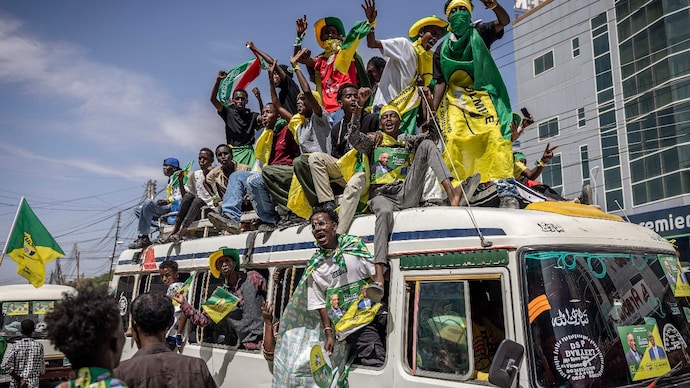
A political rally in Somaliland ahead of the 2024 Presidential elections. In December, the de-facto state was recognised by Israel, the first country to do so. (Image: AFP)
Since 1991, the State of Somaliland has existed as a political paradox. Despite officially being a part of the country of Somalia, the region effectively governed itself as a de-facto nation. The vicious civil wars and political infighting that engulfed the rest of Somalia after 1991 overshadowed events in Somaliland. The region has more or less seceded from the rest of the country, built a multi-party democratic state, has its own currency, and has maintained a state of relative peace and stability. It made headlines after Israel officially recognised the Republic of Somaliland as an independent sovereign state. Pakistan, and other Islamic nations, vehemently opposed the move. Speculations were rife that India would recognise Somaliland, but the Ministry of External Affairs swiftly junked those as rumours.
Despite having seceded in 1991, Somaliland's government in the city of Hargesia lacked any sort of international recognition at all. However, this all changed on 26 December, when Israel recognised it. For Somaliland, it was the first validation of its long quest for legitimacy. The reaction from other countries, however, was less than positive, with Somalia calling the recognition a breach of its own sovereignty and the African Union and the Organisation of Islamic Countries (OIC) warning such a step could fuel separatist movements across the continent.
Pakistan on Sunday, with 20 other nations and the OIC, rejected Israel's recognition of the Republic of Somaliland, terming Tel Aviv's move a "full and blatant disregard for international law", according to the Dawn.
"Pakistan strongly condemns any attempts to undermine the sovereignty, unity, and territorial integrity of Somalia, and rejects, in this regard, the announcement made by Israel recognising the independence of the so-called Somaliland region of the Federal Republic of Somalia," the Pakistani Foreign Office said.
INDIA REJECTS REPORTS OF RECOGNISING SOMALILAND
Some experts and handles on X created a buzz that after Israel, India could recognise Somaliland.
"Another major world power is on the cusp of offering Somaliland recognition soon: India... India is keen not to lose out to China, a strategic adversary... Somaliland offers India many commercial advantages with its Berbera port trade corridor, access to Horn's largest market - Ethiopia," posted Rashid Abdi, Research Director of Sahan Research for Horn of Africa, Middle East.
Another handle, Inside Africa, tweeted, "India emerges as a likely country to recognise Somaliland".
However, the Ministry of External Affairs rejected those rumours outright.
"The following post in misleading. Please remain alert!" posted India's MEA from its official X handle, dismissing any move on Somaliland recognition.
There were also unverified reports that Somalia's ambassador to India had defected to Somaliland and had been suspended by the Somalian President.
SOMALILAND'S QUEST FOR INTERNATIONAL RECOGNITION
The history of Somalialand is one shaped by its legacy as an important trading hub situated at the intersection of trading networks connecting Asia, Africa and Europe. After decades of existing as a quiet political anomaly, Israel's recognition means that the state is no longer on the margins of global politics. Rooted in centuries of trade and shaped by a turbulent modern history, it now stands at the centre of a geopolitical reckoning that could reshape the Horn of Africa for years to come.
The state of Somalialand is situated on the Horn of Africa beside the Gulf of Aden and the Bab-al-Mandeb Strait, which connects the Indian Ocean with the Mediterranean Sea via the Red Coast. Its position at the crossroads of one of the world's busiest maritime trading routes means that it has been a vital commercial and trading hub since ancient times.
Major towns such as Hargeisa, Berbera, and Burao have experienced steady reconstruction and economic activity. Livestock exports, telecommunications, and port services are the key economic mainstays despite the territory’s diplomatic isolation.
The state maintains little more than informal relations with the rest of the world, but does have international representatives from the US, Ethiopia, Taiwan and Israel based in the region. The country is also the recipient of significant international investment, particularly from Ethiopia and the UAE, which helped fund the re-development of the port of Berbera.
However, the lack of international recognition is a significant problem as it renders the state unable to access vital institutions like the World Bank and the Monetary Fund. It is also unable to formally enter treaties or receive direct bilateral aid at scale.
WHY IS THE ISRAELI RECOGNITION OF SOMALILAND SO SIGNIFICANT?
On 26 December, Israel's Prime Minister, Benjamin Netanyahu, officially announced that Israel had officially recognised Somaliland as an independent sovereign country, becoming the first United Nations member to do so. Announcing the act, Prime Minister Benjamin Netanyahu said Israel would move quickly to deepen cooperation with Somaliland in agriculture, health, technology and the economy.
Netanyahu congratulated Somaliland President Abdirahman Mohamed Abdullahi, praised his leadership and invited him to visit Israel. The Israeli prime minister’s office said the declaration was "in the spirit" of the Abraham accords, a series of normalisation agreements between Israel and mostly Arab states signed in 2020.
In a post on X, Somali journalist, Yusuf Gabobe stated that "Through its recognition of Somaliland, Israel has now triggered a geopolitical earthquake with the potential to reshape the Red Sea–Horn of Africa region." There are many reasons why Israel's actions could redefine geopolitics around the Horn of Africa for years to come.
Until now, Somaliland’s de facto autonomy and functioning institutions lacked formal acceptance abroad, keeping it outside key global mechanisms and limiting economic and political engagement. Israel’s recognition breaks that diplomatic isolation and elevates Somaliland from a regional question to an active geopolitical issue. The country can finally aspire to get recognition across the international community it had long coveted now that it has Israel's backing.
Israel's recognition of Somaliland breaks many precedents that had been set by various countries and blocs, like the European Union and the AU, which prioritised the integrity of Africa's current borders above anything else.
Some experts warned that legitimising separatist regions could set off a domino effect across the continent, emboldening breakaway movements from the Democratic Republic of Congo to Kenya, Nigeria and beyond. Framing the move as neocolonial interference masked as "strategic interest," they argued that Africa risks gradual fragmentation if such actions go unchallenged.
Another result of Israel's recognition of Somaliland is the fact that it is now able to access one of the world's most geopolitically significant regions. The state is located right beside the Bab al-Mandab Strait, which connects the Indian Ocean and the Mediterranean Sea via the Red Sea, and it is a vital maritime artery with an estimated 9% of the world's total seaborne petroleum trade in 2017. This route, however, has been under pressure from Houthi rebels in Yemen who have intermittently been launching drones and missiles towards commercial vessels plying the area since 2023.
Writing on X, writer and analyst Alula Frezghi noted that for Israel, the move offered short-term strategic signalling in the Red Sea but carries long-term costs such as deeper entanglement in Horn of Africa conflicts, heightened exposure to terrorist retaliation, and strained ties with African and Arab partners. For Somaliland, Israeli recognition promises symbolism without security guarantees, while increasing the risk of being drawn into confrontations with the Houthis and also the vehemently anti-Israel Al-Shabaab group which recently carried out a terrorist attack in Somalia.
He stated "if Israel sees Somaliland as a security asset, the Houthis will see it as a legitimate target. Houthi leaders have already warned that any Israeli presence in Somaliland will be treated as hostile" and warned that "Somaliland, which has enjoyed relative insulation from regional conflict, could suddenly find itself on the front line of a confrontation it did not choose."
Israel’s recognition has thrust Somaliland from quiet de-facto statehood into the centre of global geopolitics. Whether it becomes the long-awaited breakthrough for international legitimacy or a catalyst for heightened tensions in the Horn of Africa will depend on how Somalia, African institutions, and global powers choose to respond in the months ahead. Pakistan and other Islamic countries have protested Israel's move, and India has stated up front that it has no plans of recognising Somaliland.
- Ends
Published On:
Dec 30, 2025