1 month ago
Portugal is under pressure to draw up plans to adapt to the climate emergency as the country continues to be lashed by an unprecedented series of storms that have killed at least 16 people and left tens of thousands without electricity.
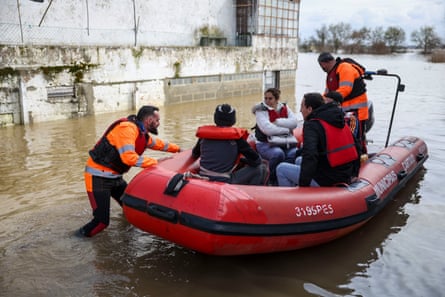
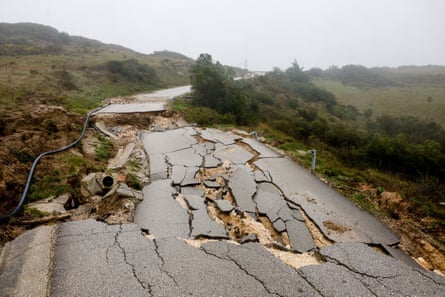
More than 3,000 people were evacuated from the Coimbra area of central Portugal on Wednesday as the Mondego River reached critical levels, while part of the country’s main motorway, the A1, collapsed after a dyke on the Mondego gave way under the weight of flood water.
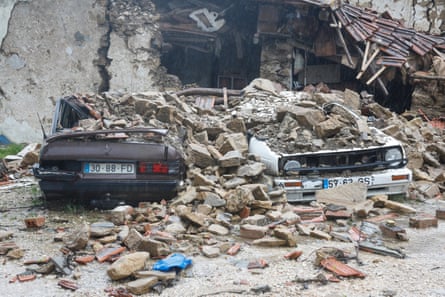
Hundreds more people have been displaced across the country since what scientists have called the “longest train of storms within living memory” began at the end of January. The extreme weather, which has affected central and southern parts of the country, has cut off power to 33,000 people and caused an estimated €775m (£675m) of damage.
Portugal’s interior minister, Maria Lúcia Amaral, resigned on Tuesday in the face of mounting anger over her handling of the emergency, saying she felt she did not have “the personal and political conditions necessary to carry out her duties”.
As the storms rage on, scientists and experts have criticised the country’s unwillingness to adapt to the bouts of extreme weather that have been plaguing the Iberian peninsula in recent years.
“We are not prepared for the present climate, much less for the future,” said Pedro Matos Soares, an atmospheric physicist, during a video conference on climate held by the University of Lisbon’s faculty of sciences this week.
“Portugal still handles land-use planning thinking about the 19th century or the first half of the 20th century climate. We have to understand what the climate is like now and what it will be like in the future. Otherwise, we’re going to have a problem.”
Nuno Martins, a professor of architecture and climate adaptation, said that several of the storms’ victims had died while trying to repair their roofs with donated tarpaulins in central Portugal, while hundreds more had been injured in falls.
Martins’s NGO, Building 4Humanity – a team of architects, engineers, and designers – has been volunteering in central Portugal and put together a manual to teach people how to repair their roofs safely.
“I was in the area and saw how desperate people are to save their houses,” he said. “I was also outside a hospital full of people who were injured after falling from the roofs. I asked some municipalities to distribute the manual together with the tarpaulins they were handing out to people, so that they could have some guidance and a greater awareness of the risks.”
The civil protection agency has taken up the suggestion and has begun distributing the manual alongside tarpaulins.
One woman in the Coimbra region said she understood why people would risk their lives to try to protect their houses. The woman, who did not wish to be named, said she believed part of her late mother’s house would eventually collapse.
“I try not to go inside because I can’t stop crying when I’m there,” she said. “I understand why people fell from their roofs. They’re desperate. If my legs allowed, I [would have] done so myself, out of my own desperation. But it’s very dangerous.”
Portugal’s centre-right government, which is led by the prime minister, Luís Montenegro, has faced sustained criticism over its handling of the storms.
“The resignation of the interior minister is proof the government has failed in its response to this emergency,” José Luís Carneiro, the general secretary of the opposition socialist party, told the press after Amaral stepped down.
The far-right leader André Ventura, who finished second in last weekend’s presidential election, accused Montenegro of an inability to deal with the crises that have buffeted Portugal over recent months.
“The minister’s departure highlights the government’s inability to manage all the adversities the country has faced, from the fires to the recent storms,” he said.
Neighbouring Spain is also suffering from the continuing extreme weather, leading the state meteorological office to issue orange and red warnings for the north coast of the country and warn of waves up to nine metres (30 feet) tall.
On Thursday, schools across the northeastern region of Catalonia were closed and dozens of flights at Barcelona’s El Prat airport were cancelled. One person was seriously injured by a falling tree, while 24 others were hurt in the storms. Catalan civil protection services sent a mobile emergency alert warning the population to stay indoors and avoid unnecessary travel.
The regional government thanked the emergency services for their efforts in the face of “an exceptional storm” and said the authorities’ response had helped minimised the storm’s impact.