 1 month ago
HomeTechnology NewsRaghuram Rajan pours cold water on AI mania, warns not every player will survive
While AI will transform the nature of work, former RBI Governor Raghuram Rajan says expectations of quick, outsized profits may be misplaced, warning that debt-funded AI firms face significant risks if adoption slows or regulation tightens.
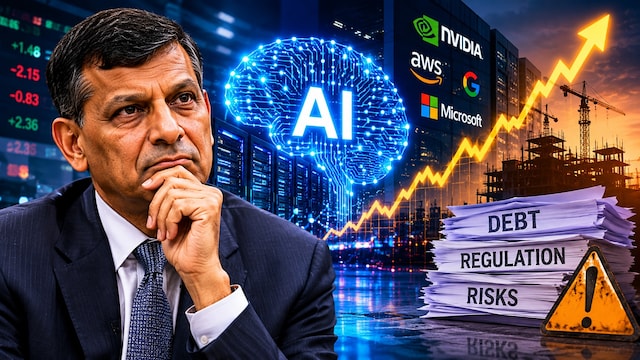
Artificial intelligence is set to reshape the nature of work, but the market's enthusiasm around the technology may be getting ahead of reality, according to former Reserve Bank of India Governor and economist Raghuram Rajan.
In a recent Project Syndicate essay titled 'A Cold Shower for AI Mania', Rajan acknowledged the transformative potential of AI tools, noting that large language models are already capable of producing referee reports on academic research papers that often rival those written by humans.
"Only rarely are human reports better," Rajan wrote, adding that AI systems can identify analytical weaknesses, check proofs and suggest improvements while drawing on a vast body of literature almost instantly.
Also read: The drone market is about to go parabolic because of AI and war. How to play it
Despite these advances, Rajan cautioned that the "market euphoria around AI has become worrisome", particularly because of the large-scale debt issuance funding investments across the sector.
He argued that risks exist at multiple points across the AI supply chain, from chipmakers and infrastructure providers to data centres, AI model developers and end users.
While individual adoption is growing rapidly and corporate usage is accelerating in areas such as software development and customer support, many large businesses are still experimenting with AI rather than deploying it across their operations.
According to Rajan, companies continue to grapple with challenges, including organising historical data, integrating AI into existing workflows, data-security concerns and the risk of errors or hallucinations damaging their brands.
He also highlighted the possibility that today's AI infrastructure could become obsolete faster than expected if chips become significantly more powerful and energy efficient, potentially making it difficult for data-centre operators to recover their investments. At the same time, he warned that the rapid improvement seen in large language models could eventually plateau until a new technological breakthrough emerges.
Also read: Maharashtra to set up six AI centres, make 2,000 GPUs to meet computing demand: Fadnavis
Rajan questioned the assumption that one AI model will ultimately dominate the industry and generate extraordinary profits. Even if a model reaches a stage where it can improve itself, competitors could still catch up, he argued. "So far, no AI model seems to have gained a sustained advantage," he wrote.
The economist also expects greater government scrutiny of the sector. As data centres consume increasing amounts of electricity and raise power demand, political pressure to restrict their expansion is likely to grow. Rajan pointed to examples of counties in Indiana that have already imposed moratoriums on data-centre construction.
Beyond infrastructure concerns, he warned that malicious uses of AI — from cyberattacks and deepfakes to unsafe interactions involving children — could fuel demands for stricter regulation and greater liability for AI developers. He suggested that the risks posed by rogue AI could eventually lead to international discussions resembling an "AI Geneva Convention".
Another potential trigger for political intervention, Rajan said, would be large-scale job losses linked to AI adoption. Fear of social and political backlash could make companies reluctant to aggressively reduce headcount, slowing the pace of AI-driven transformation.
Given these uncertainties, Rajan said it remains unclear how quickly AI will be deployed and which participants in the ecosystem will ultimately benefit. While AI's long-term promise remains intact, he cautioned that expectations of rapid, exceptional profits may prove unfounded.
"The good news is that a more limited, careful AI rollout could give firms more time to find labour-augmenting (as opposed to labour-displacing) uses," Rajan wrote. "The bad news is that euphoric visions of quick exceptional profits could be unfounded."
He concluded that AI advances are likely to pay off eventually, but not every company in the sector will emerge as a winner. "AI advances will likely pay off eventually, though not every provider will profit, or even survive."