 1 month ago
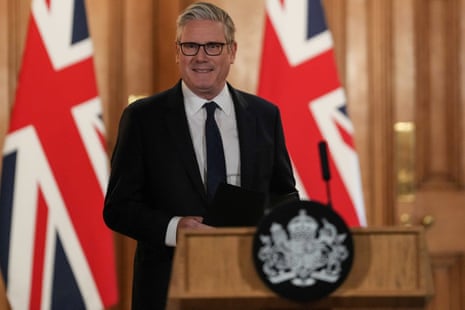
Starmer says he hopes ban will come into force around springtime next year
Starmer is now taking questions.
Q: When will this start?
Starmer says the government can move quickly.
We took powers, earlier this year to make sure we could move at speed.
I was very conscious that with the Online Safety Act it took the last government eight years from sort of identifying the beginnings of the problem to actually passing legislation, and [I] was determined that will not happen in this case.
He says legislation already passed gives ministers the powers to act using secondary legislation.
He says:
We hope to pass regulation before Christmas, and therefore to bring the ban into force in the early part of next year, probably about springtime, so we can move a real pace here.
Key events
Michelle O’Neill, the Sinn Féin first minister of Northern Ireland, has questioned Keir Starmer’s decision to announce a social media ban this week.
Speaking at Stormont, she said:
I find it really interesting that Keir Starmer decides to announce this this morning, in a week that the Makerfield byelection is going to happen, the week that potentially a contender for the leadership of the Labour party is going to come forward, and he seems to have rushed forward with this announcement.
Obviously, we all want to protect our children, but I think this is allowing social media companies to get away in the smoke in terms of their responsibility around stuff that they allow to be on platforms.
So I think that this is a very complex conversation that we need to have a discussion on, and I feel like the announcement this morning has come as a direct result of internal Labour party politics as opposed to what is the right thing to do in this space.
Paul Givan, the DUP education minister in the Northern Ireland executive, said he thought the ban was “the right thing to do”.
Back in the Commons, Desmond Swayne (Con) said Luke Pollard told MPs that John Healey asked him to stay in office when he resigned. Had he not been asked, would Pollard have resigned too? And how much persuasion did it take?
Pollard acknowledged that was a good question. He said he came from a military family; his father was a submariner. He said he respected the decisions taken by Healey and Al Carns to resign, but he decided to stay.
Dan Jarvis is with the king, and not at the urgent question on the defence investment plan, because he is being made a privy counsellor “as a matter of urgency”, defence sources have told my colleague Dan Sabbagh.
Pollard defends Jarvis not responding to Badenoch's UQ in person, saying he has meeting with king
Kemi Badenoch criticised Dan Jarvis, the new defence secretary for not being in the Commons to answer the UQ in person.
It speaks volumes that a junior minister has been sent to answer this question.
If the new defence secretary is too scared to face tough questions at the dispatch box, waiting for an easier statement later, then I don’t have much confidence in him facing down the threats from Russia.
Badenoch said the Conservatives would judge the defence investment plan by three tests (the ones she set out at a press conference this morning – see 11.41am).
And she also offered to “lend” Keir Starmer Tory votes to pass welfare reform to fund higher spending for defence.
In response, Pollard said Jarvis was not in the chamber because he was meeting the king.
Later Edward Leigh, the Conservative father of the Commons, said Jarvis was “cowardly” not coming to the Commons to respond.
At that point Lindsay Hoyle, the speaker, intervened. He said the king had “summoned” Jarvis, and that it Leigh’s language was appropriate.
Responding to Leigh’s “cowardly” jibe, Pollard said Jarvis was someone who had served in the armed forces and been honoured for his service in uniform.
MoD minister Luke Pollard declines to criticise Healey for resigning over defence funding, saying they were 'in lockstep'
In the Commons Luke Pollard, the defence minister, is responding to Kemi Badenoch’s urgent question on the defence investment plan.
He started by hinted that he might have resigned alongside John Healey last week if it had not been for Healey, the defence secretary, asking him to stay.
He said:
It’s no secret that I worked in lockstep with the former defence secretary. He is a friend and mentor. I was his deputy and I’m still standing here because he asked me to stay and because we need continuity in this complex and difficult operational environment.
Pollard also defended the government’s record on defence spending.
Do we need to spend more on defence? Yes. Does the prime minister and the chancellor agree? Yes. Are we spending more? Yes. This year’s defence budget is £11bn more than the final year under the Conservatives. Are we learning the lessons from Ukraine? Yes. Are we retiring old kit to invest in new capabilities? Yes. Are we backing our people? Yes. The biggest pay rise in 20 years and £9bn plan to fix the defence housing crisis we inherited.
And its working. Intake is up 11.6%, outflow down 8.9% and morale is up.
And to answer [Badenoch’s] question directly, if asked to fight tonight, could our forces defend the UK? Yes.
Reform UK accused of proposing tax cuts worth £40bn to boost its chances in Makerfield byelection
The Conservatives have accused Reform UK of proposing tax cuts worth £40bn in the hope of winning the Makerfield byelection.
Mel Stride, the shadow chancellor, has highlighted three proposals from Nigel Farage and his team, announced since the campaign started, that Stride claims would cost more than £40bn.
They are: the plan to scrap tax on overtime, which the Tories say would cost £14bn; the plan to lift the VAT threshold for small businesses, which the Tories say would cost £2bn; and the plan to reverse the 2024 budget employer NICs increase announced by Robert Jenrick today.
Jenrick said his policy would cost £11bn. (See 12.42pm.) The Tories say it would cost £26bn, although this is based on a figure in the budget red book that also included the money raised by cutting the NICs threshold at the same time.
Stride said:
In their desperation to try to win Makerfield, Reform are running the most reckless and expensive byelection campaign in history – throwing out a litany of policies in the hope something sticks.
Announcing tens of billions in entirely uncosted promises is not serious. It’s a symptom of a party that deals only in gimmicks and headlines, with no real plan for government. Reform have not even bothered to set out how their numbers are meant to add up.
If the tax cuts are all being proposed with the byelection in mind, the strategy does not seem to be working. Every poll conducted in the constituency suggests Labour’s Andy Burnham is on course to win. (See 2.06pm.)
Reform UK has been approached for a comment.
The latest edition of the Guardian’s Politics Weekly podcast is out. It features Pippa Crerar and Kiran Stacey talking about the social media ban.
Blair joins tributes to Roy Hattersley, his 'first boss', calling him 'one of the greats of the Labour party'
Here is our story about the death of Roy Hattersley, the former Labour deputy leader. It’s by Nadeem Badshah and Jessica Elgot.
And here is our obituary of him by Anne Perkins.
Our main story contains many tributes to Hattersley, but here are some others.
Tony Blair, the former Labour PM, said:
Roy Hattersley was one of the greats of the Labour party for decades and was my first boss as an Opposition spokesperson back in the 1980s when he taught me and encouraged me with kindness and support.
He was Labour through and through remaining devoted to the party throughout its many turbulent years.
He was also great fun to be with, endlessly creative and amusing and even when we disagreed which we did quite frequently when I was Labour leader, he did so with good humour and the best of intentions.
He was what is a rare breed nowadays in politics. A politician who loved ideas and was not at all constrained by political life being at the same time a brilliant writer and critic.
We will miss him.
And this is from Ed Miliband, the energy secretary.
I’m very sad to hear of the death of Roy Hattersley. He was an egalitarian who cared about ideas. He fought throughout his career for social justice and democracy and against inequality. I will always be personally grateful for his advice and friendship. He will be deeply missed.
Back to the social media ban, and Jess Brown-Fuller, the Lib Dem MP and justice spokesperson, has posted a video online showing her having a conversation with her six-year-old daughter about the social media ban. The daughter is clearly not very happy about it at all, and holds her mum partly responsible. Brown-Fuller defends the ban – although at the end she does make sure her daughter knows that Keir Starmer’s the chap who’s ultimately to blame.
Isabella in this clip (who is older than Brown-Fuller’s daughter) is also worried about being cut off from her social media. Asked what she would do with all the extra time she would have on her hands, she replied: “Stare at a wall.”
Starmer renews claim Labour leadership contest after Makerfield byelection would 'throw country into chaos'
Keir Starmer renewed his claim this morning that a Labour leadership challenge would plunge the country into chaos.
In his interview on ITV’s This Morning, Starmer said:
I don’t think we should have a challenge, because I think it’ll throw the country into chaos. If there is a challenge, I will fight. I’m not going to walk away from this.
We won a landslide victory just two years ago with a clear mandate to change the country, that’s a five-year mandate.
Starmer has used this argument before.
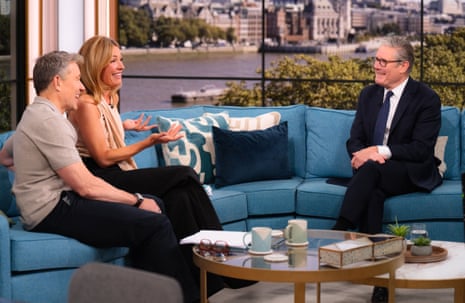
Starmer has been saying this for some time. But at Westminster there is a widespread assumption that, if Andy Burnham wins the Makerfield byelection on Thursday, there will be a challenge – and Starmer will conclude it is better to concede gracefully than fight an election he would lose.
Here is a round-up of some of the byelection news around today.
Ben Clatworthy in the Times says Burnham “is preparing to launch an immediate leadership challenge against Keir Starmer if he wins the Makerfield byelection”. Clatworthy says:
The Times understands that Louise Haigh, who is running the campaign for Burnham in Makerfield, and Lucy Powell, the deputy Labour leader, had originally been of the view that he should “go long” and challenge later in the year, after the September party conference.
But the thinking shifted on Thursday when Healey, Al Carns, the armed forces minister, and two parliamentary aides resigned over Starmer’s defence investment plan.
A source said: “They now want to go as soon as possible and are even considering saying on by-election night, ‘we’re going to challenge for prime minister’.”
A source close to Burnham insisted he would instead “want to make the night all about the clear victory over Reform UK”.
Burnham has told the i in an interview that he would like to see more devolution of employment support policy, and potentially, to regions. In her write-up, Caroline Wheeler says:
[Burnham’s] prescription is to hand far more power over welfare reforms to city regions like his own. Burnham draws on Greater Manchester’s experience of running devolved employment support programmes.
Since 2014, the city region has pioneered its “Working Well” model, which combines employment support with health, skills and housing services and relies on dedicated key workers rather than a standardised national approach. The programme was one of the first examples of the Department for Work and Pensions (DWP) devolving control over employment support to a city region.
This is an approach that Alan Milburn implicitly backed in the well-regarded report on youth unemployment he published recently.
In his i interview, Burnham also said Labour should also stick to its commitment to keep the pension triple lock during this parliament. But he would not say what should happen to it after that. The Tories and Reform UK have both signalled that they will fight the next election committed to keeping the triple lock.
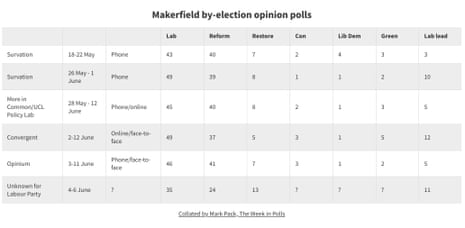
Three polls have been published over the weekend, showing Burnham 5 points, 5 points and 12 points ahead of Reform UK’s Robert Kenyon in the byelection. On Substack Peter Kellner, the former YouGov president, has an analysis of the polling in a post on his blog, and Mark Pack, the former Lib Dem president, has his own analysis in a post on his blog.
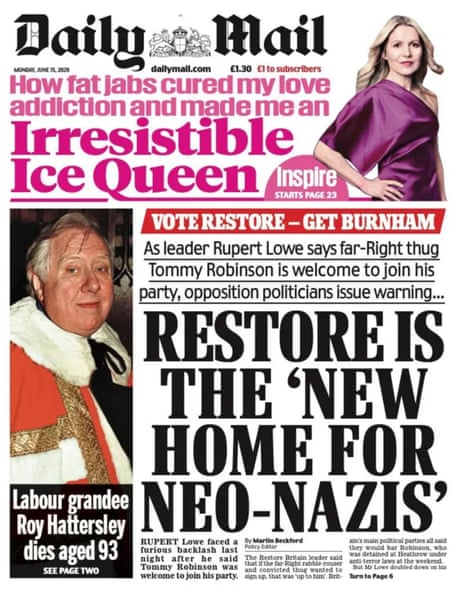
The Daily Mail has splashed on a story criticising Rupert Lowe, the Restore Britain leader, for saying Tommy Robinson would be happy to join his party. It was published after the Mail on Sunday splashed on a story saying some of the people campaigning for Restore in Makerfield attended a white supremicist conference with neo-Nazis. The Mail does not normally devote a lot of attention to the threat posted by rightwing extremism, and it is generally postive about Reform UK. Lowe says the paper’s coverage shows that “the establishment wants to eradicate Restore Britain”. Three of the five polls carried out in Makefield (or four of the six, if Labour’s purported private poll is included) suggest Burnham would lose if the Reform UK and Restore Britain vote were combined. The Mail has an editorial saying people in Makerfield should avoid voting for Restore Britain because, by splitting the rightwing vote, they could “propel Andy Burnham into Downing Street”.
There will be an urgent question in the Commons at 3.30pm on the defence investment plan, and by implication John Healey’s resignation. Kemi Badenoch has tabled the question, but she won’t get a reply from Keir Starmer. Dan Jarvis, the defence secretary, or one of his ministers, will respond.
Then, at about 4.15pm, Liz Kendall, the technology secretary, will give a statement on the social media ban for under-16s.
About an hour or so later Jarvis will make a statement on British troops seizing a Russian shadow fleet oil tanker in the Channel.
Under-18s to be banned from accessing 'romantic companion' chatbots under government's crackdown
The Department for Science, Innovation and Technology has published a news release with full details of the social media ban for under-16s announced by Keir Starmer.
At his press conference Keir Starmer did not say much about the measures proposed for under-18s. The DSIT statement covers this. It says:
The government plans to use the same model for a social media ban as Australia. This would capture user-to-user platforms, whose purpose is to enable social interaction and which allow users to post material, alongside algorithms. The ban will therefore include platforms like Snapchat, TikTok, YouTube, Instagram, Facebook and X. We do not intend for messaging services like WhatsApp and Signal to be included in the social media ban.
In a move to protect children online and address the scale of the challenge, the government will also go further than a blanket ban on social media with world-leading blocks on harmful functions such as livestreaming and stranger communication with children for under-16s. These restrictions – which together with the ban go further than any other country – will apply to a wider range of online services, including on gaming sites.
Restrictions on these functionalities will also be on by default for under 16- and 17-year-olds to prevent a cliff-edge at 16. The government will also be looking in more detail at overnight curfews and breaks in infinite scrolling for under-18-year-olds and will set out more detail in July ….
So-called AI ‘romantic companion’ chatbots – designed to simulate sexual relationships or roleplay with users – will have to enforce a minimum age of 18. Similar intimate functionalities will be restricted for under-18s on AI chatbots more widely.
Taken together, these measures will mean a much more comprehensive model than just a blanket ban on social media — one that responds to how children experience harm online, rather than just where it happens.
And here is the text of Keir Starmer’s speech this morning.