3 weeks ago
Trump gets new powers to impose 100% tariffs on major Russian energy buyers, potentially putting India, China and even US allies in the crosshairs.
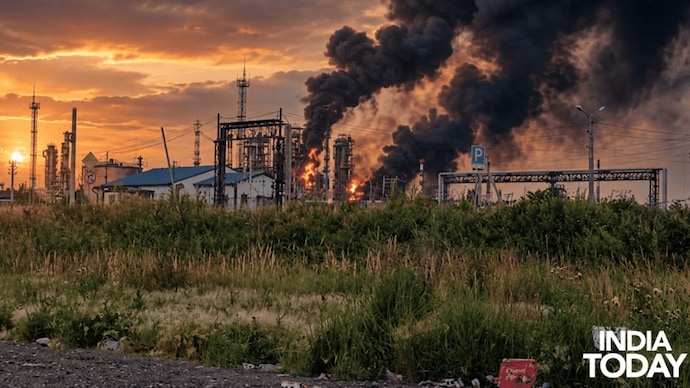
AI-enhanced image of Russia’s Omsk oil refinery, more than 2,500 km from Ukraine’s border, following a Ukrainian drone strike in July 2026
Washington has turned India’s Russian oil trade into a fresh pressure point. Overnight, the US House passed the "Lindsey O. Graham Sanctioning Russia and Iran Act of 2026", opening the door to tariffs of up to 100% on countries buying Russian energy, including India.
The timing is crucial. The bill comes as Ukrainian strikes disrupt Russian refineries, while India has stepped up its supply of refined fuel to Moscow.
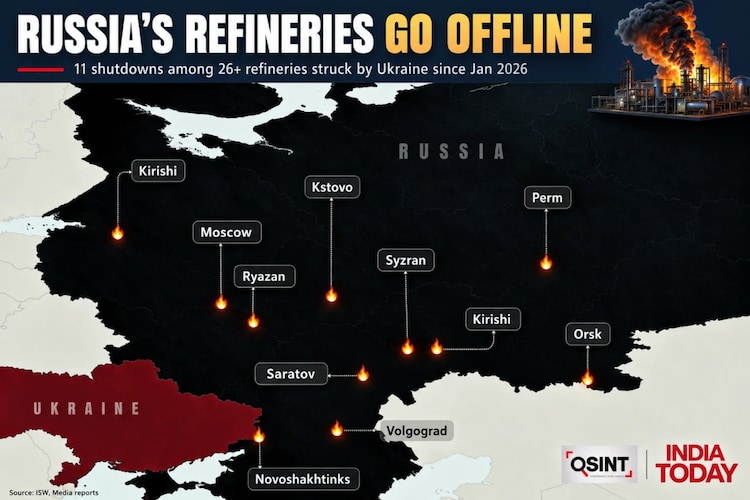
But beneath the tariff threat lies a striking energy loop. The Refinery Ledger, an open-source tracker, records "11 refinery shutdowns" following Ukrainian attacks. Meanwhile, the Centre for Research on Energy and Clean Air (CREA), an energy research organisation, says Russia imported a record "172,000 tonnes of oil products" in August, with India supplying "70% of them".
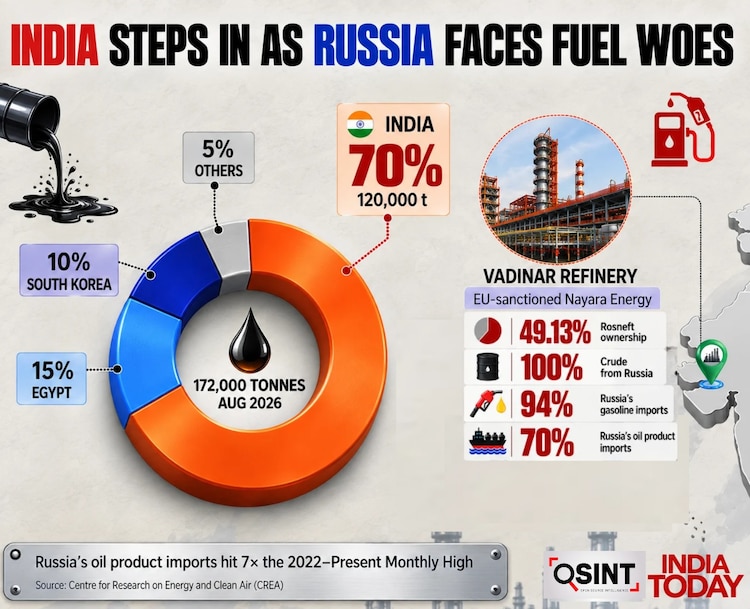
India Today’s OSINT team traced the trail through open-source, industry, and shipping records, showing how Russian crude returns as Indian fuel - while Europe still relies on Moscow for gas despite years of sanctions.
India’s Russian oil loop
Russia imported a record 172,000 tonnes of oil products in August, more than seven times its previous monthly high. India supplied about 70% of those imports, including the bulk of Russia’s gasoline imports.
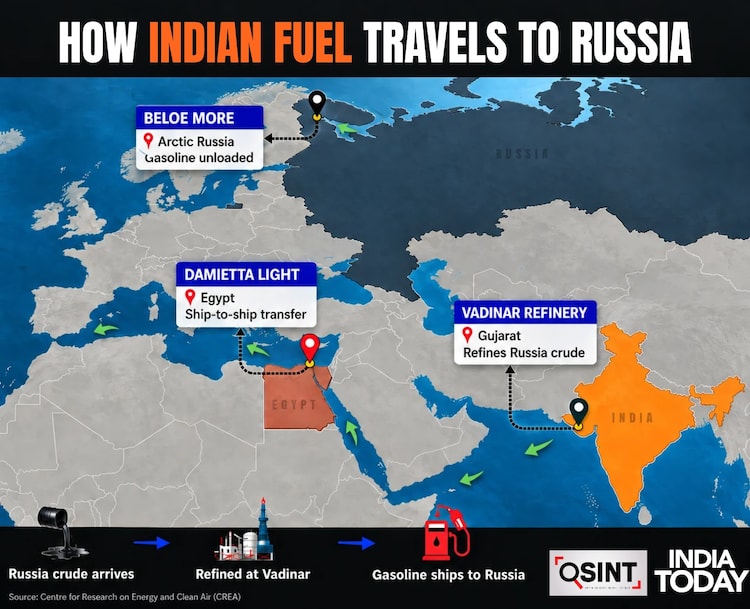
The Centre for Research on Energy and Clean Air (CREA) found that all of the gasoline was loaded at Gujarat’s Vadinar refinery and sold by Nayara Energy, in which Russia’s Rosneft holds a 49.13% stake.
Vadinar sourced "100%" of its crude from Russia during the first eight months of 2026. The fuel then travelled back to Russia, with the cargoes undergoing ship-to-ship transfers at Damietta Lightering Zone, off Egypt, before reaching Russia’s Arctic port of Beloe More.
The route is remarkable in its simplicity: Russian crude goes to India, India turns it into gasoline, and Russia buys the fuel back.
CREA put the contradiction starkly: "Russia is therefore paying a refinery that it partly owns to process its own crude into fuel it can no longer produce domestically."
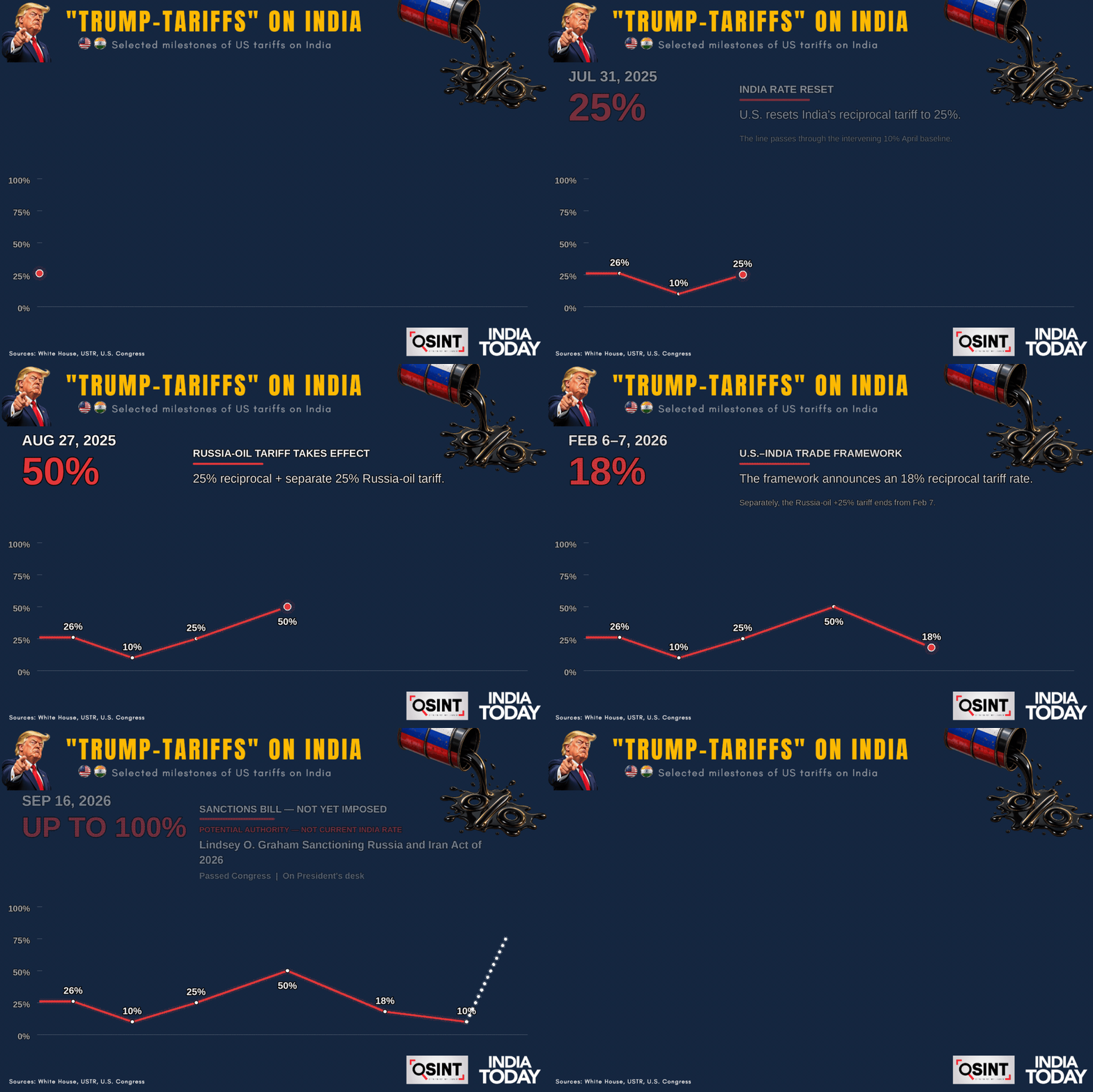
That energy loop now sits against the newly passed US bill, which gives President Donald Trump the power to impose tariffs of up to 100% on countries buying Russian energy. India’s Ministry of External Affairs said it remains "firmly committed to ensuring energy security for its 1.4 billion people" through "diversified sourcing."
For India, the calculus is straightforward: buy energy wherever it is available, because third-country sanctions cannot supersede the needs of 1.4 billion people.
Why Russia needs Indian fuel
The reason Moscow needs that fuel lies inside Russia itself. Ukraine’s sustained drone campaign has targeted the country’s refining infrastructure, disrupting plants far from the battlefield.

The Institute for the Study of War (ISW), a conflict research organisation, has tracked more than 26 Russian refineries struck since January.
The impact is already visible across Russia’s refining network. The following graphic, based on ISW and media reports, tracks "11 shutdowns among over 26 refineries struck by Ukraine since Jan 2026", including Volgograd, Ryazan, Saratov, Syzran, Kstovo, Perm and Orsk.
The strikes are also reaching deep into Russia. The Refinery Ledger records attacks on Omsk, around 2,469 km from the front; Tyumen, around 2,050 km away; and Permnefteorgsintez, around 1,526 km away.
Omsk is particularly significant: the tracker describes it as Russia’s "single largest refinery", with a capacity of 442,000 barrels per day, and records it as the deepest confirmed strike in the dataset.
Kpler, a commodity intelligence firm, estimates Russian refinery crude runs fell to around 3.80 million barrels per day in July, "the lowest level in well over two decades". It estimated 1.5 to 2 million barrels per day of processing capacity was effectively offline.
Kpler says Russia is "transitioning from one of the world's largest exporters of transportation fuels to a potential importer of selected products."
The shift is visible in Russia’s export data. S&P Global Energy data, citing Commodities at Sea, shows crude exports rising from "3.4 million barrels per day" in January to "3.837 million bpd" in August, while refined product exports nearly halved, from "2.43 million bpd" to "1.229 million bpd".
The problem is not simply damage from individual strikes. Critical processing units and supporting infrastructure have been repeatedly hit, while repairs can take months rather than weeks.
As Kpler put it, "refineries are repeatedly struck before repairs can be completed, extending outages and delaying restarts."
Recently, Russia’s Syzran refinery halted after a September 15 attack, while the Saratov refinery had already stopped operations following an earlier strike. Three of Russia’s six major diesel-producing refineries have sharply reduced or halted output, as per a Reuters report.
The Energy Agency (IEA), a global energy agency, said intensified Ukrainian attacks had compounded Russia’s refining losses and brought about a "near-halt to product exports."
The Europe contradiction
Europe’s sanctions regime has not ended its dependence on Russian energy. Instead, the trade has increasingly moved through different routes, refineries and products.
CREA found that refineries in India, Trkiye, Brunei and Georgia exported "€510 million" worth of oil products to countries enforcing sanctions in August.
Of that, €333 million went to the EU, €143 million to the US and €34 million to Australia. CREA estimated that “at least €189 million had been refined from Russian crude.”
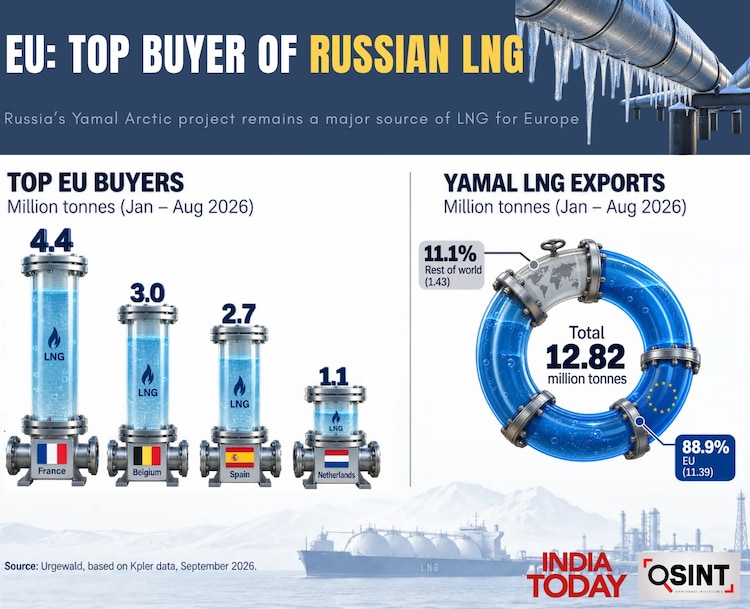
The same pattern is visible in gas. Russia’s Yamal LNG, the Arctic LNG project, exported 12.82 million tonnes between January and August 2026, with 88.9%, or 11.39 million tonnes, going to the EU.
France received 4.4 million tonnes, Belgium 3 million, Spain 2.7 million and the Netherlands 1.1 million, according to the data used in the graphic.
CREA’s August analysis found that the EU remained Russia’s "largest LNG buyer", accounting for almost half of its LNG exports. It was also the "largest buyer" of Russian pipeline gas, taking 32% of exports.
But Russian energy is reaching Europe through another route too.
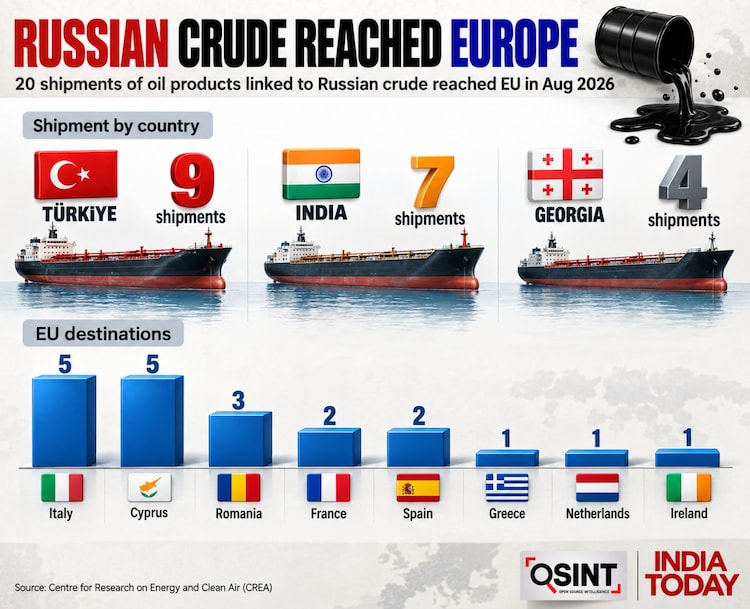
Despite the EU ban on oil products made from Russian crude, which took effect on January 21, "20 shipments" from refineries processing Russian crude were unloaded at EU ports in August.
Nine came from Trkiye, seven from India and four from Georgia’s Kulevi refinery. The shipments were identified as "high risk according to the EU’s own guidance".
So while Europe continues to receive Russian LNG directly through projects such as Yamal, Russian crude is also being transformed into petroleum products elsewhere before reaching European markets.
- Ends
Published By:
bidisha saha
Published On:
Sep 17, 2026 14:52 IST