1 month ago
A World War II-style island campaign could either end the ongoing Iran war or prolong the conflict. Both scenarios may see the US military suffer heavy losses.
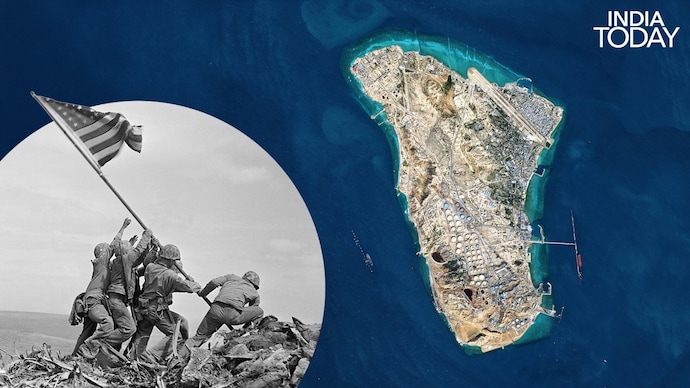
The capture of Iwo Jima resulted in one of the most defining images of World War II (inset). Donald Trump may try to attempt something similar with respect to Iran's Kharg Island. (Photos: Wikimedia Commons/Getty)
The US military’s most iconic 20th century image was born in the capture of Iwo Jima island in the Pacific Ocean. On February 23, 1945, six US Marines planted the American flag atop Mount Suribachi after one of the bloodiest battles fought by the US during World War II.
The mission to capture Iwo Jima from Japan was part of the United States's ‘island hopping’ campaign to take control of remote ocean outposts in the Pacific that formed the outer defensive perimeter of the Japanese home islands. When these islands fell, Japan stood exposed to invasion.
Imperial Japan eventually surrendered on August 15, after the twin atomic bombings of Hiroshima and Nagasaki. The Boeing B-29 Superfortress bombers that dropped these bombs took off from Tinian in the Mariana Islands which the US had wrested from Japan after a brutal week-long battle that saw the first use of napalm.
ENTER 2026
Eighty years later, a similar situation seems to be developing, albeit on a much smaller scale and compressed geography. Iran has responded to a month-long US-Israeli bombing campaign by showering ballistic missiles and drones at Israel, the UAE, Saudi Arabia, Oman, Qatar, and Bahrain.
Iran has blocked the Strait of Hormuz, through which 20 per cent of the world’s oil and gas passes, and has become the first country in the 21st century to target American military infrastructure and audaciously demand the US's withdrawal from its neighbourhood.
Iranian defiance comes even as President Donald Trump stares at three momentous events coming later in the year: a bilateral summit with Xi Jinping in Beijing on May 14-15, the 250th anniversary celebrations of the US on the 4th of July, and the domestic mid-term elections on the 3rd of November.
Trump cannot appear to be seen as weak at any of these milestone events.
On May 10, 2025, a half-hour bombing of PAF bases by the Indian Air Force got Islamabad to dial Trump to call for a ceasefire. The Iranians are hardier. In over a month now, US-Israeli warplanes have assassinated Iran’s supreme leader, Ayatollah Khamenei, and several top leaders, bombed 16,000 targets, and destroyed Iran’s air force and navy.
Yet, Teheran’s command and control and its deeply buried missile and drone sites are unaffected. It has successfully managed to blockade the Strait of Hormuz and hold the world economy hostage. Trump’s promise of a ‘Shock and Awe’ campaign like Iraq in 2003 is looking more like the Oil Shock of 1973, the worst oil crisis in history... so far.
Oil prices have surged nearly 60 per cent over the past month and the global economy is being scorched. The US-Israeli air campaign has failed to build military leverage to force Teheran to capitulate. To break this impasse, Trump has despatched over 6000 Marines and paratroopers to West Asia.
MARINE INVASION?
Even as the US holds peace talks with Iran via Pakistan, the USS Boxer Amphibious Ready Group (ARG) is set to arrive near Iran in early April with over 2000 more Marines. These US boots on the ground are the geopolitical equivalent of playwright Anton Chekov's 'gun principle', the premise that if a loaded gun is shown in the first act of a play, it absolutely must go off in the second or the third.
A US military escalation on the ground is not certain. These moves could well be a lever to force Iran to talk. If the US and Iran can achieve a breakthrough in ongoing talks, the threat of ground operations might recede. The drama might conclude before entering the second or third act. The gun might not need to be fired.
If the talks fail, however, and Trump is pressured by his three deadlines, he might consider limited military objectives. He might reach for the loaded gun. This is where the Iwo Jima image becomes important.
US troops could plant a flag, declare victory and exit with a win. The Iranian regime stays. Both sides get a win.
BUT WHERE?
Trump, a President with his own social media platform, and Pete Hegseth, a former talk show host turned Secretary of War, know the power of visual narratives. Their MAGA base is exclusively drip fed by social media.
The question is, where will the Marines plant the Stars and Stripes?
The US cannot invade mainland Iran with 10,000 troops. Iran’s million-strong ground forces -- which include the conventional army, the IRGC and Basij paramilitary -- are intact despite a month-long bombing, and could swiftly repel such incursions.
The best military scenario is for the US Marines and paratroopers to invade and hold isolated military targets, such as Iran’s 30 islands in the Persian Gulf. Some, like Qeshm, Larnak and Hormuz are located at the narrow entrance to the Strait of Hormuz. Others, like Greater Tunb, Lesser Tunb and Abu Musa, sit in the centre of the Gulf.
Iran’s crown jewel, Kharg, sits over 480 km deep inside the Gulf, close to a tri-junction with Iraq and Kuwait. Over 90 per cent of Iran’s oil and gas is pumped out through the 29-square kilometre island.
Kharg has vast storage tanks and can simultaneously berth 10 supertankers. The US could land airborne troops and special forces to capture Kharg. The Marines could plant a US flag on the island and give Trump his win.
A TALL TASK
Capturing these islands, however, is easier said than done. The Iranian islands, particularly Kharg, are heavily defended by IRGC ground troops and are laboriously mined. Any invading force will meet with heavy resistance and is likely to incur heavy losses.
All islands are within missile and drone range of the Iranian mainland, a fact that could seriously jeopardise an invasion. Iran has also threatened to escalate in the face of such a ground invasion by unleashing floating mines (dangerous because of their uncontrollable and indiscriminate nature) to completely shut the Strait of Hormuz.
At this point, the Iwo Jima image runs the risk of being overshadowed by another powerful image: of a burnt airframe of a C-130 J and CH-53 helicopter and five abandoned CH-53 helicopters.
That image is from the aftermath of Operation Eagle Claw, a failed US attempt in 1980 to rescue 53 staff members held captive at the US Embassy in Teheran. A helicopter involved in the failed mission crashed into an air refuelling tanker in the desert, killing eight US service personnel. The operation was aborted. The Delta Force rescuers fled, leaving wreckage and bodies behind.
The debacle ended then-President Jimmy Carter’s chances of being re-elected in 1980. Iran released the hostages minutes after Ronald Reagan’s inauguration on January 20, 1981, timed to humiliate Carter further.
More than four decades later, Trump is in a similar trap: an alluring Iwo Jima visual that runs through an Eagle Claw minefield. No one knows this better than Trump. Days after the US kidnapped President Nicolas Maduro on January 3, Trump bragged to The New York Times how his successful Venezuelan operation could have turned out like Carter’s Eagle Claw: “You didn’t have a Jimmy Carter crashing helicopters all over the place”.
The success of Venezuela led Trump to mount an offensive on Iran. The Iranian impasse has him reaching for outlandish off-ramps. There are no easy exits from this quagmire.
- Ends
Published By:
Dev Goswami
Published On:
Mar 30, 2026 11:42 IST
Tune In