1 month ago
Satellite imagery and shipping data suggest Gulf crude was moved via Oman coast through ship-to-ship transfers under US protection. The workaround appears to have eased wartime pressure in Hormuz, even as broader shipping risks persisted.
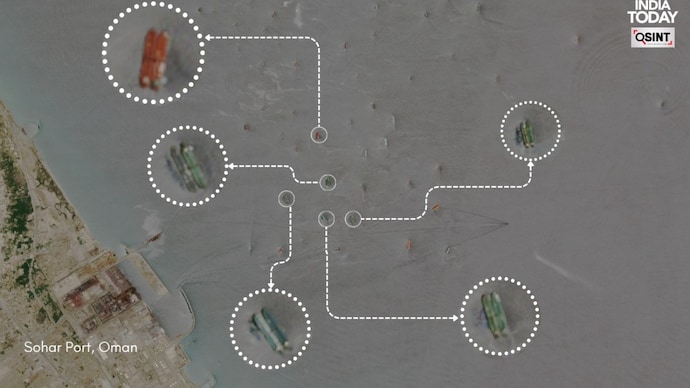
Satellite imagery shows ship-to-ship oil transfers taking place off Sohar port in Oman
For years, Washington criticised the shadowy logistics that helped China keep sanctioned Iranian crude flowing via ship-to-ship transfers, which helped Beijing bypass US sanctions. But as war turned the Strait of Hormuz into one of the world’s most dangerous maritime chokepoints, the irony may be difficult to ignore: the US itself may have ended up relying on a remarkably similar playbook.
Calling it a “secret mission”, US President Donald Trump claimed Washington had quietly helped move more than 100 million barrels of oil and enabled over 200 commercial ships to navigate Hormuz, insisting America, not Iran, controlled the strategic chokepoint.
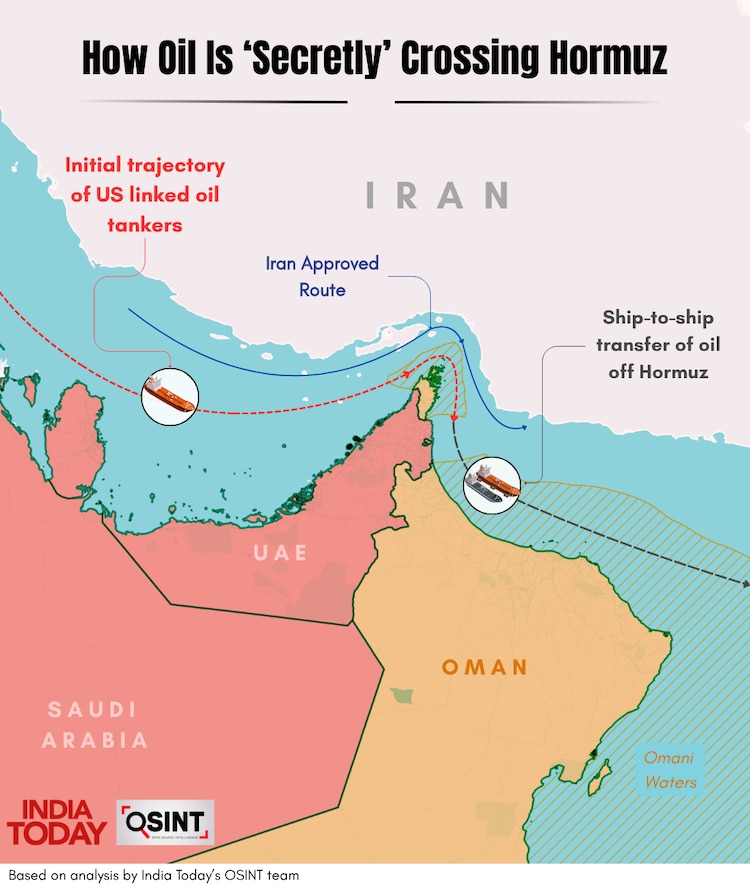
That explains why, even at the height of tensions, the feared supply shock never fully materialised. Markets braced for disruption, insurers raised alarms, and commercial shipping slowed. Yet Gulf crude kept reaching buyers.
The question was not whether oil was flowing, but how.
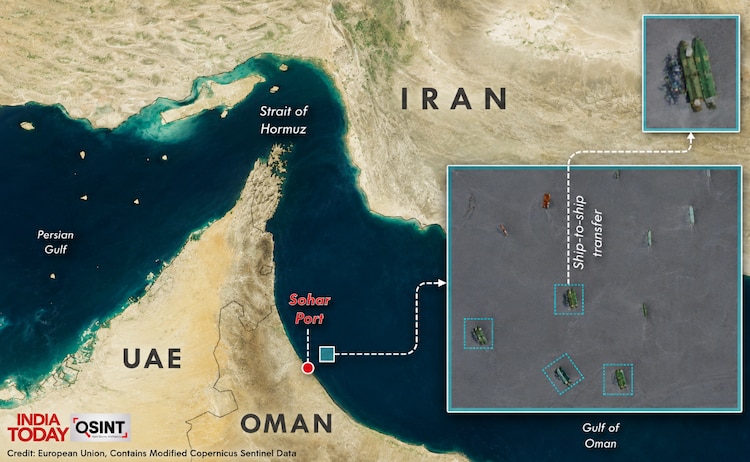
India Today’s Open Source Intelligence team analysed historical satellite imagery to trace where this quiet workaround may have unfolded. European Space Agency’s Sentinel 2 imagery shows clusters of large tankers positioned unusually close together off Oman’s coast in the Gulf of Oman, a pattern consistent with ship-to-ship oil transfers, often associated with Iran-China oil trade. However, the vessels involved in this particular case were operating in an area heavily monitored by the US military, indicating the business was taking place under US protection.
Multiple ship-to-ship transfers were visible in optical satellite imagery from June 6, roughly six kilometres off Oman’s Sohar port, according to an analysis by India Today. The pattern was not isolated: similar transfers had begun appearing in the imagery as early as May 4, suggesting a sustained offshore movement of oil in the area.
The emerging picture points to a wartime workaround. Rather than commercial vessels openly crossing Hormuz in large numbers, state-backed tankers, likely linked to Gulf producers such as Kuwait and the UAE, may have made the risky transit under close surveillance, hugging Omani waters before transferring crude offshore to buyers’ vessels waiting outside the conflict zone.
HOW OIL MOVES: WHAT REALLY HAPPENS IN AND AROUND HORMUZ
India Today’s analysis of historical satellite imagery, cross-referenced with maritime tracking reports and tanker movement data, suggests Gulf crude may still be moving despite the risks around Hormuz.
The US first set up a system to provide security cover to ships trying to pass through the Strait via the Omani route about three weeks ago. Under this arrangement, vessels seeking US assistance were required to switch off their radio signalling and transit “dark.” A network of US warships at sea and Apache attack helicopters in the air would then provide cover to ships choosing this route.
The route, which hugs the Omani coastline, narrows from roughly 33 km to just 800 metres at some points, making it a navigational challenge for very large crude carriers.
Maritime tracking reports and industry assessments have separately flagged the same area as an emerging offshore transfer point for Gulf crude. The pattern was first identified by TankerTrackers, a vessel-tracking service, which traced the oil's origin as non-Iranian but did not disclose where the ship-to-ship transfers took place.
Taken together, the imagery and maritime data suggest a likely pattern: oil-laden non-commercial tankers from the Arab countries cross Hormuz carrying crude from Gulf producers, move toward offshore transfer points near Oman’s coast, and offload cargo to commercial vessels waiting in comparatively safer waters beyond the Strait. The emptied tankers can then return through Hormuz for another short run, potentially reducing exposure inside one of the world’s riskiest maritime corridors.
Maritime historian Sal Mercogliano, in an analysis posted on X, described the workaround as “relatively straightforward”. He wrote that “tankers, including Very Large Crude Carriers, are exiting the Persian Gulf” and, according to TankerTrackers, “the VLCCs are conducting ship-to-ship (STS) transfers to other tankers in the Gulf of Oman.”
According to Mercogliano, “the empty tankers, which run the Strait with their AIS, run back through the Strait to pick up a new load of oil from the UAE, Saudi Arabia, Bahrain, Qatar or Iraq.” He argued that “this explains why we have not seen an appreciable drop in the number of ships stuck in the Persian Gulf,” suggesting that the repeated use of the same ships, backed by war risk insurance, may be helping sustain oil flows despite wartime disruption.
Mercogliano also speculated that “the Apache helicopter that recently crashed was probably a part of this operation,” though no official evidence has confirmed such a link. He further argued that “this would also explain the recent announcement by Kuwait to fix new contracts for its oil,” suggesting confidence that crude can still move through Hormuz.
Even so, the workaround has limits. Ship-to-ship transfers may help move crude, but not LNG, LPG, container cargo, or bulk freight at scale. Those sectors may still require the kind of visible military protection Washington originally promised.
While the Iran conflict has driven up energy prices for consumers worldwide, it has been a windfall for US energy companies and American exports more broadly. US Government data shows its exports of goods and services climbed 2.6 percent in April, reaching $327.1 billion.
- Ends
Published By:
bidisha saha
Published On:
Jun 11, 2026 18:48 IST