4 weeks ago
Crew of seized tanker could face US prosecution, White House says
White House press secretary Karoline Leavitt has just spoken for the first time on the US seizures of two Venezuelan oil tankers, in the North Atlantic and the Carribean.
She was asked by a reporter whether the seizure of the Russian-flagged Bella-1/Marinera risked larger conflict with Russia. Moscow has already responded angrily to the US seizure, calling it a violation of international law.
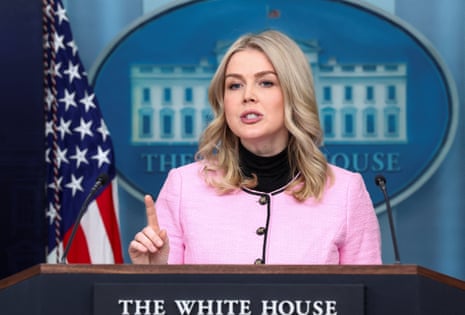
Leavitt did not answer the question about antagonising Russia, instead just providing a summary of the operation. I don’t see any key details we didn’t know.
Leavitt said: “The vessel seized in the North Atlantic… shows the USA is not going to tolerate that [ships breaching sanctions].
She pointed out the vessel was subject to a US order which means its crews could be subject to prosecution too and brought back to the US to face trial. Moscow earlier had urged the US to release the crew.
“This administration is going to fully enforce the sanctions policy.”
Key events 35m ago Explainer: why so much interest in a rusty tanker in the Atlantic? 1h ago Rubio says US plan for Venezuela is stability, recovery, then transition 1h ago Ukraine welcomes US seizure of Russian-flagged tanker 1h ago US House speaker insists no expectation for boots on the ground in Venezuela 2h ago US 'not winging it' in Venezuela, says Rubio 2h ago UK Home Office calls oil tanker seizures 'important activity with US allies' 3h ago Leavitt brushes off Russia anger over ship seizure 3h ago Leavitt says US controlling Greenland would deter China and Russia in the Arctic 3h ago Crew of seized tanker could face US prosecution, White House says 4h ago Rubio says US on verge of deal to take 'all the oil stuck in Venezuela' 4h ago Venezuela interim authorities want oil seized on the Sophia, says Rubio 4h ago Hegseth says US military power, on display with tanker seizures, 'will continue' 4h ago Rubio meeting with Denmark on Greenland issue next week 5h ago UK confirms support to US seizure of Russian flagged oil tanker 5h ago Senior Russian lawmakers decries US seizure of Russian-flagged tanker as piracy 5h ago 'No state has right to use force against ships' from other jurisdictions, Russia says after US seizure of Russia-flagged tanker 5h ago 'We will always be there for Nato, even if they won't be there for us,' Trump says 6h ago US military confirms seizure of Russian-flagged tanker 7h ago Russia's footage of Marinera purports to show US special forces helicopters near tanker 7h ago Venezuela-linked Russia-flagged tanker seized in North Atlantic near Iceland - US media report 7h ago Icelandic coast guard says it is monitoring movements of Marinera 7h ago Reported US attempt to seize Russian-flagged Marinera - context 8h ago US attempting to seize Russian-flagged tanker - media reports 8h ago Danish, Greenlandic ministers seek urgent meeting with US Rubio over Greenland's future 8h ago Russia reportedly sends submarine to escort ‘shadow fleet’ tanker being pursued by US 8h ago Live in Greenland? Share your views on Trump's comments 9h ago UK's Farage says Trump right about need for big Nato base in Greenland - but using force to seize it would be 'outrageous' 9h ago Brigitte Bardot's funeral gets under way in Saint-Tropez 10h ago Ukraine's national interests will be protected at Paris talks, Zelenskyy's chief aide says 10h ago Ukraine-US talks to continue in Paris, Zelenskyy says 10h ago Eyes on Marinera oil tanker as Russia deploys naval escort 10h ago EU reveals weak hand as Trump raids Venezuela and threatens Greenland 11h ago How a US takeover of Greenland would undermine Nato from within - analysis 11h ago More than 700 flights from Amsterdam cancelled due to extreme weather 11h ago European leaders rally behind Greenland as US ramps up threats 12h ago Morning opening: One step forward, one step back Show key events only Please turn on JavaScript to use this feature
Alaska senator Lisa Murkowski told the Associated Press (AP) earlier that she hated “the rhetoric around either acquiring Greenland by purchase or by force,” adding, “I think that it is very, very unsettling.”
New Hampshire Democrat Jeanne Shaheen and North Carolina Republican Thom Tillis, co-chairs of the bipartisan Senate Nato Observer Group, said the US needs to honor its treaty obligations to Denmark, AP reported.
“Any suggestion that our nation would subject a fellow Nato ally to coercion or external pressure undermines the very principles of self-determination that our Alliance exists to defend,” the senators said in a joint statement.
Explainer: why so much interest in a rusty tanker in the Atlantic?
by Tural Ahmedzade, Harvey Symons, Oliver Holmes and Dan Sabbagh
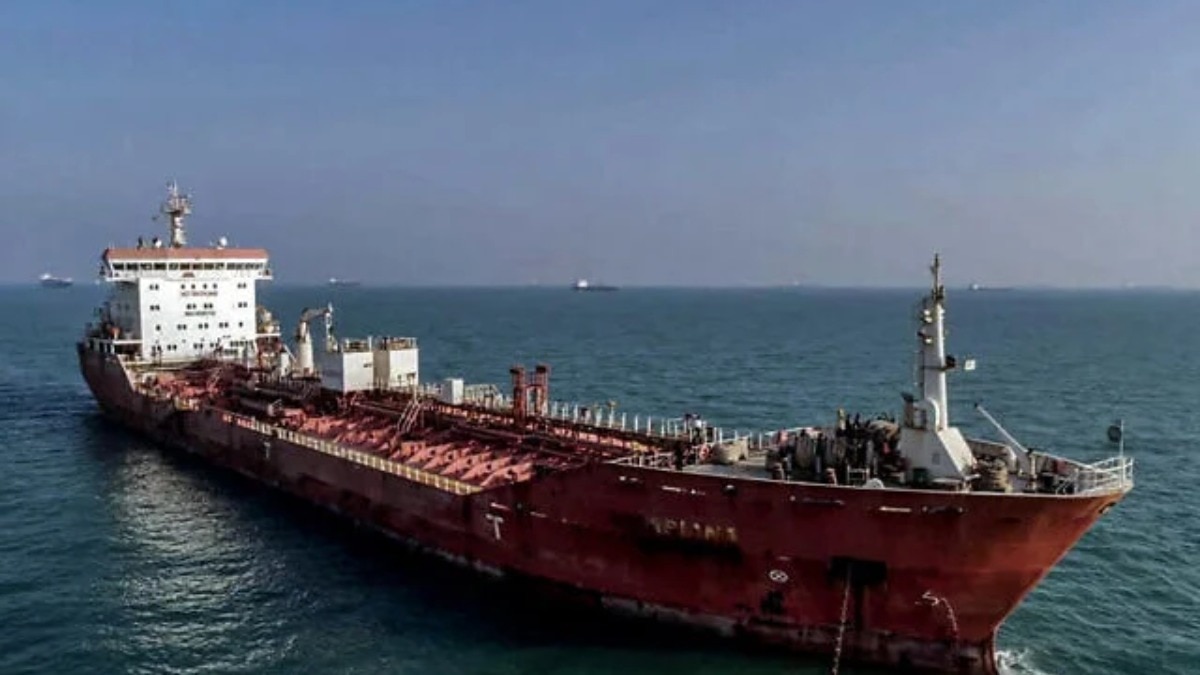
A massive, rusty crude oil tanker floating north through the Atlantic has become the centre of global interest after it was followed for days and eventually seized by US forces while Russia’s military rushed towards it.
Despite not carrying any oil, the 300-metre-long ship is clearly of value. Theories for why range from speculation that high-value Russian weapons are hidden in the hull, to the ship’s potential to become a symbolic trophy in a transatlantic power struggle between Washington and Moscow.
Currently called the Marinera, the name-changing ship is part of the shadow or “ghost” fleets used by Russia, Iran and Venezuela to avoid western sanctions. For years these vessels have moved cargo and cheap fuel around the globe, including to China.
Washington and its European allies have long sought to crack down on the illicit maritime trade. Those efforts reached a critical point last month after Donald Trump imposed a naval blockade on sanctions-busting tankers operating near Venezuela, home to the world’s largest oil reserves and a key destination for shadow fleet vessels.
Read the full explainer at the link below:
Rubio says US plan for Venezuela is stability, recovery, then transition
Further to his insistence that the US is “not winging it” in Venezuela, we have more details on what secretary of state Marco Rubio said earlier regarding the US’s plan for the country.
Rubio said the United States has a three-step plan for Venezuela that will begin with stabilizing the country after US forces seized Nicolás Maduro on Saturday, overseeing the country’s recovery and finally a transition to a more representative form of government, Reuters reports.
“We don’t want it descending into chaos,” said Rubio, after briefing US senators on the Trump administration’s plan for the country. He added that he was working with Venezuela’s interim president, Delcy Rodríguez, and had spoken with her several times since the weekend’s raid in Caracas.
A tightened quarantine on Venezuelan oil would be central to that effort, he said:
We are in the midst right now and in fact about to execute on a deal to take all the oil. We are going to take between 30 and 50 million barrels of oil. We’re going to sell it in the marketplace at market rates, not at the discounts Venezuela was getting.
That money will then be handled in such a way that we will control how it is disbursed in a way that benefits the Venezuelan people, not corruption, not the regime.
Rubio went on:
The second phase will be a phase that we call recovery, and that is ensuring that American, western and other companies have access to the Venezuelan market in a way that’s fair.
Also, at the same time, begin to create the process of reconciliation nationally within Venezuela, so that the opposition forces can be amnestied and released and from prisons or brought back to the country, and begin to rebuild civil society.
And then the third phase, of course, will be one of transition.
Ukraine welcomes US seizure of Russian-flagged tanker
Ukraine’s foreign minister has said that Kyiv welcomes the US seizure of the Marinera Russian-flagged tanker linked to Venezuela, adding that it showed Donald Trump’s “resolute leadership”.
“The apprehension of a Russian-flagged ship in the North Atlantic underscores the United States’ and President Trump’s resolute leadership,” Andrii Sybiha wrote on X.
“We welcome such an approach to dealing with Russia: act, not fear. This is also relevant to the peace process and bringing a lasting peace closer.”
US House speaker insists no expectation for boots on the ground in Venezuela
My colleague Shrai Popat reports that US House speaker Mike Johnson emerged from the closed-door meeting with top administration officials and his lower chamber colleagues about the capture of Nicolás Maduro convinced that there would be “no boots on the ground” in Venezuela.
“We don’t anticipate that’s going to be necessary,” the speaker said. “We went to apprehend a criminal. We did it with precision. It was justified, and that job has been done. We now hope that the people in Venezuela can govern themselves.”
He also appeared to downplay the prospect of the US taking military action on Greenland, despite the White House making it clear that all options remain on the table for Trump’s aspiration to acquire the Arctic island.
“We’re not at war with Greenland,” Johnson said in comments reported by the Hill. “We have no intention of being, no reason to be at war with Greenland, OK?”
“So, all this stuff about military action and all that. … I don’t think that’s a possibility. I don’t think anybody’s seriously considering that. And in Congress, we’re certainly not,” he added.
Earlier Karoline Leavitt told the White House press briefing that while there are currently no boots on the ground in Venezuela, “the president, of course, reserves the right to use the United States military if necessary”.
And, as we’ve been reporting, she also didn’t rule out the possibility of using military forces in Greenland. She told reporters:
All options are always on the table for President Trump as he examines what’s in the best interest of the United States, but I will just say that the President’s first option always has been diplomacy.
Again, look at Venezuela, he tried ardently to strike a good deal with Nicolás Maduro and he told him I will use the United States military and you will not like it, if you don’t take such a deal, and look at what happened.
US 'not winging it' in Venezuela, says Rubio
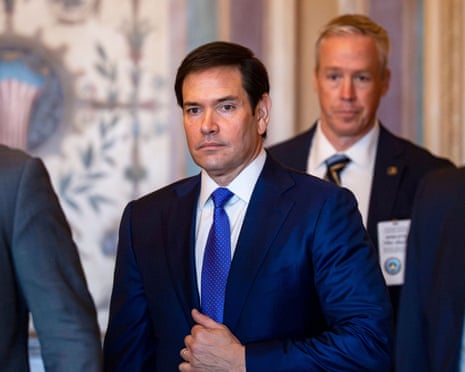
US secretary of state Marco Rubio has pushed back on the heavy criticism from Democratic senators of the US military operation in Venezuela and the Trump administration’s plan to run the country, telling reporters on Capitol Hill that the US is “not winging it” in Venezuela.
“The bottom line is, we’ve gone into great detail with them about the planning. We’ve described it to them,” Rubio said, following a private meeting with senators.
In fact, it’s not just winging it. It’s not just saying or speculating, it’s going to happen. It’s already happening.
The regime can no longer move oil and generate revenue unless the US allows, Rubio said, giving Washington “tremendous leverage” and “control”.
Sky New has the clip.
Earlier, White House press secretary Karoline Leavitt also pushed back on criticism and insisted there was a plan for the country after the US capture of Nicolas Maduro and , telling reporters, “There is a long-term plan here.”
UK Home Office calls oil tanker seizures 'important activity with US allies'
Mike Tapp, parliamentary under-secretary of state at the Home Office has spoken to the BBC describing the UK’s assistance in the US operation to seize two oil tankers as “important activity with our US allies”.
When asked if there were concerns of Russian retaliation for the UK’s role in helping seize the Russian-flagged Bella 1/Marinera ship, he said the UK’s concerns were focused on “taking on those who are trying to get around sanctions and we’ve been really clear we’ll continue to do that with the Russian shadow fleet, and today is a part of that”.
Leavitt brushes off Russia anger over ship seizure
Leavitt is asked if there are concerns of increased tensions with Russia because of the tanker seizure, and with China over the Venezuela operation. She says:
“The president has very good, open relationships with both President Putin and President Xi. He has spoken with them numerous times… and I believe those personal relationships are going to continue.
But as for the president and the United States- he’s going to enforce our policy that’s best for the US, and in respect to these ship seizures, that’s enforcing the embargo on all dark-fleet vessels that are illegally transporting oil.”
The Kremlin has already responded angrily to the US seizure, saying “no state has the right to use force against ships properly registered in the jurisdictions of other states”.
When questioned on whether Trump is still committed to Nato and the article 5 provision of the alliance’s members coming to each other’s defence – Leavitt repeats Trump’s message on Nato from earlier today that “we will always be there for Nato even if they are not there for us”.
Leavitt says US controlling Greenland would deter China and Russia in the Arctic
A reporter asks Leavitt what the US stands to gain if it were to take control of Greenland given it already has access to military bases there, can station personnel on the territory, and place assets.
Leavitt replies: “More control over the Arctic region and ensuring that China and Russia and our adversaries cannot continue their aggression in this very important and strategic region.”
Leavitt says the US coastguard is “escorting” the Sophia to the US – this is second oil tanker that was seized in the Caribbean.
Asked a slew of questions on Greenland, Leavitt is pressed on why the US has not ruled out using military force.
She says Trump won’t broadcast the US’s foreign policy. “All options are always on the table for President Trump as he examines what’s in the US’s interests…but the president’s first options, always, has been diplomacy,” she claims.
Crew of seized tanker could face US prosecution, White House says
White House press secretary Karoline Leavitt has just spoken for the first time on the US seizures of two Venezuelan oil tankers, in the North Atlantic and the Carribean.
She was asked by a reporter whether the seizure of the Russian-flagged Bella-1/Marinera risked larger conflict with Russia. Moscow has already responded angrily to the US seizure, calling it a violation of international law.
Leavitt did not answer the question about antagonising Russia, instead just providing a summary of the operation. I don’t see any key details we didn’t know.
Leavitt said: “The vessel seized in the North Atlantic… shows the USA is not going to tolerate that [ships breaching sanctions].
She pointed out the vessel was subject to a US order which means its crews could be subject to prosecution too and brought back to the US to face trial. Moscow earlier had urged the US to release the crew.
“This administration is going to fully enforce the sanctions policy.”
Rubio says US on verge of deal to take 'all the oil stuck in Venezuela'

Shrai Popat
Speaking to reporters, Rubio said that the US is about to execute on a deal to take “all the oil that is stuck in Venezuela”.
“We’re going to sell it in the marketplace, at market rates, not at the discounts Venezuela was getting. That money will then be handled in such a way that we will control how it is dispersed in a way that benefits the Venezuelan people, not corruption, not the regime,” Rubio added.
When pressed by reporters about whether the US is concerned about the interim leader’s loyalty to her deposed predecessor, Rubio remained resolute.
“The bottom line is that there is a process now in place where we have tremendous control and leverage over what those interim authorities are doing and are able to do,” the secretary of state said.
“But obviously this will be a process of transition. In the end, it will be up to the Venezuelan people to transform their country. We are prepared under the right conditions, using the leverage that we have, which includes the fact that they cannot move any oil unless we allow them to move it.”