1 month ago
The India-EU free trade agreement (FTA), years in the making, will give India broad market access to those sectors that have long fostered Pakistan's export success in Europe, especially textiles and apparel. Pakistan now seems to be feeling the heat and is in panic mode.
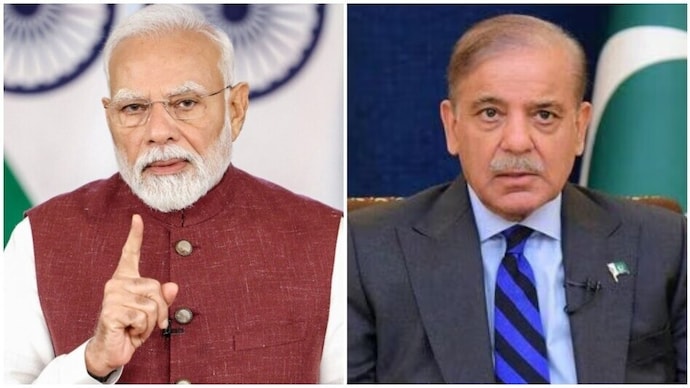
PM Narendra Modi and Pakistan's Shehbaz Sharif

New Delhi,UPDATED: Jan 31, 2026 11:28 IST
The 'mother of all trade deals' between India and the European Union (EU) has not only caused ripples in the US, but also closer home, across the border in Pakistan. The free trade agreement (FTA), years in the making, will give India broad market access to those sectors that have long underpinned Pakistan's export success in Europe, especially textiles and apparel. These labour-intensive sectors were the worst hit due to Donald Trump's 50% tariff on India. With the India-EU trade deal, Pakistan now seems to be feeling the heat.
The Shehbaz Sharif government is in panic mode. The EU is Pakistan's second-largest export market, and at stake is $9 billion (Rs 8.25 lakh crore) in annual shipments, mostly textiles and apparel. Pakistan's foreign ministry on Friday said it was in touch with the European Union to tackle any impact on its exports in the wake of the trade deal with India. Moreover, Pakistan's Deputy Prime Minister Ishaq Dar also held a hastily arranged inter-ministerial meeting to review the situation. It followed a meeting between PM Shehbaz Sharif and the EU's ambassador to Pakistan.
"We are following this matter bilaterally with the EU member states and also collectively with the EU headquarters in Brussels," the Pakistan foreign ministry spokesperson said.
WHY IS PAKISTAN FEELING THE HEAT?
The timing of the India-EU FTA could not be more unsettling for Pakistan, coming as it struggles to scale up exports and its economy is in tatters. According to a World Bank report, Pakistan's export share has sharply fallen from 16% of GDP in the 1990s to about 10% in 2024.
At the centre of Pakistan's concern is that the India-EU deal would weaken its competitive edge in the European market. Pakistan enjoys Generalised System of Preferences Plus (GSP+) status, a scheme under which Pakistani traders get duty-free access to the EU market on nearly 66% or two-thirds of their exports.
Under the GSP+ status, granted in 2014, Pakistan saw its textile exports to Europe increase by 108%. In fact, the 27-member EU bloc accounts for nearly $7 billion, or 40%, of Pakistan's textile shipments each year. Crucially, the GSP+ status for Pakistan will expire next year.
The textile sector is Pakistan's largest industrial employer and biggest source of its export earnings. The sector provides employment to around 15 to 25 million people.
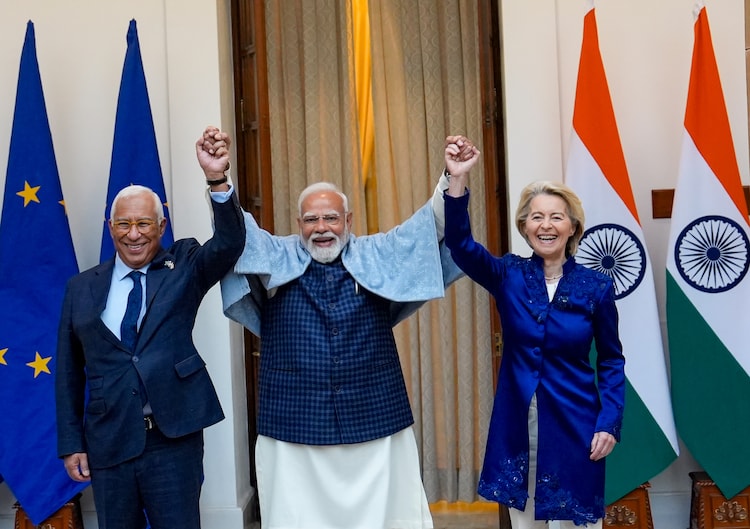
HOW TRADE DEAL WILL BENEFIT INDIA?
On the other hand, before its trade deal with the EU, India's textile and apparel products faced tariffs of up to 12%. As part of the FTA, the EU will now eliminate or reduce tariffs on 99% of goods imported from India over seven years. India, on its part, will do away with or cut tariffs on 97% of EU shipments.
This will give India a massive competitive edge in exporting labour-intensive goods hit hard by Trump's tariffs, including apparel, gems, jewellery and footwear. As a result, needless to say, Pakistan will lose the unbridled export advantage it enjoyed. Ditto for Bangladesh, which currently exports garments duty-free to Europe. Its garment shipments will now face tougher competition.
This aspect was highlighted by Union Minister Piyush Goyal during his press briefing after the India-EU deal was finalised on January 27.
"All these years, there have been questions of why Bangladesh earns $30 billion in exports to the EU, and India cannot do it. It was because Bangladesh, being a Least Developed Country (LDC), had zero duty," Goyal said.
IMPACT ON PAKISTAN
With the FTA deal with the EU, the dynamics have now fundamentally changed. Tariffs on Indian textiles and apparel will fall to zero from the first day the deal comes into effect.
"India has become significantly more competitive in the EU market, effectively neutralising and, in several segments, overtaking Pakistan's GSP+ advantage," Kamran Arshad, the chief of All Pakistan Textile Mills Association (APTMA), told The Dawn.
Moreover, there is also no confirmation if the EU would extend the GSP+ status, as the bloc looks to ramp up bilateral trade deals to reduce dependence on an unstable US and an aggressive China.
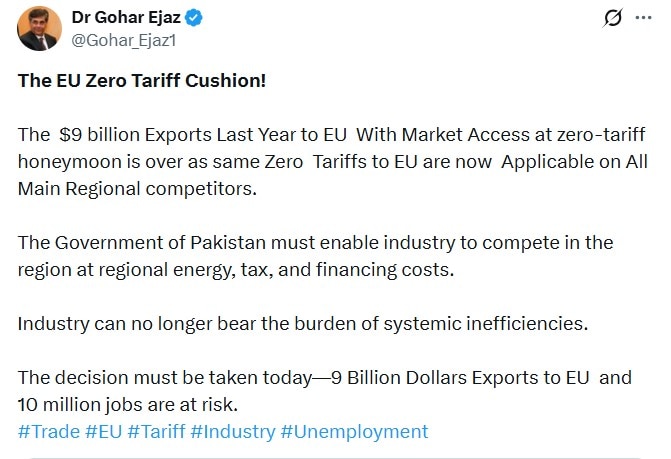
Giving the Sharif government a reality check, Pakistan's former Commerce Minister, Dr Gohar Ejaz, said Islamabad's "zero-tariff honeymoon" with the EU market was over. Dr Ejaz underlined that 10 million jobs were at risk.
"Pakistan must enable industry to compete in the region at regional energy, tax, and financing costs. Industry can no longer bear the burden of systemic inefficiencies," he tweeted.
Pakistani exporters have warned that unless the government lowers production costs, especially energy tariffs, the country could face a declining market share in Europe and job losses in the textile sector, as reported by Dawn.
The reaction from the Sharif government was immediate. On Saturday, Pakistan announced a Rs 4.04 cut in electricity tariff for industrial consumers to lower production costs.
The India-EU 'mother of all deals' has definitely come as a 'mother of all setbacks' for Pakistan on the export front.
- Ends
Published By:
Abhishek De
Published On:
Jan 31, 2026