 3 weeks ago

China was once one of the most attractive and fastest-growing markets for many American brands.
With its population of more than 1.4 billion people and massive opportunities for businesses, companies were racing to take advantage of the boon that China could offer.
But in recent years, some consumer brands, including Nike, Starbucks and General Motors, have begun to see the tide turn. With rising geopolitical tensions, a surge in domestic competition and a disconnect from the Chinese consumer, American companies have lost ground in the region that once offered fuel for growth.
"China is such a big market. The numbers are so big so quickly when you talk about China that sort of everybody has wanted to try, and that's why all brands went there," Aaron Cheris, head of global retail practice at Bain & Company, told CNBC.
Yet those companies haven't adjusted to the local market and its changing structures and needs, he said.
"If anything, the question isn't what's going wrong in China — it's why isn't that happening in the rest of the world," Cheris added.
A person walks past a Starbucks coffee shop at a mall in Beijing, Nov. 5, 2025.
Wang Zhao | Afp | Getty Images
Cheris said price premiums for American products are often not worth it for Chinese consumers, and Chinese brands often have a fast innovation cycle and better distribution within the region.
"We're just not nearly as developed. Our brands don't necessarily think and develop quite in the same way," Cheris said.
The U.S. and China have also been embroiled in geopolitical tensions over the past few years, especially with President Donald Trump's volatile tariff agenda. And while the political backdrop may be disincentivizing Chinese consumers from buying American, it coincides with a rise in pride for domestic brands as consumers look to buy more local.
Some of those domestic brands have also disrupted the broader industry, reset innovation cycles and launched price wars.
Still, some companies — such as Lululemon, Ralph Lauren and Kentucky Fried Chicken — are finding success in China with their products, a discrepancy Cheris said is due to "the basics" of their business strategies.
"Am I coming in with a good value? Did I have a compelling product that felt locally relevant? Am I advertising and making it available in the channels and stores that are winning in that market?" he said. "It really is a blocking and tackling and running your brand right kind of story."
For more U.S. companies to turn around their China businesses, Cheris said, they'll have to make sure the product is worth the price premium and quality.
"The key will be which brands take it seriously enough and really build enough local capability to do that, rather than just saying, 'I'm going to take what I built globally and try to sell it to a Chinese consumer,'" he said.
Here's how some consumer companies have seen their influence in China dwindle over the past few years:
Retail
Some retailers' popularity and relevance have tanked in China over recent years as their bets to go big internationally faltered.
Nike is one of the biggest victims. The sneaker company has seen its China business shrink 30% since 2021, with its annual revenue hitting its lowest level in eight years in the spring. While China was once Nike's fastest-growing region, shoppers are increasingly turning to domestic brands over international ones, while Nike is attempting to overhaul its distribution model in the country.
Yaling Jiang, founder of consumer research firm ApertureChina, previously told CNBC that Nike has "just become irrelevant" in China, while Adidas has gained traction.
That slowdown is against a backdrop of China's sports renaissance, with the country's sportswear market more than doubling over the past decade, according to GlobalData.
And Nike isn't sure it'll be able to recover its losses. On its most recent earnings call in June, outgoing CFO Matt Friend said he was unable to determine when the company's China business would return to growth. Still, Cathy Sparks, the vice president and general manager of Greater China for Nike, previously told CNBC the company is actively working to reconnect with Chinese consumers.
A Nike store in Guangzhou, Guangdong Province, China, July 22, 2026.
Qin Zihang | Visual China Group | Getty Images
Other retailers have seen similar struggles.
Beauty retailer Estée Lauder has faced significant headwinds in China, with CEO Stéphane de La Faverie saying on a conference call in early June that he doesn't believe China will soon resume to double-digit growth.
"We deal by making sure that our brands are the most locally relevant in the market where we operate," he said, adding that he's "confident" the company's performance will be revived.
On an earnings call on Wednesday, de La Faverie said the company has seen net sales growth in mainland China, adding that "the market is strong."
In 2022, Gap sold its China business to e-commerce firm Baozun in a $40 million all-cash deal after experiencing a slowdown in its business and an inability to connect with Chinese consumers. Under the deal, Baozun refined the company's local strategy and Gap broke even for the first time earlier this year, with plans to open 50 new stores in mainland China in 2026.
Abercrombie & Fitch is also reportedly looking for local partners in China to hand off the reins of its business there and strengthen its performance.
Some brands, such as Lululemon and Ralph Lauren,have managed to maintain relevancy and sales. Lululemon has seen its China business rise and now expects China to grow about 20% for the year, while Ralph Lauren saw 40% growth in China in its most recent quarter.
Food and consumer packaged goods
While some food and beverage companies, such as Kentucky Fried Chicken, have continued to see success in the region, others have seen stark declines.
Starbucks entered mainland China in 1999, and it became the company's second-largest market by 2015. But the Covid-19 pandemic started a downward turn for the company, which saw Chinese consumers seeking out lower-priced local brands instead.
"The market is going through a transition as we see an increase in mass market competitors, which we believe will shake out over time, and the market will emerge looking fundamentally different than what we see today," then-CEO Laxman Narasimhan said on a Starbucks earnings conference call in early 2024.
Starbucks has seen intense competition from Chinese brand Luckin Coffee, which now has more than three times the number of stores in China. It also sells its drinks at a steep discount.
At the same time, Starbucks' U.S. business was struggling, leading CEO Brian Niccol to create a joint venture with Boyu Capital to operate the company's business in China. Boyu holds a roughly 60% stake in the joint venture and aims to use its local knowledge to lift Starbucks' sales in China once again.
China is also the second-largest market for consumer packaged goods giant Procter & Gamble. But in recent years, P&G's product sales have struggled in China.
"Coming out of Covid, [Greater China] was a depressed market. It was a tough competitive environment, and the results were not great," P&G CEO Shailesh Jejurikar said on the company's earnings conference call in late July.
Sales of its pricey SK-II skincare brand have seesawed. Chinese consumers are traveling less and scaling back spending even when they do go on vacation, hurting sales of SK-II, which relies heavily on luxury travel retail and duty-free stores. In late 2023, SK-II, which originated in Japan but is owned by P&G, also saw sales plummet, as anti-Japanese sentiment weighed on demand from Chinese consumers.
Still, P&G maintains that many of its brands are strong in China, saying some segments are hurt more by the consumer environment than a loss in brand equity. Company executives said they can grow sales in China, such as with diapers made with silk fibers that are winning over consumers.
"We are now growing share in China for the first time in 15 quarters, driven by fundamental changes we made similar to what we're doing in the company," Jejurikar told analysts in late July.
Autos
Employees work on a car assembly line at the SAIC General Motors Co., May 18, 2022.
Ren Yong | SOPA Images | Lightrocket | Getty Images
The U.S. automotive industry has been crippled in China.
What was once the largest potential growth market for automakers a decade ago has now turned into a massive restructuring, largely driven by the rise of domestic Chinese car companies and overcapacity creating a price war.
Detroit's "Big Three" automakers — GM, Ford Motor and Chrysler parent Stellantis, which is no longer based in the U.S. — have collectively fallen from a global market share of 21.4% in 2019 to an estimated 15.7% in 2025, according to S&P Global Mobility. As a result, they've retreated from the region or restructured their Chinese operations.
General Motors, which is the longest-standing U.S. automaker in the country, is now just a shell of its former self in China. Its earnings in the region fell from around $2 billion annually in 2018 to two consecutive years of losses in 2024 and 2025.
GM's fall from grace in the country comes as the automaker is seeing increased domestic competition and changing consumer sentiment. Experts have said local automakers are being fueled by government funding, as well as a culture of innovation and speed that China has instilled in its workers.
Still, a slowing Chinese market and underutilization have forced domestic companies — such as BYD, Geely and more — to begin exporting to major auto markets globally, including Europe, Canada and South America.
More Chinese consumers are also choosing electric vehicles over traditional gas-powered cars for their price and quality. New energy vehicles, which include battery and hybrid-powered cars, accounted for 65.1% of new passenger cars sold in July — up from 54% a year ago, according to China Passenger Car Association data released Tuesday.
GM isn't the only American automaker considering its future in the region. EV leader Tesla is reportedly weighing the sale or spinoff of its Chinese business, according to a July report by The Wall Street Journal.
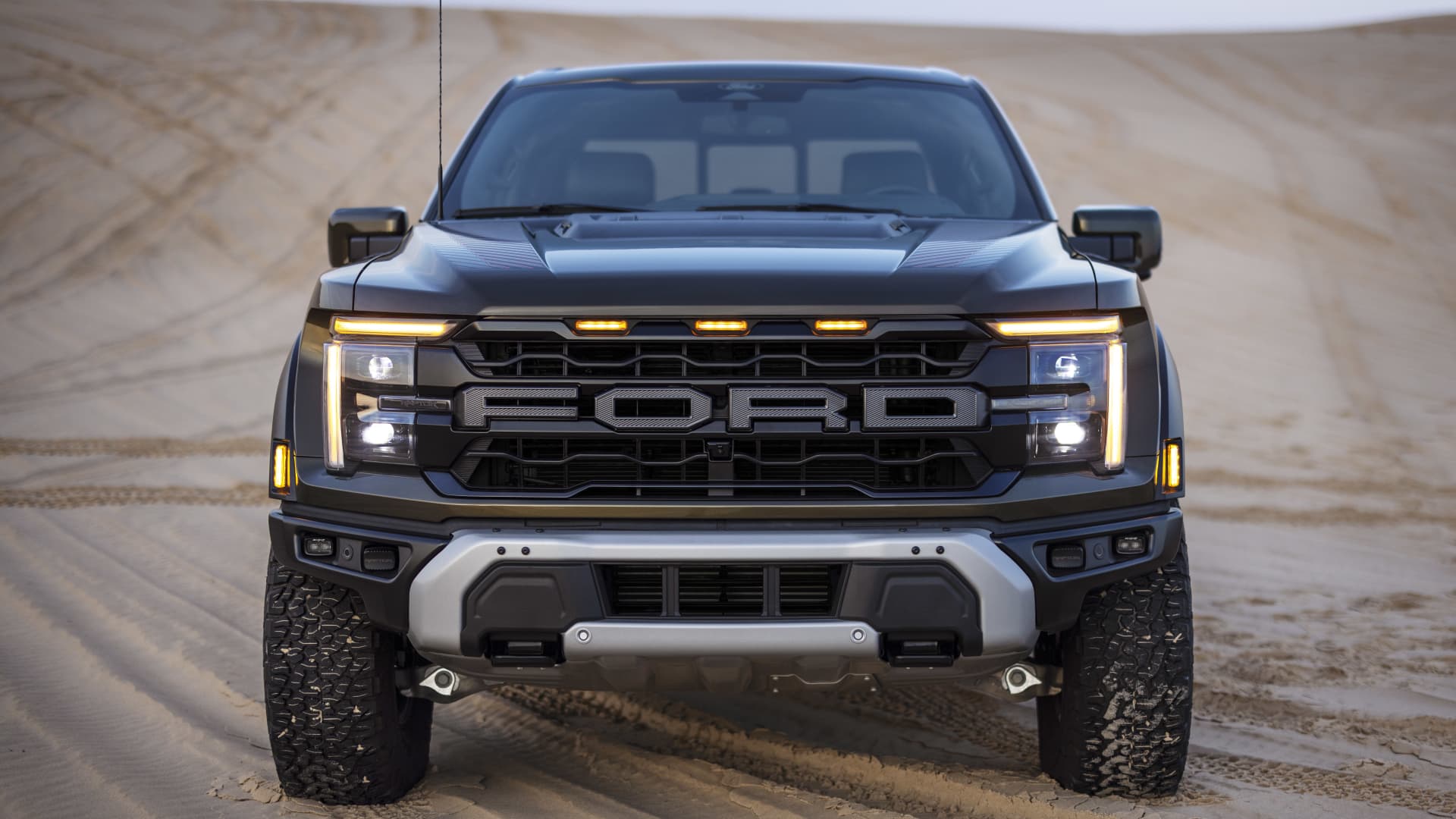
Ford, which in recent years has worked to position itself as the most American automaker, has been moving more of its operations and sales efforts to the U.S., including shifting the production of its Lincoln models from China to the U.S. beginning in 2030.
Between 2018 and 2022, Ford said, it saw a 32.4% decline in China sales. The company no longer reports its financial results by region.
– CNBC's Gabrielle Fonrouge, Amelia Lucas and Mike Wayland contributed to this report.