1 month ago
Zelenskyy says talks with US side ‘not easy’ but ‘productive’
Meanwhile, Ukrainian President Zelenskyy has delivered an address to mark the end of the talks in Berlin. He just spoke at the German-Ukrainian Business Forum.
He says after two days in Berlin, the talks on the US side were “not easy” but they were productive.
He also went on to say Russia is using its relentless strikes as leverage in negotiations – noting not a single power station in Ukraine has been exempt from attack.
Still no detail yet on any tangible compromises made. The two sides are hashing out the US plan presented several weeks ago that has been amended since in other rounds of negotiations in Geneva and Florida.
The exact details aren’t public but Zelenskyy has said Kyiv will not accept any territorial concessions – which the plan purportedly suggests.
Key events 3m ago Berlin crunch meeting on Ukraine about to get under way 20m ago Using Russian frozen assets to fund Ukraine remains tricky as list of critics of EU's proposal grow — snap analysis 49m ago There is notable change in tone, but we're not there yet — snap analysis 1h ago Despite positive US rhetoric, sounds like Ukraine, US are still quite far from comprehensive deal — snap analysis 1h ago Merz suggests EU plan on frozen Russian assets is only one possible under voting rules 1h ago Ukraine needs clarity on guarantees before it can consider territorial asks, Zelenskyy says 1h ago Merz hails new momentum in Ukraine talks, US security guarantees, with 'chance for real peace process' 2h ago US officials briefing on talks with Ukraine — summary 2h ago Russia open to Ukraine joining EU, say US officials 3h ago Zelenskyy says talks with US side ‘not easy’ but ‘productive’ 3h ago Ukraine negotiator notes ‘real progress’ in second round Berlin talks 4h ago Syrian admits deadly knife attack in Austria 4h ago Spain fines Airbnb €64m for unlicensed rental listings 5h ago Russia seeks $230bn in damages from Euroclear over seized assets 6h ago Ukraine-US talks in Berlin end, Zelenskyy's office says 7h ago Nato's Rutte to attend Berlin talks, alliance confirms 7h ago EU's von der Leyen to attend Berlin talks, commission confirms 7h ago US invited to this evening talks between Zelenskyy and European leaders, Germany says 7h ago Ukraine-US talks restart on second day - report 8h ago Moving ahead with EU plan to fund Ukraine using frozen Russian assets 'won't be very easy,' EU foreign policy chief says amid Belgium's opposition 8h ago 'Great deal of work under way,' Zelenskyy says after morning talk with Finland's Stubb 8h ago Ukraine still wants 'Article 5-like' security guarantees, Zelenskyy says 8h ago Ukraine not joining Nato fundamental issue for Russia, Kremlin says 9h ago Morning opening: Crunch time Show key events only Please turn on JavaScript to use this feature

Jakub Krupa
Oh, to be a fly on the wall flag for these Zelenskyy/Witkoff exchanges.

Berlin crunch meeting on Ukraine about to get under way
And here is the cast for tonight’s crunch EU-Ukraine-US talks in Berlin, hosted by Germany’s Friedrich Merz.
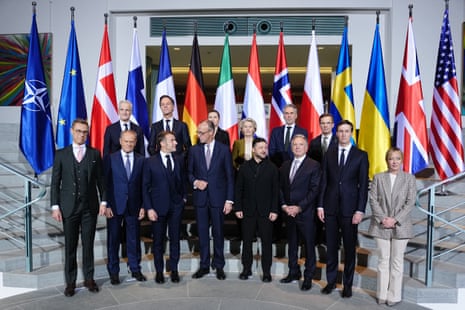
Back row: Norway’s Jonas Gahr Støre, Nato’s Mark Rutte, Denmark’s Mette Frederiksen, European Commission president Ursula von der Leyen, the Netherlands’s Dick Schoof and Sweden’s Ulf Kristersson.
Front row: Finland’s Alexander Stubb, Poland’s Donald Tusk, France’s Emmanuel Macron, Germany’s Friedrich Merz, Ukraine’s Volodymyr Zelenskyy, US envoy Steve Witkoff, US president’s son-in-law Jared Kushner, and Italy’s Giorgia Meloni.
Not pictured, but also expected (hence the British flag): UK’s Keir Starmer.
Using Russian frozen assets to fund Ukraine remains tricky as list of critics of EU's proposal grow — snap analysis
Jakub Krupa
It’s also worth highlighting Merz and Zelenskyy’s comments on frozen Russian assets.
Expect the topic to dominate tonight’s dinner with other European leaders in Berlin, as they figure out if they can find a way forward ahead of this week’s European Council.
It’s no longer just Belgium – most affected because of Euroclear – but also Malta, Bulgaria, the Czech Republic and, crucially, big hitter Italy that appear to be against the idea. That’s why the EU’s foreign policy chief, Kaja Kallas, said earlier today that it could be tricky to get it agreed this week (11:52)
Russian frozen assetsClearly, Merz and UK’s Starmer had hoped to convince Belgium’s prime minister Bart de Wever to drop his opposition during their private dinners on last two Fridays before the list of opposing countries got any longer, but it appears that is not happening.
What makes it trickier to get him to move is the fact that 67% of Belgians support de Wever’s principled position, a new Le Soir-RTL-Ipsos-Het Laatste Nieuws-VTM poll showed.
But Merz is also right to point out that in reality it’s either this or nothing (18:21), and you can see his argument that the EU’s credibility to act in a way that actually moves the dial is at stake here – just days after Trump criticised EU leaders that they talk to much, but don’t actually make decisions that matter.
One to watch.
There is notable change in tone, but we're not there yet — snap analysis
Jakub Krupa
On the European side of things, this Merz/Zelenskyy press conference featured some notably more upbeat language on the ability to get to an agreement, including on the key issues such as future security guarantees for Ukraine.
Merz and Zelenskyy joined Finland’s Alexander Stubb and other leaders in claiming that a ceasefire, or a deal of sorts, is closer than ever. And it’s probably true.
But there are still important areas in which the two sides are apart, and, crucially, it remains to be seen which part of what was discussed or even provisionally agreed in Berlin survives a US debrief with the Russians. They had previously made it very clear that they were not keen on many European or Ukrainian ideas.
Both leaders also appeared to be wary of making promises that wouldn’t be kept or sufficient to deter Russia from having another go at Ukraine. Merz’s reference to previous Minsk agreements (18:07), and Zelenskyy’s insistence on seeing “Article 5-like” guarantees all in black and white before he commits on other thorny issues like territories (18:13) send a clear signal here.
It feels like we will need more details set out publicly – and political commitment, including from Donald Trump – for this issue to progress further.
But it’s notable that Merz went out of his way to praise the US president for his determination to reach a deal, just a day after he warned in a domestic speech about the end of Pax Americana and the urgent need to change the way Germany thinks about its security and future.
“The decades of Pax Americana are largely over for us in Europe, and for us in Germany as well. It no longer exists as we knew it. And nostalgia won’t change that,” he said on Sunday in Munich.
The Europeans face a really tricky balancing act as they need to figure out how to leave that nostalgia towards the US behind and face the increasingly urgent new reality in front of them when it comes to their own security decisions while also having no alternative to working very closely with the US administration if they are to have any hope of finding a way forward on Ukraine.
Not an easy one, that.
Despite positive US rhetoric, sounds like Ukraine, US are still quite far from comprehensive deal — snap analysis

Andrew Roth
in Washington
I’m just off a call with US officials on Steve Witkoff and Jared Kushner’s discussions with the Ukrainians and European delegations in Berlin, which included nearly 8 hours of meetings with Ukrainian leader Volodymyr Zelenskyy.
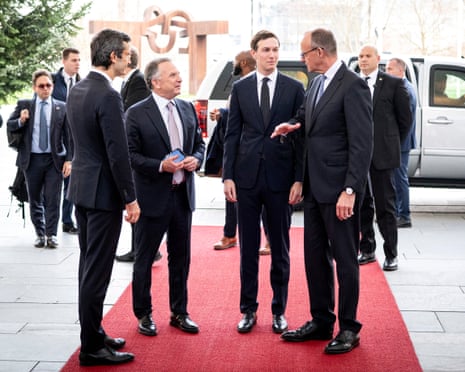
While the discussions were described as constructive in particular concerning future US-brokered security guarantees for Ukraine, it sounds like the sides are quite far from a comprehensive peace deal, with significant differences remaining on the future status of the occupied Ukrainian territory, as well as key issues like the future operations of the Zaporizhzhia nuclear power plant.
The US delegation was upbeat. The officials claimed that they are “90%” of the way toward a deal between Ukraine and Russia -- in particular, the US delegation claimed that they had developed “Article 5-like” security guarantees for Ukraine that had satisfied both Kyiv and the Europeans (we’ll see what the Europeans brief about that).
The US officials said they wouldn’t release details of the security guarantees yet, but that it included “very strong safeguards” to prevent the war from restarting if a deal is reached. That said, the US won’t be putting boots on the ground in Ukraine according to the officials, so they’ll have to release more details to convince skeptics that Russia will respect those “Article 5-like” guarantees in the future.
A lot of questions remain.
The main one is territory. It was clear from the call that there is not an agreement yet on who would control what territory after a peace deal and how that territory would be recognised. One US official said they had “brainstormed” on turning the occupied Ukrainian territory into an “economic free zone” and they had spent “a lot of time trying to define what that would mean, how it operates.”
So there’s a long way to go in those discussions as well, and the US officials admitted that they may not be able to get that issue across the line: “Ultimately, if we can get that defined, then it will really get to [Russia and Ukraine] to work out the final issues of sovereignty and to see if there’s a deal that can be done between them.”
The US officials said they’ll go back to working groups in the US this weekend, but that they’re ready to travel to Russia or Ukraine in the future if the deal can get done.
Merz suggests EU plan on frozen Russian assets is only one possible under voting rules
Interestingly, when asked about the use of frozen Russian assets which continues to be opposed by some member states, Germany’s Merz suggestions that it’s the only option that the EU can actually pass, as alternative proposals – including new borrowing – would require unanimity and be effectively blocked by dissenters, such as Slovakia or Hungary.
At a separate appearance alongside Zelenskyy earlier today, Merz said that the EU’s credibility was at stake if the member states fail to agree on a way forward on this issue at this week’s European Council.
He warned that “the European Union’s ability to act will be severely damaged for years, if not longer, and we will show the world that we are incapable of standing together and acting at such a crucial moment in our history.”
Ukraine needs clarity on guarantees before it can consider territorial asks, Zelenskyy says
In his comments, Zelenskyy says that Ukraine wants to make sure its interests are respected and he says that he feels “that our partners hear Ukraine and are ready to help” and willing to “bring the real end of the war closer.”
But he repeatedly says that security guarantees must be workable for any peace deal to work, and Ukraine needs clear understanding on what they are and how they will be monitored before it can take any decisions on frontlines and territories.
He also stresses that territorial issues are “painful” for Ukraine, and the sides are still apart with “different positions” on ceding territory.
Merz hails new momentum in Ukraine talks, US security guarantees, with 'chance for real peace process'
In his opening remarks, Germany’s Merz welcomes “productive discussions” in Berlin, and “a great deal of diplomatic momemtum” to end the war.
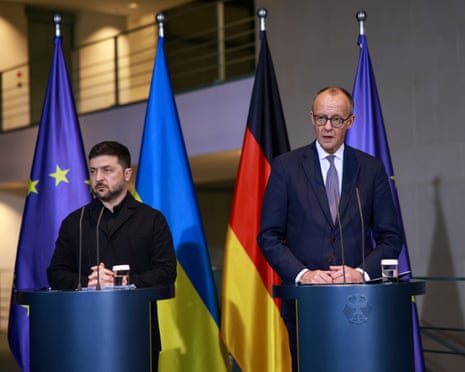
He says there is “a chance for a real peace process for Ukraine,” even if the talks are still in “early stages.” But he says that “perhaps for the first time” since the outbreak of the full-scale war, reaching a ceasefire appears actually possible.
He pointedly praises US president Trump, saying that without his “tireless efforts” and “commitment,” the new momentum would not have emerged.
Merz also says that while Russia keeps playing for time with maximalist demands, the European side of the table is determined to progress the talks.
He particularly welcomes the US proposals on “legal and material” guarantees for Ukraine, which he calls “remarkable.” “We won’t repeat the mistakes of Minsk,” he said.
On the thorny issue of territory, he says “it is the Ukrainian people who have defended their territory for almost four years,” and only they can decide on any changes here.
German chancellor Merz and Ukrainian president Zelenskyy are now giving a joint press conference to update the press on the talks so far.
I will bring you the key lines.
US officials briefing on talks with Ukraine — summary
Jakub Krupa
So, if you’re joining us now, let’s recap the key lines coming out from Berlin this afternoon after we have heard briefings from both the US and Ukraine.
US and Ukrainian delegations hailed “real progress” in peace negotiations during “really, really positive” talks “in almost every aspect,” with the US delegation claiming that “90%” of the issues between the two sides have been resolved.
The eight hours talks over Sunday and Monday involved a number of European representatives, including German chancellor Friedrich Merz and national security advisers from France, Germany, and the UK.
In sharp contrast to last week’s comments by Trump, the European participants was described as “outstanding” and constructive during the talks.
The talks included discussions of “Article 5-like” security guarantees for Ukraine to protect it against any future Russian aggression, after Kyiv dropped its longstanding ask to be admitted to Nato alliance.
Russia would also be open to Ukraine joining the European Union, US negotiators claimed.
US president Donald Trump is believed to be “pleased” with the progress made in talks.
Some further work has been delegated to working groups to refine existing proposals, with some differences remaining on territory and sovereignty issues.
Russia said it expected to be updated on the talks by the US side later today.
Russia open to Ukraine joining EU, say US officials
US officials say they expect Russia will accept the deal that’s been negotiated with Ukraine this weekend.
As reported earlier, the US officials say they expect Russia would be open to Ukraine joining the EU and “90%” of the issues between the two sides has been solved.
However, there is still a “final decision on territory” which will “be up to Ukraine”.
Some other key points from this US officials briefing:
Russia could be open to Ukraine joining the European Union as part of peace deal to end war
“90%” of the issues have been resolved
Trump will call in to the meeting being held tonight with Zelenskyy and European leaders
Any package would have strong Nato-like security guarantees for Ukraine
Appears territory and sovereignty lines are still the “final” issue
We’re just getting some lines now too from a US official on the talks and what was discussed.
Overall, the negotiations were “very positive”, Reuters reports the official saying, but ultimately there still needs to be an agreement on territorial lines.
Security guarantees, that is protection for Ukraine after the war, were also a major topic discussed as well as the use of frozen funds for reconstruction.
Zelenskyy says talks with US side ‘not easy’ but ‘productive’
Meanwhile, Ukrainian President Zelenskyy has delivered an address to mark the end of the talks in Berlin. He just spoke at the German-Ukrainian Business Forum.
He says after two days in Berlin, the talks on the US side were “not easy” but they were productive.
He also went on to say Russia is using its relentless strikes as leverage in negotiations – noting not a single power station in Ukraine has been exempt from attack.
Still no detail yet on any tangible compromises made. The two sides are hashing out the US plan presented several weeks ago that has been amended since in other rounds of negotiations in Geneva and Florida.
The exact details aren’t public but Zelenskyy has said Kyiv will not accept any territorial concessions – which the plan purportedly suggests.
The White House has now withdrawn that alert about a press call- saying it was sent in error.
The White House will be holding a press call shortly on the Ukraine war peace talks that have taken place in Berlin.