1 month ago
Baloch nationalists, separatists and sections of the diaspora are marking August 11 as Balochistan's Independence Day. That's three days before August 14, Pakistan's Independence Day. Why is a Pakistani province celebrating Independence Day on August 11?
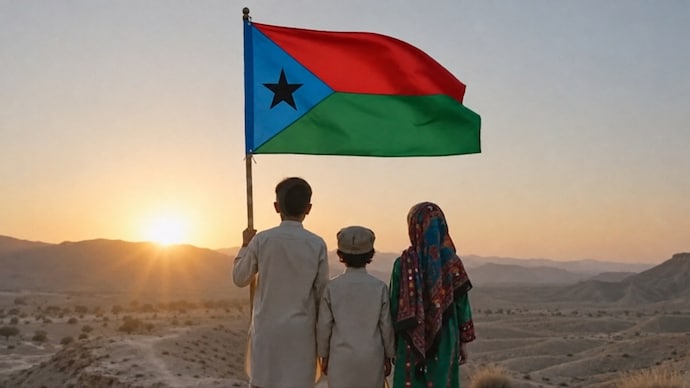
Baloch nationalists mark August 11 as their Independence Day, three days before Pakistan celebrates its own. (Image: Baloch Students Organization Azad/ X)

New Delhi,UPDATED: Aug 11, 2026 16:16 IST
Three days before Pakistan celebrates its Independence Day, Baloch nationalists and separatists mark an Independence Day of their own. This morning, among the usual news nuggets on my X feed, stood out a few PTI clips where people of Baloch ancestry in India marked August 11 as Balochistan's Independence Day. One might wonder why a province of Pakistan is celebrating its own Independence Day even as a fierce armed struggle and peaceful protests have continued there for decades. And why August 11? Does the date have any connection with Pakistan's August 14 or India's August 15?
Actually, August 11 marks what Baloch nationalists call Balochistan's Independence Day, commemorating when the Khanate of Kalat (a kingdom ruling in the region which is present-day Balochistan) asserted its sovereignty as British rule ended in 1947.
Kalat remained outside Pakistan for a little over seven months before its ruler, Mir Ahmad Yar Khan. Then, the ruler, the Khan of Kalat, was betrayed by Muhammad Ali Jinnah and was forced to sign an Instrument of Accession on March 27, 1948.
History gives August 11 a meaning even though it has no official status in Pakistan, where August 14 is the recognised Independence Day (including in Balochistan province). The Balochistan High Court's 2026 gazetted holiday calendar, for example, lists August 14, not August 11, as Independence Day. For Baloch nationalists and separatists advocating a separate nation, August 11 represents a sovereignty they say was lost in 1948.
An X handle named Mir Yar Baloch, who says he's a journalist and a poet, claimed that "Balochistan is not a province of Pakistan" and demanded that the world recognise it as an "independent country". He said the proposed Republic of Balochistan would soon begin the "formal commencement of passports, currency... and embassies", while efforts to unite Baloch leadership were underway. He claimed Balochistan had prepared "an army of five hundred thousand" and possessed "fifty trillion dollars’ worth" of rare-earth minerals and energy resources. He also alleged that Pakistan had "shut down mobile and internet services" to prevent August 11 celebrations, but claimed people celebrated despite the restrictions.
Now, let's get back to the story and have a look at how Jinnah betrayed the Khan of Kalaat.
WHY AUGUST 11 MATTERS TO BALOCH NATIONALISTS
The story goes back to the chaotic final days of the British Raj in the Subcontinent. Under colonial rule, the kingdom of Kalat enjoyed a distinctive treaty relationship with the British. On August 11, 1947, an agreement between Kalat and the Muslim League recognised Kalat as an independent state. Kalat subsequently declared its independence, with its traditional flag hoisted and a khutbah read in the name of the Khan, the leader.
The Baloch Movement (BNM), in an X post, described August 11 as "Balochistan’s Day of Sovereignty and Liberation from British Rule".
It quoted an All India Radio (AIR) announcement as saying: "The State of Kalat has decided to regain its independent status as of 11th August 1947. The Khan of Kalat declares that Kalat shall henceforth be a sovereign and independent state, having friendly relations with all nations, particularly with its neighbours, India and Pakistan."
A 2017 release by the Baloch People's Party similarly cited a New York Times report of August 12, 1947, which reproduced an announcement that Pakistan recognised Kalat "as an independent, sovereign state with a status different from that of Indian states".
It must here be made clear that the entire present-day Balochistan was not one unified princely state in 1947. Kalat, Kharan, Las Bela and Makran had separate political positions, while British Balochistan was another administrative entity. Kharan, Las Bela and Makran eventually acceded separately to Pakistan.
SEVEN MONTHS OF FREEDOM FOR BALOCHISTAN, THEN CAME ACCESSION
The crucial dispute is over what happened next in Balochistan after it declared independence. When Pakistan pushed Kalat to accede, Khan initially resisted. Both houses of Kalat's legislature opposed the merger proposal. By March 1948, however, Pakistan had accepted the accession of Kharan, Las Bela and Makran, dramatically weakening Kalat's position.
But after Pakistan separated these regions from Kalat, and Pakistani forces moved into the Baloch coastal regions of Trubat, Pasni and Jiwani, the Khan had to agree to accession to Pakistan.
On March 27, 1948, the Khan, Mir Ahmad Yar Khan, signed the Instrument of Accession. The accession came after Jinnah's administration put mounting pressure on Khan. This is what the Baloch nationalist organisations call a Pakistani military "occupation".
The BNM says August 11 is a reminder that Balochistan "was once a free and independent nation. Is freedom taken by force".
The Baloch People's Party release from 2017 described flag-hoisting and awareness campaigns across Balochistan and among the diaspora, calling August 11 the Baloch " Day".
That sentiment has echoes in India too. Munaf Baloch, a Mumbai resident who traces his ancestry to Balochistan, told PTI that around 1,000–1,500 Baloch people live in Mumbai. "Thinking about Balochistan's independence brings a sense of great happiness because we currently lack proper visa facilities. We are also constrained by India-Pakistan relations," he said.
So, for Baloch nationalists, August 11 represents a lost sovereignty. Pakistan celebrates Balochistan as an integral part of the country.
That competing symbolism is visible even today.
While Baloch nationalist groups are marking August 11, Pakistan Prime Minister Shehbaz Sharif has been promoting a patriotic song from Balochistan, in Baloch language, ahead of Pakistan's August 14 celebrations. That appeared to be a clumsy attempt to counter growing Baloch nationalist sentiment. A small trivia here. The singer of the song, Akhtar Chanal Zahri, is a Baloch folk singer, who sang Afghan Jalebi in the John Abraham-starrer Phantom, a 2015 Bollywood film. Zahri has also featured in Coke Studio Pakistan.
And therein lies the significance of August 11. It does not mean that Balochistan is an internationally recognised independent country, nor does it speak for the uncontested history of the entire province. But 79 years after Kalat's brief assertion of sovereignty, the date is a powerful political symbol for Baloch nationalists. And, coming just three days before Pakistan's Independence Day, August 11 is a reminder of what Balochistan was, what it became and what Baloch nationalists believe it should be.
- Ends
Published By:
Sushim Mukul
Published On:
Aug 11, 2026 16:16 IST