54 minutes ago
The Eiffel Tower in Paris has landed at the centre of a controversy after its management allegedly restricted the entry of women staffers during a visit by a religious delegation from BAPS, reportedly at the delegation's request for limited interaction with women. The incident has sparked a debate online over who should be held responsible: BAPS or SETE, the organisation that manages the iconic monument.
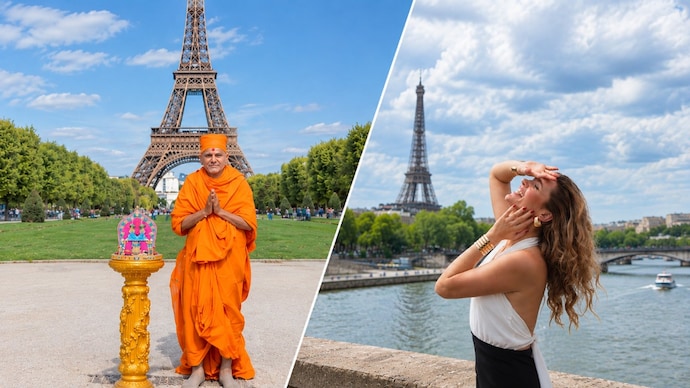
The management of Eiffel Tower claimed that the BAPS delegation requested limited women interaction during their visit to the iconic structure. (Image: BAPS and Getty)
The Eiffel Tower, a symbol of engineering and modernity, has become the centre of a controversy for an unusual reason. A private visit by around 100 people linked to the Bochasanwasi Akshar Purushottam Swaminarayan Sanstha (BAPS) on September 5 triggered a protest by Eiffel Tower employees and led to the temporary closure of the monument on Monday (September 7). The protest closure took place over allegations that the visit of the religious delegation, the management of the Eiffel Tower, SETE, asked women employees to leave the area.
After facing massive backlash, SETE acknowledged that the visiting delegation of BAPS had asked for arrangements that lead to "limited interactions with women" and admitted that such conditions "should not have been accepted".
The controversy spiralled into a wider debate online over religion, gender equality and institutional responsibility. The question at the centre of the debate was who is actually to blame for the "no-woman" fiasco, BAPS for making the request, or SETE for agreeing to it, or both?
BAPS issued an official clarification on Tuesday in which it maintained that the visit was coordinated with Eiffel Tower authorities in advance. The organisation said the large delegation's visit had been scheduled in consultation with management at the beginning of regular opening hours to minimise inconvenience to the public. It also said it was not aware of any instance in which female employees were asked to leave their workstations or visitors were denied entry during the visit.
The religious body expressed regret over the controversy and apologised to anyone who "might have felt hurt" or "inconvenienced".
Those clarifications by both the parties — BAPS and SETE — has made the blame game more complicated.
If BAPS made the request, critics argue, the religious delegation cannot simply distance itself from the consequences. But if SETE, which is responsible for the management of the monument and employs its staff, agrees to the arrangement, questions are equally being raised about why the operator permitted conditions that appeared to discriminate against its female employees in the first place.
DEBATE OVER WHO IS TO BLAME FOR EIFFEL TOWER FIASCO
Ishaan Tharoor, global-affairs columnist for The New Yorker magazine, sharply criticised BAPS, calling it an "embarrassing, backward institution" and referring to controversies surrounding the organisation in the United States.
"BAPS is an embarrassing, backward institution with a disproportionate amount of influence. Unclear what happened here but the scandals in the US surrounding de facto indentured laborers are bad enough," he posted on X.
Vasant Bhatt, a Hindu-American activist, pushed back against Tharoor's framing. "If Eiffel Tower management had agreed to staffing accommodations for a prearranged visit, the outrage should be directed at the management that approved and implemented those arrangements," Bhatt argued.
Bhatt added that "BAPS does not own the Eiffel Tower, employ its staff or write its workplace policies."
Indian-American author Rajiv Malhotra placed the responsibility more directly on the religious delegation. He argued that if monks of the BAPS follow a policy that prevents them from being near women, then it is the swamis who should avoid public places rather than women being removed from those spaces.
"BAPS policy is that swamis can't be near women. Therefore, swamis must avoid public places, rather than removing women from public places. What happened at the Eiffel Tower was unfair to the local staff. This is bad for Hindu dharma in France," Malhotra wrote on X.
Former diplomat Kanwal Sibal called the BAPS controversy, "if true" a "self-inflicted wound" by the religious group. He also pointed blame at SETE.
"Why want to visit the Eiffel Tower if you want to reduce contact with women? This is a red rag to feminists, especially in a country with a rich history of feminist thought and activism. The Eiffel Tower management is at fault too. They should have refused the request," Sibal wrote on X.
Sibal also said that it could be a smear campaign by the French media.
"It is possible though that this is a propaganda smear. French press is negative towards India and this story could have been planted knowing the French media will amplify it," he added.
CONGRESS SPOKESPERSON TALKS ABOUT BAPS SATSANG, GENDER DIVIDE
Shama Mohamed, Spokesperson of the Congress party, highlighted a gender bias in the BAPS events. Shama claimed that at the gathering hosted by BAPS "men sit in front" and "women at the back".
"I have seen the BAPS at close quarters and even attended a Satsang of theirs which took place at my neighbour's apartment in Pune. Even at the Satsang, men sat in front and women at the back. I have also been to the Shri Swaminarayan Mandir in Kalupur, Ahmedabad for my neighbor's daughter's wedding and what I have understood is that their Swamis can't be near women," she posted on X.
"Hence, men of all religions who can't be near women should avoid public places instead of asking women not to be there as it is unfair to women folk," Mohamed argued.
FRENCH POLITICIAN REBUTS CRITICISM ABOUT HINDUISM
Not everyone accepted the premise that the episode reflected Hindu religious practice at all.
A former deputy of the French Assembly, citing his own experience of India and Hindu traditions, questioned the very characterisation of the incident.
Paul Giacobbi, said he had visited Hindu temples in Bengal, Delhi, South India and Gujarat, had married according to Hindu rites and held Overseas Citizen of India status.
"...I've never seen a Hindu temple or ceremony that excluded women! What's this story? What is this so-called Hindu sect that would have demanded the exclusion of women? Fake news or fantasy of the incompetents who infest Paris City Hall?" Giacobbi posted on X.
The reaction from French officials has been less ambiguous to the no-woman fiasco.
Paris Mayor Emmanuel Gregoire said the anger expressed by Eiffel Tower employees was legitimate and that such conditions were unacceptable. He stressed that equality between women and men must apply everywhere, including at France's historic monuments, and said an investigation would be launched.
The controversy therefore sits at the intersection of two very different questions. First, whether a religious group should be allowed to follow its own rules and practices while visiting a foreign institution or a public spot. Second, whether those practices can be accommodated when doing so affects employees who do not belong to that religious group.
There might ultimately be responsibility on both sides, but of different kinds. If BAPS requested that interactions with women be limited, it should be questioned for making such a demand in a public workplace. As SETE accepted and implemented it, the body should be questioned about allowing its female employees to bear the cost of its decision.
Ironically, the Eiffel Tower is an iconic structure symbolising modernity and equality. The controversy is no longer simply about what happened during one private visit on September 5. It is about who had the right to ask, who had the power to refuse, and who ultimately made the women disappear.
- Ends
Published By:
Avinash Kateel
Published On:
Sep 8, 2026 16:32 IST