4 weeks ago
West Midlands to take public control of local bus network
The prime minister, Andy Burnham, has confirmed a new partnership between the government and the West Midlands Combined Authority (WMCA) to take local control of bus services in the region.
Burnham said the “absolutely massive” move would protect thousands of jobs, which were threatened after the parent company behind local operator Express indicated it was leaving the market.
The deal, which is backed by £11.5m of new government funding, will support the WMCA to keep bus services running by bringing the bus network under public control, the government said.
WMCA is working on a longer term ambition to directly control bus services through franchising, like in London and Greater Manchester, paying contractors to run the services for them.
“Government and local leaders have joined forces to keep vital bus services running for millions of people across the West Midlands, protecting thousands of jobs and empowering local decision making to deliver better, more affordable, and more reliable bus services,” Burnham said in a video posted on X.
Reacting to the government’s announcement, the shadow transport secretary, Richard Holden, questioned the move, saying it could come at huge cost to the taxpayer. He wrote in a post on X:
Buses in Manchester and London are franchised (ie owned by a private company but operated under a local authority brand.) It seems strange that the Government didn’t try and facilitate this or encourage another private operator to take over the enhanced partnership operation in the West Midlands but instead transfer c. £100m of liabilities to local taxpayers backed by The UK Govt & ultimately UK taxpayers.
Key events
Green energy entrepreneur changes mind to back new oil and gas drilling in North Sea
The green energy entrepreneur and Labour donor Dale Vince has urged the prime minister to allow more drilling for oil and gas in the North Sea, in a reversal of his previous position.
Vince, who has given more than £5m to Labour over several years, said he had told Andy Burnham that the Rosebank and Jackdaw projects should be approved as long as the oil and gas produced were subject to price controls to make them cheaper than energy imported from overseas.
“If we price-control wholesale energy across the board like we have retail, we have to do this to reform our energy system,” he told the BBC’s Newsnight programme, adding that the move could help bring down people’s energy bills.
“If we are going to use fossil fuels we might as well make them here as to bring them from abroad – that makes more sense and comes to the fore. We will use fossil fuels for a number of years to come and it makes sense to make them here if we can also save money here and create some jobs. I’m up for it.”
Allow content provided by a third party?
This article includes content hosted on platform.x.com. We ask for your permission before anything is loaded, as the provider may be using cookies and other technologies. To view this content, click 'Allow and continue'.
Dale told The Sunday Times in April that allowing new North Sea drilling would be a “betrayal” and urged the then energy secretary, Ed Miliband, to honour Labour’s manifesto pledge against new drilling.
The decision on whether Rosebank, Britain’s largest untapped oilfield, and another planned North Sea development, the Jackdaw gasfield off the coast of Aberdeen, can go ahead will be a key environmental test for Burnham and risks the first revolt of his premiership. The proposals are both now in the hands of ministers, with the consultation on Jackdaw having closed a week ago.
While no final decision has been made, the prime minister has said he will take a “pragmatic” approach to oil and gas drilling in the North Sea, suggesting he is at least open to the prospect. This is despite warnings that any new drilling there will worsen the climate crisis and leading economists saying that new fields in the North Sea will not bring down UK fuel prices or stimulate growth.
Heather Stewart
Forty prominent progressive academics are urging Andy Burnham’s government to join a new global push to tackle inequality.
The experts include Nobel winner Joseph Stiglitz, University College London professor Mariana Mazzucato, vice-chancellor of the London School of Economics Larry Kramer, and Kate Pickett, co-author of The Spirit Level.
In an open letter, they call on Burnham to sign the UK up to help create a new Panel on Inequality (IPI), which is being developed at the UN.
“The organising principle of the prime minister’s policy agenda – the Makerfield test – aims to ensure that places forgotten by Westminster finally receive fairness after decades of neglect,” they say in the letter.
“While these efforts are commendable, inequality is also a global issue, becoming more entrenched as the geopolitical climate destabilises.”
They say the IPI will provide “an independent, trusted global evidence base on the causes and consequences of inequality, alongside analysis of the policies that can reduce it”. By backing it, they argue, Burnham could “cement the organising principles of his politics globally”.
Speaking to the media earlier today, prime minister Andy Burnham said “nothing of consequence” was exchanged when he was text messaging somebody impersonating Donald Trump’s chief of staff Susie Wiles.
“All politicians are receiving these pressures and these challenges, but I did everything right. There was a minimal exchange of information of zero consequence, and it was quickly reported,” he told reporters.
The BBC is reporting that a 62-year-old man who lives near Norwich, and who works at Serco, appeared at Ipswich magistrates court yesterday, charged with misconduct in public office.
Police said he was charged in connection with the release of information related to the location of asylum seekers in Thetford, places which “were later targeted during several nights of violent disorder in the town”. He was remanded in custody.
Burnham to report to Parliament on early release scheme in two weeks
Andy Burnham has said he will present findings on a review of the early release scheme in England and Wales when parliament returns in two weeks’ time.
Justice Secretary Alex Norris is drawing up plans to “maximise public safety and minimise the early release of prisoners”, the prime minister said.
After weeks of media pressure, Burnham pledged to do “everything possible” to ensure Pc Andrew Harper’s killers Albert Bowers and Jessie Cole aren’t eligible for early release, PA Media reports.
Pressed on reports ministers are considering exempting prisoners who committed “unlawful act” manslaughter from the scheme, he said “at this moment in time, this is speculation”.
A former leading judge has warned it would be “unlawful” to block solely Bowers and Cole from early release while freeing other prisoners convicted of the same offence.
Chart of England and Wales prison population.The prime minister has also commented on the announcement that local buses are to be brought under public control in the West Midlands (see post at 12.04 for more details).
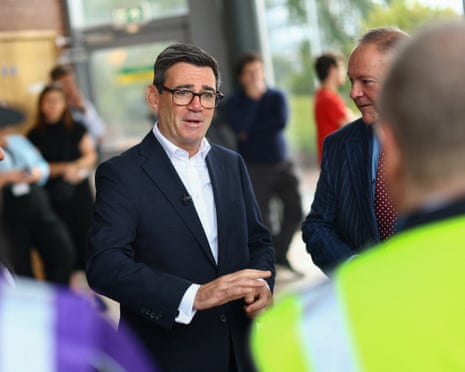
Speaking to reporters in Wolverhampton, Andy Burnham said:
This is the single biggest act of public control since I came into office. And the reason I’m here supporting the mayor of the West Midlands, a very big day for the West Midlands, is to prevent services from collapsing, because the bus service here was close to collapse.
And the first reason is to protect what is the backbone of the public transport system here across the West Midlands, serving millions of people. We needed to step in to secure services in the short term.
But longer term, we are now building to a model under full public control, so that people here can get the benefits of that.
Jakub Krupa
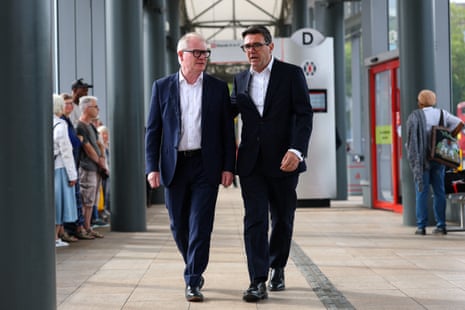
Andy Burnham responded to Russia’s warnings against London after reports of Ukraine using British-made drones to strike Russian territory. Burnham told reporters:
“This is the UK doing what it has long said it would do, which is to support Ukraine 100% against this illegal war led by Vladimir Putin.
“We are providing support so that Ukraine can defend itself, and that’s been the British position all the way through this conflict by previous prime ministers, it remains the case with me … We are not fair weather friends. We will be there in Ukraine’s hour of need, and that won’t change.” You can read more in our Europe live blog here:
Russia warns UK of ‘consequences’ over reports Ukraine using British drones in attacks
Jamie Grierson
Moscow has threatened the UK with “consequences” after reports that British drones have been used to strike targets on Russia’s mainland for the first time.
Ukraine used drones made by two UK companies as part of a so-called deep-strike campaign, the Sunday Times reported.
Kyiv has stepped up its attacks on Russia this year, with long-range missiles and swarms of drones increasingly targeting military industries and energy facilities.
It has also targeted giant depots for Wildberries, Russia’s largest online retailer, burning billions of pounds’ worth of merchandise and bringing the war home to the Russian public more than four years into Moscow’s full-scale invasion of Ukraine. You can read the full story here:
West Midlands to take public control of local bus network
The prime minister, Andy Burnham, has confirmed a new partnership between the government and the West Midlands Combined Authority (WMCA) to take local control of bus services in the region.
Burnham said the “absolutely massive” move would protect thousands of jobs, which were threatened after the parent company behind local operator Express indicated it was leaving the market.
The deal, which is backed by £11.5m of new government funding, will support the WMCA to keep bus services running by bringing the bus network under public control, the government said.
WMCA is working on a longer term ambition to directly control bus services through franchising, like in London and Greater Manchester, paying contractors to run the services for them.
“Government and local leaders have joined forces to keep vital bus services running for millions of people across the West Midlands, protecting thousands of jobs and empowering local decision making to deliver better, more affordable, and more reliable bus services,” Burnham said in a video posted on X.
Reacting to the government’s announcement, the shadow transport secretary, Richard Holden, questioned the move, saying it could come at huge cost to the taxpayer. He wrote in a post on X:
Buses in Manchester and London are franchised (ie owned by a private company but operated under a local authority brand.) It seems strange that the Government didn’t try and facilitate this or encourage another private operator to take over the enhanced partnership operation in the West Midlands but instead transfer c. £100m of liabilities to local taxpayers backed by The UK Govt & ultimately UK taxpayers.
Civil service chief got record £500,000 payout after Starmer dismissal

Rowena Mason
The former head of the civil service Chris Wormald received a record payout, in the region of £500,000, when he was forced out of the top job in Whitehall by Keir Starmer, it has emerged.
The unprecedented payment was made after Wormald served just 14 months in the role of cabinet secretary before being replaced by Antonia Romeo.
There had been speculation about the scale of the payout, first reported by the FT, after Cat Little, the permanent secretary of the Cabinet Office, had to request a ministerial direction from Starmer in February to override value-for-money concerns before she could approve it.
The previous highest settlement was given to Tom Scholar, who was forced out as permanent secretary of the Treasury by Liz Truss as one of her first acts during her brief tenure as prime minister. He was given £457,000, including severance pay and compensation in lieu of notice and leave.
Wormald is to become a crossbench peer after he was nominated by Starmer on leaving office. You can read more on this story here:
Charities have broadly welcomed the government’s announcement that disabled people in England will be able to travel by bus for free 24/7 from next April, but say more work needs to be done to ensure barriers are removed across other areas aside transport.
“Today’s announcement that bus travel will be free for disabled people is hugely welcome. It will directly remove a significant financial barrier that prevents many disabled people from getting around, connecting with others and taking part in their communities,” Mark Gale, policy manager at the national disability charity Sense, said.
“Life already costs more when you’re disabled, not because of disability itself, but because of the additional costs and barriers disabled people face. These can include higher energy bills to keep homes at safe temperatures and power essential equipment, as well as the costs of specialist support and therapies.”
“Free bus travel will help break down one of the barriers disabled people face and give more people the freedom to live the lives they choose, rather than having their choices restricted by unaffordable transport costs.”
“But transport is only one part of the picture. The government must go further to dismantle the financial barriers that exclude disabled people from everyday life. That means making energy more affordable through a targeted energy tariff and committing to protect and increase disability benefits, so that disabled people have the financial security and support they need to participate fully in society.”
After Labour came into power in July 2024, legislation was passed to renationalise all passenger trains when contractually allowed, a process that is due to conclude by the end of 2027.
However, the major “rolling stock” companies (Eversholt, Porterbrook and Angel Trains) – who own and lease carriages and engines – remain privately run. They typically lease rolling stock to the train operating companies who then deploy it on their services.
The train drivers’ union, Aslef, has called on the government to commit to public ownership of all new rolling stock (such as trains and carriages).
Aslef’s general secretary, Dave Calfe, said:
Huge sums of money are being taken out of our railway in profits and dividends by private rolling stock companies. A lot of it ends up in offshore tax havens. We need to keep that money on the track, not send it offshore.
Burnham urged to intervene over ‘zero-hours’ custody officers in private prison
Rajeev Syal
Andy Burnham is under pressure to intervene in a privately run prison that is seeking to recruit custody officers on zero-hours contracts for the first time across England and Wales’ prison estate.
Managers at HMP Millsike, a category C prison for 1,500 prisoners near York operated by the outsourcing company Mitie, have signed off online adverts for £25-an-hour prisoner escort roles “on a flexible, task-based basis”.
Mitie has submitted a proposal to the Prison Service to employ people on a zero-hours contract which is “under consideration”, a government official confirmed on Monday night.
The £400m prison has about 350 empty cells because of a shortfall of staff, prison sources have confirmed. The POA, the prison officers’ union, has called on the prime minister to intervene in keeping with the government’s pledge to curb zero-hours contracts that undermine workers’ rights, security and stability.
Burnham has faced mounting pressure over the government’s early prisoner release scheme aimed at freeing up capacity, after it was revealed that the killers of the police officer Andy Harper would be freed.
While the prime minister has pledged that Jessie Cole and Albert Bowers will remain in prison, he has been told he cannot exempt specific offenders from early release without also keeping about 500 other offenders who have also been convicted of manslaughter locked up. You can read more here:
Axel Rudakubana, who when aged 17 killed three girls at a dance class and tried to murder eight others as well as two adults in the Southport attack in July 2024, had been referred to Prevent three times but his case was closed over a lack of clear ideology.
The chair of the inquiry into that attack has previously said officers were “hampered” by a lack of clarity on whether they should take someone on who demonstrated signs of being fixated on violence but without adherence to a particular ideology.
Rudakubana has been described as a “violence fascinated individual” – someone with no clear or fixed ideology who became obsessed with violence and harming others anyway. The Home Office has set up a taskforce to help manage the risk posed by VFIs.
The second phase of the Southport inquiry, which opened in July, is examining how to deal with individuals who pose a risk of extreme violence, but where ideology is not the primary driver, as well as the role of the internet and social media in influencing and enabling them.
Speaking on Sky News this morning, the work and pensions minister, Lilian Greenwood, described the ‘Children referred to the Prevent programme’ report as “worrying” and said the government will consider how ministers can better protect children online.
“My colleagues will want to look very carefully at this report and its recommendations and consider what more we can do,” Greenwood said.
“We’re already looking at issues around young people and extremism in responding to the recommendations from the Southport inquiry. I’m sure that this work will add to that.”
Under-16s across the UK will be blocked from accessing the major social media platforms from next spring, but there are concerns the ban could push children towards (even more) unsafe sites and doesn’t target the problem of harmful algorithms.
Children becoming ‘intoxicated with extremism’, children's commissioner for England warns
In a new report about referrals to the Prevent programme, the children’s commissioner for England warned that children are “becoming intoxicated by extremism, radicalisation or a desire to harm others” as she urged the government to take tougher action to protect them from harmful online content.
The government’s anti-terrorism programme, Prevent, has seen referrals rise from 2,918 in 2016-17 to over 4,700 last year, with over half of all referrals last year for children, according to the report, which is based on new data, interviews with professionals and analysis of official figures.
Most of the referrals for children in 2024-25 were not linked to ideological radicalisation, but many instead had a “fascination” with extreme violence or mass casualty attacks, the children’s commissioner, Dame Rachel de Souza, said.
“This group of children might be frequently talking about weapons, idolising ‘famous’ attackers, or sharing videos of violence (such as beheadings or suicides),” she wrote.
“They may be sharing extreme pornography with peers, encouraging others to join dangerous online communities or to self-harm.”
She recommends that children currently sent to Prevent should be assessed through local safeguarding teams – which should include counter-terrorism policing – and then sent to the right support.
Currently, children referred to Prevent are often referred back to the organisation that referred them, most often an education setting, without having had an appropriate intervention.
“A referral should be the start of understanding a child’s individual circumstances, not the end of the process,” de Souza said.
“When a child does not progress through Prevent, we must be confident other services are there to understand and meet their needs. Simply returning children to services that made the referral, without a clear understanding of what is driving their behaviour or who will be responsible for meeting their needs, risks missing opportunities to provide the right support children desperately need.”
The report also recommends the government restrict tech companies from having acess to children until they can demonstrate they have measures in place to protect them from harm.
She also said online platforms should be required to complete a risk assessment for the “risk of radicalisation or violence fixation” and suggested other measures including curfews, bans on advertising, limits on scrolling and blocks on strangers being able to contact children.
Disabled people in England to get 24-hour free bus travel under government reforms
Disabled bus pass holders in England will be able to travel for free at all hours from April next year, the government has announced.
Currently, disabled bus passes are valid for travel only on weekdays from 9.30am to 11pm unless local authorities fund an extension, as Greater Manchester did earlier this year when Andy Burnham was mayor.
The prime minister, who is announcing the changes as part of his drive to reduce the cost of living, said it was “simply not right that many disabled people cannot travel using their pass during certain times of the day”.
The £60m to fund the move comes from existing budgets – with £40m from the Department for Work and Pensions and £20m from the Department for Transport.
Burnham is visiting a bus station in the West Midlands this morning and is expected to give more details on the policy then. He’s got a pooled interview with broadcasters at 11am, followed by questions by regional media.
Liberal Democrat Tom Gordon, who has been campaigning for the change for almost two years, is among those welcoming the move.
“Disabilities don’t start at 9 o’clock, neither should disabled bus passes and soon enough they won’t. This is a huge win for the disabled community,” the MP for Harrogate and Knaresborough said.
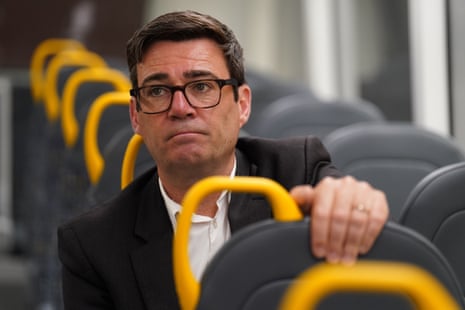
While the announcement has been praised for removing barriers in people’s everyday lives, the prime minister is facing questions about how it will be paid for.
A Conservative party spokesperson said: “This is simply the shuffling around of existing departmental budgets. Andy Burnham needs to come clean about how he is going to fund this growing list of policies.”
Since coming to power in July, Burnham has announced a range of policies aimed at relieving pressure on financially squeezed households and businesses, including cutting business rates for pubs, capping bus fares at £2 and scrapping VAT from electricity bills.
However, the announcements have often been vague and Burnham is under close scrutiny over how his plans will be funded having promised to stick to Labour’s fiscal rules while promising to boost defence spending and raise infrastructure investment.