1 month ago
Burnham cuts tax on electricity bills in first major policy announcement as PM
Good morning and welcome to our live coverage of UK politics. Andy Burnham has announced an £850m tax cut on electricity bills to help ease cost of living pressures in his first significant policy announcement as prime minister. It means that electricity bills will be reduced by an average of £45 a year from October.
Downing Street said the move will be partly funded by scrapping Keir Starmer’s digital ID scheme, which would have cost an estimated £1.8bn over three years. Because of Brexit, EU VAT rates apply on electricity bills in Northern Ireland so the cut will not apply there. Instead the Stormont executive will be given funding to implement an equivalent level of support. Announcing the policy, Burnham said:
I said I wanted to give people breathing space, and that’s what I’m announcing on my second day as prime minister. We’re taking immediate action to cut taxes on energy bills, put more money in people’s pockets and bring back hope.
The newly appointed chancellor, John Healey, said the cut will “bring down inflation while supporting households in every postcode”, signalling the political direction of the new cabinet. While welcomed as a positive initial step to help people save money off their bills, the policy has been criticised, including by Lib Dem leader Ed Davey, for not going far enough.
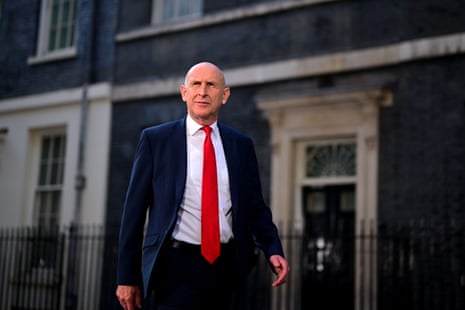
In an extraordinary intervention this morning, Darren Jones, Starmer’s former chief secretary, said the money had not been set aside for the digital ID scheme, which Burnham says will pay for the VAT tax cut. Jones, who was sacked as the Dunchy of Lancaster, wrote in an X post:
Good news that VAT will be cut on electricity bills. It’s a simple way for families to save a few quid, and to mechanically help to keep inflation that little bit lower. But the DigitalID program was unfunded. The government will have to set out how it will pay for its new policies at the budget.
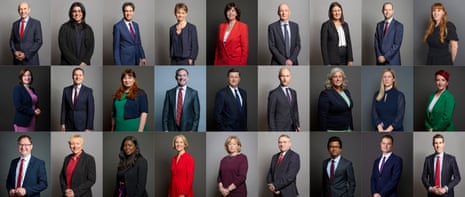
Burnham will chair his first Cabinet meeting at 12.30pm after having removed Starmer loyalists from it yesterday. The ministers to lose their jobs included Rachel Reeves, David Lammy, Darren Jones, Steve Reed, Peter Kyle, Richard Hermer, Liz Kendall, Jo Stevens and Hilary Benn. But Reeves was understood to have turned down another job to return to the backbenches. We will bring you the latest throughout the day, which promises to be a busy one. Here is a non-exhaustive list of the members of the new cabinet:
Chancellor: John Healey
Foreign secretary: Ed Miliband
Home secretary: Shabana Mahmood
Health secretary: Yvette Cooper
Work and pensions secretary: Pat McFadden
Housing secretary: Angela Rayner
Business secretary: Jonathan Reynolds
Education secretary: Lucy Powell
Equalities minister: Bridget Phillipson
Culture secretary: Lisa Nandy
Defence secretary: Wes Streeting
Justice secretary: Alex Norris
Environment secretary: Angela Eagle
Energy secretary: Miatta Fahnbulleh
Scottish secretary: Douglas Alexander
Welsh secretary: Stephen Kinnock
Northern Ireland secretary: Chris Bryant
Transport secretary: Heidi Alexander
Chancellor of the Duchy of Lancaster: Louise Haigh
Key events
Shares in defence companies have risen sharply after Andy Burnham appointed John Healey as chancellor, with investors hoping the former defence secretary will use his new position to increase defence spending. You can follow all of the latest business news in our live blog here:

Lisa O’Carroll
Andy Burnham has phoned Northern Ireland’s first minister, Sinn Fein’s Michelle O’Neill, and the deputy first minister, Emma Little Pengelly, following the change in secretary of state from Hilary Benn to former trade minister Chris Bryant.
He has also phoned the first ministers of Wales and Scotland, Rhun ap Iorwerth and John Swinney, outlining his seriousness about “creating a new politics - rooted in finding common ground” and collaboration with the devolved governments.
A spokesperson for Burnham said together they could “drive deeper devolution” to help growth to all postcodes in the UK.
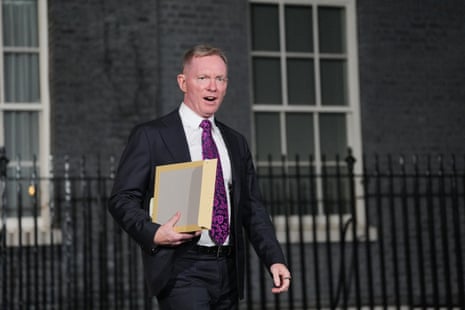
Bryant, a former trade minister and Anglican priest, will be tasked with taking forward the “Troubles bill”, which will replace the Legacy Act brought in by the Conservatives in 2023 and opposed by all five main Northern Ireland parties.
He will also face concerns among unionists who fear a Nigel Farage led UK government in three years time will fuel Sinn Fein calls for a border poll on a united Ireland.
Politicians in Northern Ireland, Scotland and Wales, have already expressed concern that a “nationalist rump” in England could lead to the break up of the UK.
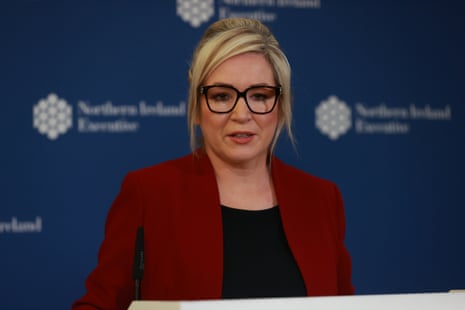
Sinn Féin’s Michelle O’Neill, who has said she is ready to work constructively with him. Photograph: Liam McBurney/PA
António Costa, the president of the European council, said in a post on X that he held a “good” phone call with Andy Burnham last night, in which he said they agreed to “further strengthen” EU-UK relations and continue to cooperate to support Ukraine.
He said there was also discussion about “common geopolitical challenges facing Europe”, which could be a reference to many things, including energy prices soaring due to the US-Israel war on Iran, Europe’s trading and security relationship with Washington, the future of Nato, the continent facing a wave of hybrid warfare, driven by Russia, or the surge of national populism and backlash against immigration.
Burnham declared his support for Ukraine, Nato and the UK’s nuclear deterrent in a recent Opinion piece for The Times in which he also said Britain’s relationship with the US will be “critical” – both in terms of defence and security. He seems to be sticking very closely to Keir Starmer in terms of these foreign policy issues, but it remains to be seen what his wider views are.
The new foreign secretary, Ed Milliband, could take a stronger stance against Israel for its continuing assault on Gaza, widely seen as a genocide, and illegal settlement expansion in the West Bank, as well edging the UK on a pathway towards restoring foreign aid after heavy cuts under Starmer’s government.
Russian warship carries out rare live-fire exercise 45 miles off UK coast

Dan Sabbagh
A Russian warship conducted a rare live-fire exercise in the Channel 45 miles south of Plymouth on Monday, the day Andy Burnham was appointed as prime minister.
The Neustrashimy suddenly announced it intended to fire its guns and requested that a British warship, which had been tracking it, retreat to a safe distance.
The patrol vessel HMS Tyne repositioned, allowing the Russian frigate to conduct a 30-minute firing drill at 9.30am in international waters to the south of the UK.
Russian warships have been sailing around British waters for much of 2026. Last month another frigate, the Admiral Grigorovich, fired warning shots within a few hundred metres of a couple on a British pleasure yacht, south of the Isle of Wight.
You can read the full story here:
PM to announce plans to slash hospitality business rates by 20% 'within days' - report
Huffpost UK is reporting that Andy Burnham will reveal plans to reduce business rates for the hospitality sector by 20% within days. It also reports that a £2 cap on bus fares is to be announced as soon as tomorrow.
During the Makerfield byelection campaign last month, Burnham acknowledged criticism of the government’s policies towards small businesses, pledging help on business rates.
As the Guardian’s senior political correspondent, Peter Walker, explains in this story, under Burnham’s plan, pubs, clubs and music venues would receive a 20% cut next year, while smaller, independent hospitality, leisure and retail companies would have the threshold for paying business rates raised for the first time since 2017, taking many outside the scope of the tax. A taper system would avoid a payments cliff edge.
Lisa O’Carroll
Hamish Falconer, who takes over from Nick Thomas-Symonds as minister for intergovernmental relations and European relations, brings solid international experience to his new role.
He will be charged with continuing the reset of relations with the EU but will have to take a crash course in some really technical subjects including the sanitary and phytosanitary agreement aimed at reducing Brexit barriers for food exporters and the electricity trading systems.
The 40-year-old former diplomat, who worked in the foreign office and the department for international aid previously, was elected an MP in 2024 and was immediately marked out for a new career, appointed under secretary of state for the middle east and north Africa.
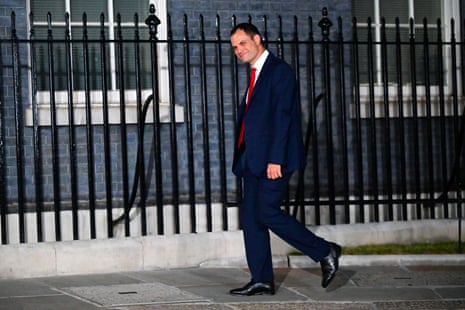
Falconer is the MP for Lincoln and son of Labour grandee and peer Charlie Falconer, who served in Tony Blair’s government. He worked for the foreign office for 10 years, focusing on national security, terrorism and hostage recovery, particularly in Afghanistan.
He also had a stint at the UK’s Crime Agency in Pakistan and south Sudan, working on human trafficking investigations.
Thomas Byrne, the Europe minister in Ireland, which is the current holder of the EU’s rotating presidency, said he looked forward to “working closely” with Falconer.
The new business secretary, Jonathan Reynolds, defended the make-up of the cabinet, which has a majority of members based in the north of England, with five from Greater Manchester.
Asked if there was a risk of a north-south divide, Reynolds, the MP for Stalybridge and Hyde in Greater Manchester, told BBC Radio 4’s Today: “No, there isn’t.”
“I don’t want to get touchy about it, but I can’t remember previous occasions where people have objected to too many people from a different part of the country being in there,” he said.
Andy Burnham, the Makerfield MP and former mayor of Greater Manchester, is making it his political mission statement as PM to devolve power across the UK, ensure growth in “every postcode” and, perhaps in an attempt to win back Labour voters from Reform, to target underinvested in small towns and cities that have struggled after the closure of factories.
While this may be popular with many voters, some experts warn that fetishising the industrial past is not the route to modern economic prosperity and devolution in itself is not a miracle cure, as my colleague Richard Partington notes in this story.

There is a lot of news to digest this morning. Andy Burnham made changes to the cabinet throughout the day and into the night in order to mark a shift in policy direction from his deeply unpopular predecessor. Helpfully, my colleagues Rowena Mason and Peter Walker have done a round up of whose in and whose out, with some insightful details on their careers and, for those who still have jobs, what challenges they will face in their briefs:

Kiran Stacey
Andy Burnham promised to end rough sleeping in England in his first pledge as prime minister, allocating an additional £340m over three years as he seeks to replicate the homelessness schemes he rolled out in Greater Manchester.
Speaking in front of Downing Street immediately after becoming prime minister on Monday, Burnham said he would try to get people off the streets “at the earliest opportunity”.
The announcement was welcomed by homelessness campaigners, who say the pledge can be met with enough money and political will.
The prime minister’s critics, however, greeted the promise with scepticism, pointing out that despite having set out a similar goal as Greater Manchester mayor, Burnham had overseen four years of rising street homelessness.
Officials said the government would now put an extra £340m into its homelessness strategy – equivalent to £113m a year – which would come from unused parts of the housing department’s budget.
Graph showing rough sleeping by regional mayoraltyThe newly appointed business secretary, Jonathan Reynolds, has defended the policy, declaring the cut to VAT on electricity bills “a statement of priorities”.
Responding to Darren Jones’s claim that the cut remained unfunded, Reynolds told Radio 4’s Today programme:
They are part of the government’s pressure, it is a legitimate decision to remove that pressure and instead use the allocation of resources … It’s a straightforward switch spend, it’s the right decision to make, and one that will be made by the British people.
Burnham's VAT cut policy 'coming apart at the seams' already, Lib Dems say
In our opening post we mentioned criticism of the tax cut announcement on household electricity bills from the Lib Dem leader, Ed Davey, who has told Times Radio that the policy is “coming apart at the seams” already.
“It’s a bit confusing isn’t it? And I don’t think it’s the best way to help people with their bills,” Davey added.
He said his party was calling for an “essential energy guarantee”, which the Lib Dems claim will cut energy bills by giving every household an essential amount of energy, equal to 50% of typical consumption, at a “discounted rate”.
Davey calls for Burnham to hold a budget as soon as possible so the figures can come under proper scrutiny. Sticking to the commitments not to raise the main rates of income tax, national insurance or VAT rule out the most obvious ways to raise revenue.
Also speaking on Times Radio, the shadow defence secretary, James Cartlidge, said that the Office for Budget Responsibility said last year that the digital ID card scheme had not been funded. He said: “They (the OBR) literally said that, so you can’t fund a tax cut… with savings from a programme that itself wasn’t funded.”
Burnham cuts tax on electricity bills in first major policy announcement as PM
Good morning and welcome to our live coverage of UK politics. Andy Burnham has announced an £850m tax cut on electricity bills to help ease cost of living pressures in his first significant policy announcement as prime minister. It means that electricity bills will be reduced by an average of £45 a year from October.
Downing Street said the move will be partly funded by scrapping Keir Starmer’s digital ID scheme, which would have cost an estimated £1.8bn over three years. Because of Brexit, EU VAT rates apply on electricity bills in Northern Ireland so the cut will not apply there. Instead the Stormont executive will be given funding to implement an equivalent level of support. Announcing the policy, Burnham said:
I said I wanted to give people breathing space, and that’s what I’m announcing on my second day as prime minister. We’re taking immediate action to cut taxes on energy bills, put more money in people’s pockets and bring back hope.
The newly appointed chancellor, John Healey, said the cut will “bring down inflation while supporting households in every postcode”, signalling the political direction of the new cabinet. While welcomed as a positive initial step to help people save money off their bills, the policy has been criticised, including by Lib Dem leader Ed Davey, for not going far enough.
In an extraordinary intervention this morning, Darren Jones, Starmer’s former chief secretary, said the money had not been set aside for the digital ID scheme, which Burnham says will pay for the VAT tax cut. Jones, who was sacked as the Dunchy of Lancaster, wrote in an X post:
Good news that VAT will be cut on electricity bills. It’s a simple way for families to save a few quid, and to mechanically help to keep inflation that little bit lower. But the DigitalID program was unfunded. The government will have to set out how it will pay for its new policies at the budget.
Burnham will chair his first Cabinet meeting at 12.30pm after having removed Starmer loyalists from it yesterday. The ministers to lose their jobs included Rachel Reeves, David Lammy, Darren Jones, Steve Reed, Peter Kyle, Richard Hermer, Liz Kendall, Jo Stevens and Hilary Benn. But Reeves was understood to have turned down another job to return to the backbenches. We will bring you the latest throughout the day, which promises to be a busy one. Here is a non-exhaustive list of the members of the new cabinet:
Chancellor: John Healey
Foreign secretary: Ed Miliband
Home secretary: Shabana Mahmood
Health secretary: Yvette Cooper
Work and pensions secretary: Pat McFadden
Housing secretary: Angela Rayner
Business secretary: Jonathan Reynolds
Education secretary: Lucy Powell
Equalities minister: Bridget Phillipson
Culture secretary: Lisa Nandy
Defence secretary: Wes Streeting
Justice secretary: Alex Norris
Environment secretary: Angela Eagle
Energy secretary: Miatta Fahnbulleh
Scottish secretary: Douglas Alexander
Welsh secretary: Stephen Kinnock
Northern Ireland secretary: Chris Bryant
Transport secretary: Heidi Alexander
Chancellor of the Duchy of Lancaster: Louise Haigh