4 weeks ago
With lakhs of followers across Instagram and Facebook, Pakistani gangster Shahzad Bhatti has built an online persona. Indian security agencies have alleged he turned that visibility into a recruitment tool, drawing young men into a network involved in reconnaissance, explosives and attacks.
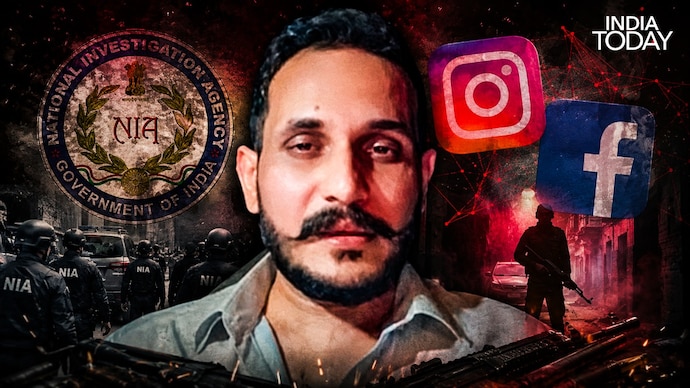
Pakistani gangster Shahzad Bhatti has around 2.5 lakh followers on Instagram and more than 4.5 lakh on Facebook. (Image: Social Media)

New Delhi,UPDATED: Aug 18, 2026 13:45 IST
Shahzad Bhatti, the Pakistani gangster backed by ISI, whose terror module was busted in India in an operation ahead of Independence Day, has the kind of social media following usually associated with influencers. Around 2.5 lakh people follow him on Instagram, and more than 4.5 lakh on Facebook. But according to Indian security agencies, the Pakistani gangster was using that online reach for something sinister — finding young men in India and allegedly drawing them into a network involved in bombs, explosives and espionage.
Bhatti, who reportedly operates from the UAE, used social media as a recruitment ground, reported The Hindu newspaper, citing a UP Police officer. He watched who liked or commented on his posts, reached out to some of them and initially offered small amounts of money for seemingly simple tasks. Putting up posters carrying his photograph was allegedly one of them, according to the report published on Monday (August 17).
The assignments given by Bhatti could then become progressively more dangerous. According to an Uttar Pradesh police officer quoted by The Hindu, Bhatti offered recruits Rs 5,000 to Rs 10,000 for the posters before moving some of them towards tasks like throwing grenades, planting explosives and conducting reconnaissance of sensitive locations.
In other words, his social media following was not just about projecting the image of a gangster. It gave Bhatti access to a pool of potential recruits whom he could identify, approach and test. Young men looking for money were drawn in, while religious sentiments were also exploited in some, reported The Hindu. The recruitment also relied on a mix of fear and promises.
Police said Bhatti's recruits were also asked to install CCTV cameras outside railway stations, air bases and arterial roads, with the footage allegedly relayed live to Pakistan. In one case, investigators alleged that Bhatti guided recruits online on making petrol bombs and IEDs, according to the report.
SECURITY AGENCIES CRACKDOWN ON SHAHZAD BHATTI'S NETWORK
The allegations have come to light as Indian security agencies have mounted a major crackdown on the Shahzad Bhatti Network ahead of Independence Day.
Union Home Minister Amit Shah said more than 200 operatives linked to the alleged ISI-backed network were arrested in coordinated operations across 14 states on August 12. The government said the operation disrupted plans for subversive attacks and involved recoveries of IEDs, grenades bearing Pakistan Ordnance Factory markings, pistols, live cartridges, petrol bombs, CCTV cameras and SIM cards.
The arrests were made in Uttar Pradesh, Haryana, Delhi, Punjab, Rajasthan, Maharashtra, Uttarakhand, Karnataka, Gujarat, Bihar, Telangana, Himachal Pradesh, Jammu and Kashmir and Kerala. The government said more than 80 FIRs and 200-plus arrests have cumulatively been recorded against the network under the UAPA, BNS, Arms Act, NDPS Act and Explosive Substances Act.
Bhatti's alleged network had spread across 14 states. The Investigation Agency (NIA) is probing multiple cases involving him and, in June, searched 18 locations in Punjab and Haryana in connection with terror-gangster network cases linked to him.
NIA LINKS BHATTI TO SEVERAL ATTACKS
A June 27 arrest in Rajasthan provided investigators with another alleged link to Bhatti. Rajasthan Police arrested 20-year-old Krish Rai for allegedly filming the Hanumangarh and Raisinghnagar police stations and sending the videos, along with their exact locations, to a person who identified himself as Bhatti.
The NIA has also linked Bhatti to several attacks. It alleges that he masterminded the March 2025 grenade attack on the residence of social media influencer Roger Sandhu in Jalandhar. Bhatti was charged as an absconder in the case in April 2026.
He has also been accused of orchestrating the November 2025 explosion at the Women Police Station in Sirsa and the January 2026 car-bomb blast at the Baldev Nagar police station in Ambala. In the Sirsa case, the NIA named Bhatti and Pakistan-based handler Sohail Ahmad alias Sohail Baloch among nine accused, alleging that they recruited and radicalised operatives through social media and encrypted platforms.
Government sources cited by The Hindu said Bhatti had moved beyond organised crime over the past year, allegedly at the behest of the ISI.
Social media gave him access to a vast audience, allowing him to reach people with little or no connection to organised crime. That makes his case unusual, as gangsters rarely cultivate a parallel identity as social media influencers.
Pakistan has rejected the allegations. Its Foreign Office called Union Home Minister Amit Shah's claims linking Pakistan to the arrests "baseless assertions" and accused India of conducting a "malicious campaign" against Islamabad.
The investigation into the network is continuing, with agencies examining the handlers, recruits, funding channels and digital links that allegedly connected Bhatti's social media accounts to operatives on the ground in India.
- Ends
Published By:
Anand Singh
Published On:
Aug 18, 2026 13:45 IST