 1 hour ago
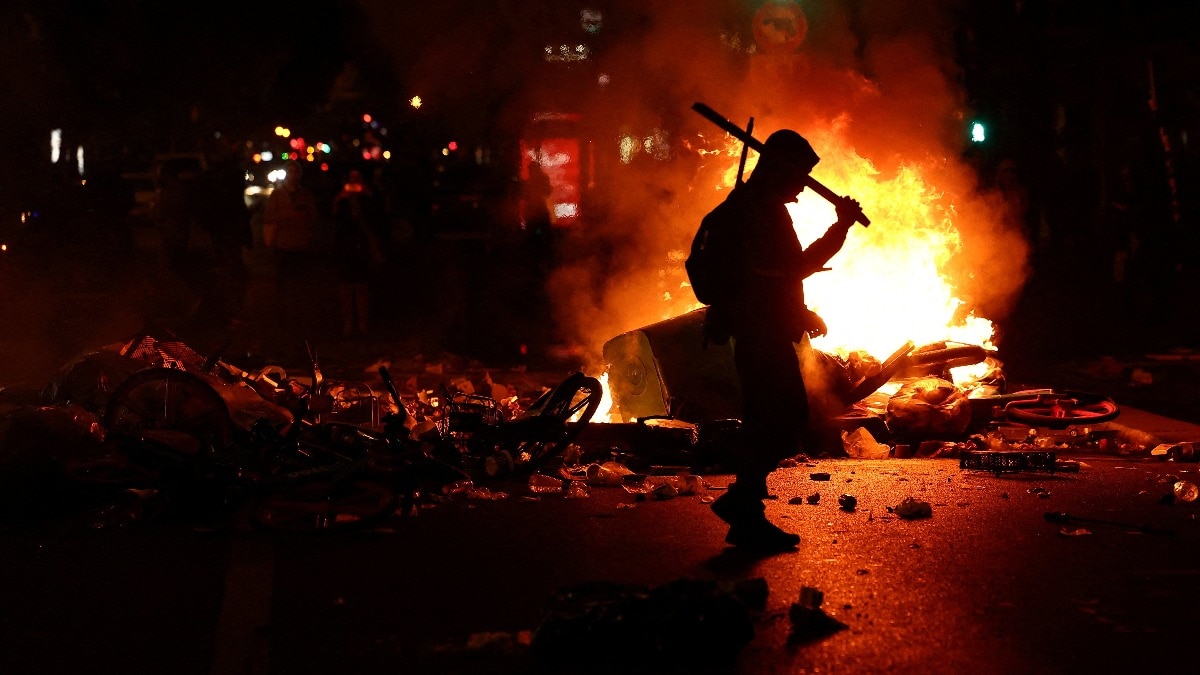
France imposed localised curfews and restrictions on public gatherings in Paris, Lille, Nice and other cities on Monday following a weekend of riots, looting and clashes between protesters and police. The unrest has intensified pressure on Prime Minister Sebastien Lecornu's government over security failures, damaged businesses and mounting public anger ahead of the country's next presidential election.
Authorities opted for targeted restrictions rather than a blanket curfew in Paris, with Lecornu saying that localised measures were more appropriate for the time being. He also left open the possibility of declaring a state of emergency.
"My determination to restore order is absolute," Lecornu told reporters.
Paris police barred protests in certain areas of the capital from 8 pm on Monday and imposed a curfew around Place de la Republique and Les Halles from 11 pm until 6 am on Tuesday. Police said additional personnel had been deployed to ensure compliance with the restrictions.
A source in Lecornu's office said a curfew for minors would remain in force from 8 pm to 6 am over the next two days in Lille, Douai, Wattignies and Denain, with the agreement of local mayors. In Nice, Mayor Eric Ciotti announced an overnight curfew for minors in the city centre, while Marseille banned gatherings and demonstrations.
The restrictions followed weeks of student demonstrations and a weekend of widespread violence that saw shops looted, property damaged and clashes erupt between protesters and security forces.
According to France's Interior Ministry, around 2,400 people were arrested and nearly 1,000 officers were injured. One protester died after suffering a cardiac arrest on Saturday.
NEARLY 3,000 SHOPS AFFECTED
The Federation of Trade and Retail said almost 3,000 shops had been affected by the violence over the weekend, prompting calls for government support for businesses.
"Behind every ransacked shop are business owners, employees and families who have seen years of work and effort wiped out in a matter of hours," the federation said, seeking social security and tax relief for affected establishments.
Lecornu said the government would introduce furlough measures from Tuesday to support businesses affected by the unrest.
In central Paris, luxury shopping areas were among the worst-hit locations. At Place Vendome, known for its luxury hotels and boutiques, the entrance to a Dior store was smashed, while windows at outlets belonging to Rolex, Louis Vuitton, Ralph Lauren and Gucci were damaged.
In Marseille, football club Olympique de Marseille said its official store on the city's historic main avenue had been looted. A town hall in central France was also set on fire.
Gerard Nouchi, who manages two clothing stores in Marseille, said police had been unable to prevent the looting.
"They trashed everything, broke things, insulted us," Nouchi said, describing the destruction as "like a real tornado".
The government has also ordered online platforms selling looted goods to remove listings and cooperate with authorities to help prosecute those reselling stolen items, Junior Digital Minister Anne Le Henanff said on X.
LECORNU BLAMES FAR-LEFT GROUPS
Lecornu accused far-left groups of contributing to some of the worst unrest France has experienced in years, alleging that certain movements were seeking to destabilise the country ahead of the presidential election.
"There is, after all, a far-left movement that wants to cause — we can't put it any more strongly — profound unrest in the country in the run-up to the presidential election," he said.
Hard-left presidential candidate Jean-Luc Melenchon challenged the prime minister to provide evidence for his allegations.
"Otherwise, he should apologise, keep quiet and stop fanning the flames of unrest," Melenchon said on X.
Meanwhile, French trade unions called for another round of strikes and rallies on November 5, signalling the possibility of further disruption.
The unrest comes amid concerns over the cost of living, deteriorating public services, a weak economy and rising national debt. Hundreds of thousands of people took to the streets over the weekend to protest against what many described as declining and dysfunctional public services.
MACRON REJECTS INTERIOR MINISTER'S RESIGNATION
President Emmanuel Macron's government is facing mounting scrutiny over its handling of the violence, particularly as it seeks to pass a budget bill aimed at bringing public finances under control.
Macron's office said he had rejected Interior Minister Laurent Nunez's offer to resign. Instead, the president instructed him to end the barricades and looting and be transparent about what Macron described as failures in intelligence and anticipation.
Nunez said the Champions League match between Paris Saint-Germain and Barcelona scheduled for Tuesday evening would go ahead as planned.
The mayors of Paris, Marseille and Lyon, writing jointly in the newspaper Liberation, said they were accustomed to demonstrations but had been alarmed by the scale of the latest violence.
"But on Saturday ... for the first time, we had the feeling that whole sections of our cities had been left without protection," the mayors said.
France deployed 60,000 police officers and other security personnel on Saturday, Nunez told France Inter radio, while acknowledging that the deployment had not been sufficient to control violent crowds.
The start of school holidays on Monday could ease tensions, although students continued to organise gatherings and blockades at several locations, including the Louvre gallery and Sciences Po university in central Paris.
As French cities began clearing the damage, Macron arrived in Kuwait as part of a Gulf trip aimed at securing additional petrol and diesel supplies to help lower fuel prices. The unrest also comes as cost-of-living concerns fuelled protests in other European countries, including Italy, Belgium and Albania.
European governments have advised their citizens travelling to France to avoid large crowds and exercise caution.
- Ends