49 minutes ago
Alabama governor warns of 'possible spinoff tornadoes'
We have a statement from the Alabama governor, Kay Ivey:
Right now, we are worried about strong winds, heavy rain and possible spinoff tornadoes in certain parts of the state. As we approach the weekend and any travel plans, make sure you have reliable information as conditions develop. We often hear in emergency management: Hope for the best. Prepare for the worst. That is the approach we need with this particular storm system. After all, we only want to see one Tide roll this weekend. Y’all be safe, heed local warnings and stay weather aware.”
Key events
One person has died in Escambia County, Florida due to the tropical storm, according to the county’s sheriff Chip W. Simmons.
“A tree fell on a house and it unfortunately took the life of a lady,” Simmons said in a video published on social media. “And our thoughts and prayers are obviously with that family.”
This seems to be the first death in Florida resulting from the storm. Earlier this morning, Florida governor Ron DeSantis said during an interview with Fox News he had not yet received any reports of fatalities.
Florida governor Ron DeSantis said during an interview with Fox News on Saturday morning that they had not received any reports of fatalities yet in the state.
DeSantis attributed this to likely heightened preparation and previous experience with other tropical storms and hurricanes.
“We’re a peninsula in the middle of a tropical part of the world – we’ve gotta deal with these things,” DeSantis said.
No search and rescue requests after Isaias a ‘good sign’, DeSantis says
Florida governor Ron DeSantis said no requests for search and rescue assistance had been received following Isaias, which he described as “cautiously, a good sign”.
Speaking to Fox News, he said:
I think that may be a sign that people heeded the warnings, took proper precautions. We sure would love to say we have not gotten a report of a fatality yet, and we’ll see what happens.
There’s also a lot of hazards post-storm that people should be careful of, but so far we’ve had a lot of assets in place that have not been called on, which is a good sign. I’d rather be over-prepared, and not have to use them, than not have what you need.”
He added that emergency crews have been working overnight to clear roads and bridges, restore power and assess damage.
The day so far
If you’re just joining us, here are the main developments:
Hurricane Isaias has weakened to a post-tropical cyclone early Saturday, the Hurricane Center (NHC) said, after it made landfall in Florida and lashed the US Gulf Coast with heavy rain and fierce winds.
The category 2 hurricane hit the coast near Destin, Florida, late Friday, with maximum sustained winds of 105 mph.
The storm is expected to move across Alabama and into the Tennessee Valley, the NHC added, with maximum sustained winds decreased to near 35 mph.
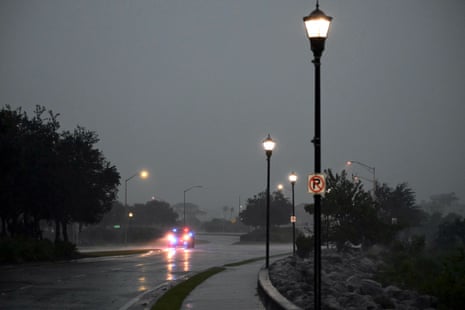
More than 900,000 people have been left without power across the south-east, according to poweroutage.us, with Florida and Alabama among the worst-hit.
The NHC warned heavy rainfall across the south-east increases the risk of flash flooding, with southern Alabama, the Florida Panhandle and south-western Georgia expected to be among the hardest-hit areas, while landslides are also possible in the Southern Appalachians.
Alabama governor Kay Ivey said authorities were worried about “possible spinoff tornadoes” in certain parts of the state.

David Hambling
One significant effect of the stronger El Niño is fewer hurricanes in the Atlantic. In the 30 years to 2020, on average the first hurricane arrived by 11 August, the second by 26 August and the third by 7 September.
Isaias’s October arrival marks a stark contrast from this trend.
At the start of the season, the Oceanic and Atmospheric Administration (NOAA) predicted a quiet year, anticipating between three and six hurricanes, well below the average of seven. The August forecast cut the expected number to between two and six. Until this year, the latest date for the first Atlantic hurricane was 11 September, in 2002 and 2013.
El Niño is marked by comparatively warm sea surface temperatures in the Pacific and a weakening of the seasonal trade winds. One side-effect is that it increases wind shear – the change in wind speed with height – over the Atlantic. This makes it less likely for tropical storms to evolve into hurricanes, as these require relatively stable air to form over a wide area.
But while things have been mostly quiet on the Atlantic side of the Americas, the eastern Pacific has seen plenty of activity, with 10 hurricanes so far.
Alabama governor warns of 'possible spinoff tornadoes'
We have a statement from the Alabama governor, Kay Ivey:
Right now, we are worried about strong winds, heavy rain and possible spinoff tornadoes in certain parts of the state. As we approach the weekend and any travel plans, make sure you have reliable information as conditions develop. We often hear in emergency management: Hope for the best. Prepare for the worst. That is the approach we need with this particular storm system. After all, we only want to see one Tide roll this weekend. Y’all be safe, heed local warnings and stay weather aware.”
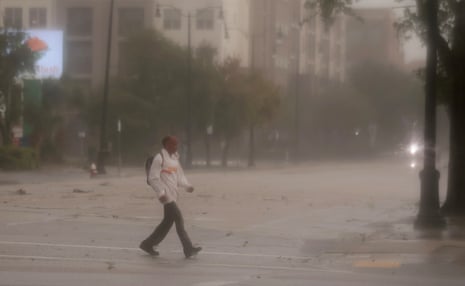
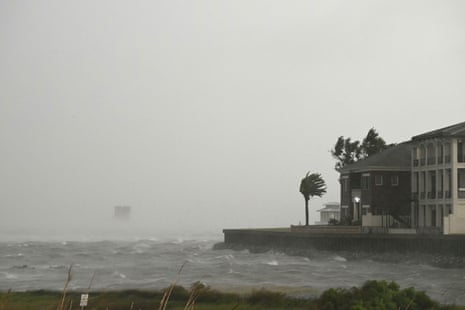
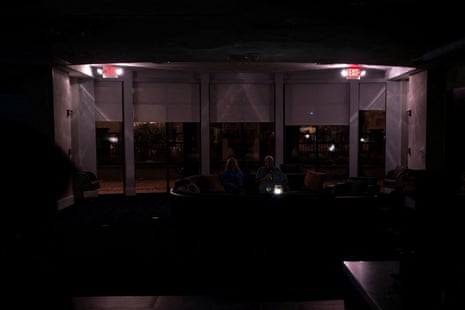
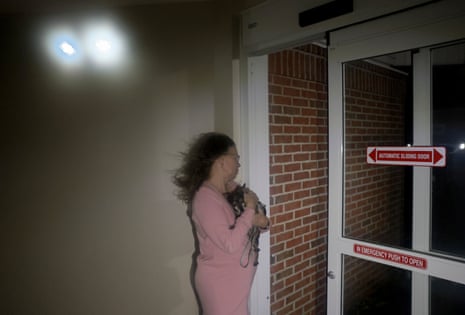
Here are some images on the newswires of the hurricane passing through Pensacola, Florida:
How storm surges are formed
As a hurricane approaches a coast, the churning winds force ocean water up on to land; atmospheric pressure from the storm also helps squeeze the water ashore. The shallower the continental shelf, the higher the threat of a dangerous surge. The water may take a couple of days to fully subside.
graphicWater is heavy – about 1,700lb, or 770kg, to a cubic yard (0.76 cubic meters) – and it can move fast in a surge, sweeping people to their deaths, throwing about boats and vehicles, and pulverizing structures. Six inches of fast-moving water is enough to knock over an adult, the Hurricane Center (NHC) says. Surges become even more dangerous as they coincide with high tide.
Hurricane Katrina in 2005 caused storm surges of over 25ft on the Mississippi coastline. The NHC says many of the 1,500 people killed lost their lives, directly or indirectly, due to the storm surges.
Our data visuals team has been keeping tabs on the path of hurricane Isaias. Here’s where we expect it to hit:
Isaias weakens as it moves across Alabama and Tennessee Valley - NHC
The storm is expected to move across Alabama and into the Tennessee Valley later today and Sunday, the Hurricane Center (NHC) said in its latest advisory.
“Maximum sustained winds have decreased to near 35 mph (55 km/h) with higher gusts. Slow weakening is forecast today, and Isaias is forecast to dissipate on Sunday,” the center said.
The NHC warned heavy rainfall across the south-east increases the risk of flash flooding, with southern Alabama, the Florida Panhandle and south-western Georgia expected to be among the hardest-hit areas, while landslides are also possible in the Southern Appalachians.
More than 860,000 without power
Isaias has left more than 860,000 people without electricity as it moves inland across the south-east.
Here’s the latest breakdown of the worst affected states, according to poweroutage.us:
Florida: 436,745
Alabama: 316,366
Georgia: 87,334
Washington: 6,550
California: 4,467
Texas: 4,404
Ohio: 3,827
Idaho: 1,549
Isaias, first Atlantic hurricane of 2026 season, batters US Gulf coast
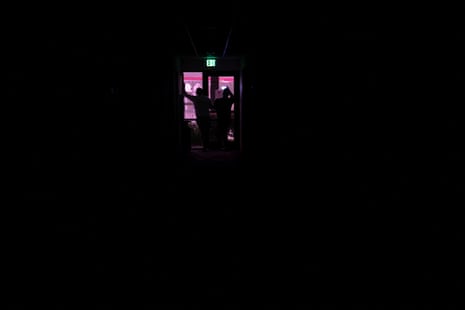
More than half a million people were without power after hurricane Isaias wreaked havoc on the US Gulf Coast, with Alabama and the Florida Panhandle being hit the hardest by the storm.
The category 2 hurricane made landfall near Destin, Florida, late Friday, with maximum sustained winds of 105 miles per hour. It weakened to a post-tropical cyclone by early morning, with winds of 65 mph, the Weather Service said.
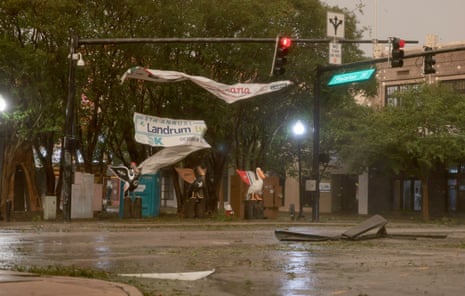
More than 750,000 people in Florida and Alabama have been left without power, according to poweroutage.us, with outages also reported in Georgia for tens of thousands of customers.
“Things are flying really fast, and I’ve never seen wind this fast before, so it’s intense, it’s scary,” Jonathan Ramos, a 40-year-old government employee, said from his hotel in Pensacola, Florida, where the power went out.
“I don’t recommend people coming down here for fun to do this.”
You can read our overnight report here:
Isaias intensified into a hurricane on Wednesday night, then becoming the first Atlantic hurricane of the 2026 season.
In the days prior to landfall, storm surge warnings were in effect from the mouth of the Mississippi River to the Suwannee River in Florida. Residents in the affected areas were urged to follow advice from local officials and evacuate if instructed to do so.
Stick with us as we bring you the latest news and updates from hurricane Isaias.