 3 weeks ago
Nepal's PM Balendra Shah rose to power as the face of the country's Gen Z revolt. But as his popularity grows into a personality cult, people are asking if he is overshadowing the country's institutions. Is Balen Shah becoming a Nepali Caesar who wants to wear sunglasses to Parliament?
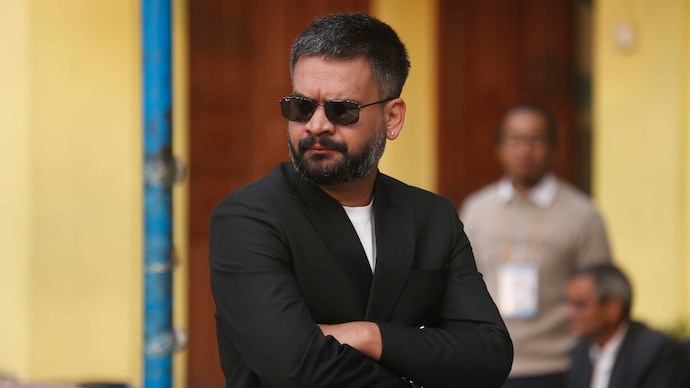
Balen Shah waiting to cast his ballot at a polling station in Nepal's Sinamangal during the election in March. (Image: Getty)
There was a time, not long ago, when Nepal's Prime Minister Balendra 'Balen' Shah's black sunglasses seemed to represent everything Nepal's young generation wanted from politics. It was a symbol of distance from the old guard, a refusal to play by established political scripts and the confidence of a man who did not need the usual language of power. Those sunglasses might be reflecting something altogether different now.
Balen Shah, the rapper-turned-politician of Nepal, emerged from the anger of the country's Gen Z uprising of 2025 as an unlikely political hero. The movement that swept away the old order had been fuelled by frustration over corruption, poor governance, economic stagnation and the failure of established parties to deliver.
Shah, already a popular former mayor of Kathmandu, became the face of that rejection. The Rastriya Swatantra Party (RSP) embraced Shah, and subsequently won a near two-thirds majority in the March snap election, carrying him from Kathmandu's city hall to the prime minister's office.
But Balen Shah, the man who was once celebrated for standing outside Nepal's political establishment, is now facing a more uncomfortable question. Experts in Nepal are questioning the Nepal prime minister about what happens when an outsider becomes the establishment and overshadows the democratic institutions.
An Opinion piece in The Kathmandu Post published on Sunday (August 23) put that question bluntly. In his Opinion piece, analyst Samar SJB Rana asked whether Nepal, after overthrowing one political order, risks replacing it with something equally dependent on one personality. His warning was stark. He wrote, "Nepal wants no Caesar".
And the timing could hardly be more pointed. Nepal's House Speaker Dol Prasad Aryal has directed Balen Shah to appear before the House on August 26 and answer questions of lawmakers, who have been left frustrated by the PM's absence. Shah has attended only a fraction of parliamentary sittings, intensifying criticism that the prime minister is keeping his distance from the institution that is supposed to scrutinise his government.
Balen Shah is likely to be present in the House on Wednesday (August 26), but in his black sunglasses, which have become a political flashpoint. Shah's refusal to ditch them, citing medical conditions, even in Parliament reveals his insistence on his image.
Shah and his ways are coming for closer scrutiny as the government headed by him completes the first 150 days in power in Nepal. Many, however, believe that Balen Shah has lost some of the political shine in the first five months in office.
BALEN'S JOURNEY FROM GEN Z HERO TO BUILDING PERSONALITY CULT
Analyst Rana's argument in the Opinion piece published in the Kathmandu Post begins with the very movement that brought Shah to power.
The September 2025 Gen Z uprising was fundamentally a rejection of Nepal's established political class. Balen Shah's RSP capitalised on the anger, but Rana argues that its election campaign also placed unusual emphasis on Shah himself.
The slogan "Chup Chap Ghanti Chaap", or "quietly stamp the bell", became part of that personality-driven campaign. Rana also points to one of Shah's social media messages, like "dukkha hunus" (rest assured), as an example of a political culture in which voters are encouraged to trust rather than question the leader.
Rana argues that it is dangerous for a small democracy like Nepal.
"A new democracy like Nepal could also succumb to such a threat when personality cults are welcomed with adulation while dissent against deified political leaders is met with severe derision and cyberbullying. In a democracy, when citizens seek salvation from only one individual, it could undermine the distribution of power among public authorities," Rana wrote.
The warning echoes the old democratic anxiety about the cult of the leader. Once citizens begin looking to one individual as the country's saviour, Parliament, constitutional bodies and other checks on executive power can gradually appear as obstacles rather than safeguards.
Rana's concluding lines of the Opinion piece capture the argument. "Democracy in Nepal will be measured by the creation of stronger institutions, not by relying on a Nepali Caesar to save the country," he wrote.
BALEN SHAH'S CULT AND HIS PARLIAMENT TEST
The most immediate test of that argument is playing out inside Parliament. In May, he walked out of a joint session during Nepal President Ram Chandra Paudel's address after handing over the government's plans and programmes.
The Nepali Times report described the episode as part of a broader pattern of "disdain towards Parliament", the international community and even his own party.
The issue is not simply that Shah left one parliamentary sitting. It is the larger governing style that critics say the episode represents.
His government also moved to pass controversial ordinances after suspending Parliament, drawing opposition criticism. Among the contentious moves was the appointment of a new chief justice by bypassing three senior candidates.a
He also created unease in diplomatic ties, saying he wouldn't hold individual meetings with representatives of countries, before making a U-turn. On August 10, he met Indian Ambassador Naveen Srivastava and Chinese Ambassador Zhang Maoming separately, marking a shift in his diplomatic approach.
Balen Shah is "alienating constituencies that any government eventually needs: the media, the intelligentsia, the opposition parties and key foreign partners", wrote Biswas Baral, the former Editor of The Kathmandu Post, for The Diplomat in June.
Now, with the Speaker asking Shah to appear before the House and answer questions on August 26, the prime minister faces a more formal test of accountability.
For a leader whose political brand was built around directness and decisiveness, appearing before lawmakers might seem routine. But in the current political climate, it has become symbolic.
WHEN BALEN SHAH'S GOVT EXERCISED OVERREACH OF POWERS
Another authoritarian trait of the Balen Shah-led government that has drawn widespread backlash concerns Nepal's anti-corruption watchdog, the Commission for the Investigation of Abuse of Authority (CIAA).
In June, Shah's advisers summoned CIAA officials and rebuked them over delays in an investigation. This was clearly an overreach by the executive, raising concerns over the independence of a constitutional body.
Balen Shah's own remarks at the RSP's national convention have added to the controversy. Speaking about investigations into alleged wrongdoing, he said that, if necessary, the government could consult the CIAA not merely for five hours but for five years.
His supporters see this as an uncompromising anti-corruption stance. For his critics, however, the problem is precisely who is questioning whom.
QUESTIONS OVER BALEN SHAH'S SOCIAL MEDIA HANDLES
There is Balen's preferred political language, Facebook. His online presence was central to his rise, and it remains one of his most powerful tools. But critics increasingly argue that the same platform that made him accessible can also allow him to bypass conventional political accountability.
In June, while his government faced criticism over controversial ordinances, the treatment of displaced and landless communities and allegations of neglect of marginalised groups in the budget, Shah posted on his Facebook, "I also want to become an ambassador. If anyone has the prime minister's number, could you please share it?"
The post was intended as sarcasm over a government secretary's request for an ambassadorial appointment. Ministers and lawmakers joined in with jokes.
But the episode triggered a larger debate over whether humour from the head of the government was trivialising serious affairs of state. Now Shah's social media accounts are under scrutiny as his Facebook page remains to state him as a "Musician/Rapper".
The Nepal News said the personal accounts were being used to disseminate government information. It highlighted this as Meta, the parent company of Facebook, Instagram, Messenger, and WhatsApp, disqualifies government officials and leaders of political parties from monetisation under its Partner Monetisation Policies.
GEN Z TURNING UP AGAINST BALEN SHAH
The most striking sign that something has changed is that criticism about Balen Shah is no longer coming only from Nepal's traditional political class. Women activists and Gen Z figures who were part of the movement that helped bring Shah's political generation to prominence have also begun speaking out.
"Any post that is critical of Balen or the Cabinet seems to trigger a lot of trolling," lawyer and activist Tanuja Pandey, who was at the forefront of the Gen Z protests in Nepal in September 2025, told Nepali Times. The protests were the first in the world by Gen Z agitators to have overthrown a government.
The attack on critics is significant because supporters often treat criticism of the leader as an attack on the movement itself. This is one of the traits of elected leaders becoming autocrats.
BALEN'S SUNGLASSES BECOME POLITICAL FLASHPOINT
In Nepal, nothing illustrates the power of personality better than Balen Shah's sunglasses. They were once simply part of his image, the rapper's shades, the mayor's shades, the young politician's shades. But they have gradually acquired a political meaning.
During protests following the death of Ganesh Nepali, demonstrators turned "take off your dark glasses" into a demand that Shah confront the anger on the streets. Opposition lawmakers echoed the criticism inside Parliament. They urged the prime minister to take off his shades inside the Parliament. But refusing to bend, Shah has submitted his medical reports and has been granted a pass to wear his shades inside Parliament.
The pair of sunglasses have since become a curious symbol of the debate around Shah. They are seen as confidence to supporters but arrogance to critics.
The danger now in Nepal, as Rana's Caesar analogy suggests, is that the revolution's greatest symbol could become its greatest contradiction. Balen Shah might still prove to be the leader Nepal's Gen Z revolution was looking for. But if Nepal is to avoid replacing one political cult with another, Balen will have to strengthen the institutions and prove they are bigger than the man who inherited them.
- Ends
Published By:
Avinash Kateel
Published On:
Aug 25, 2026 14:44 IST